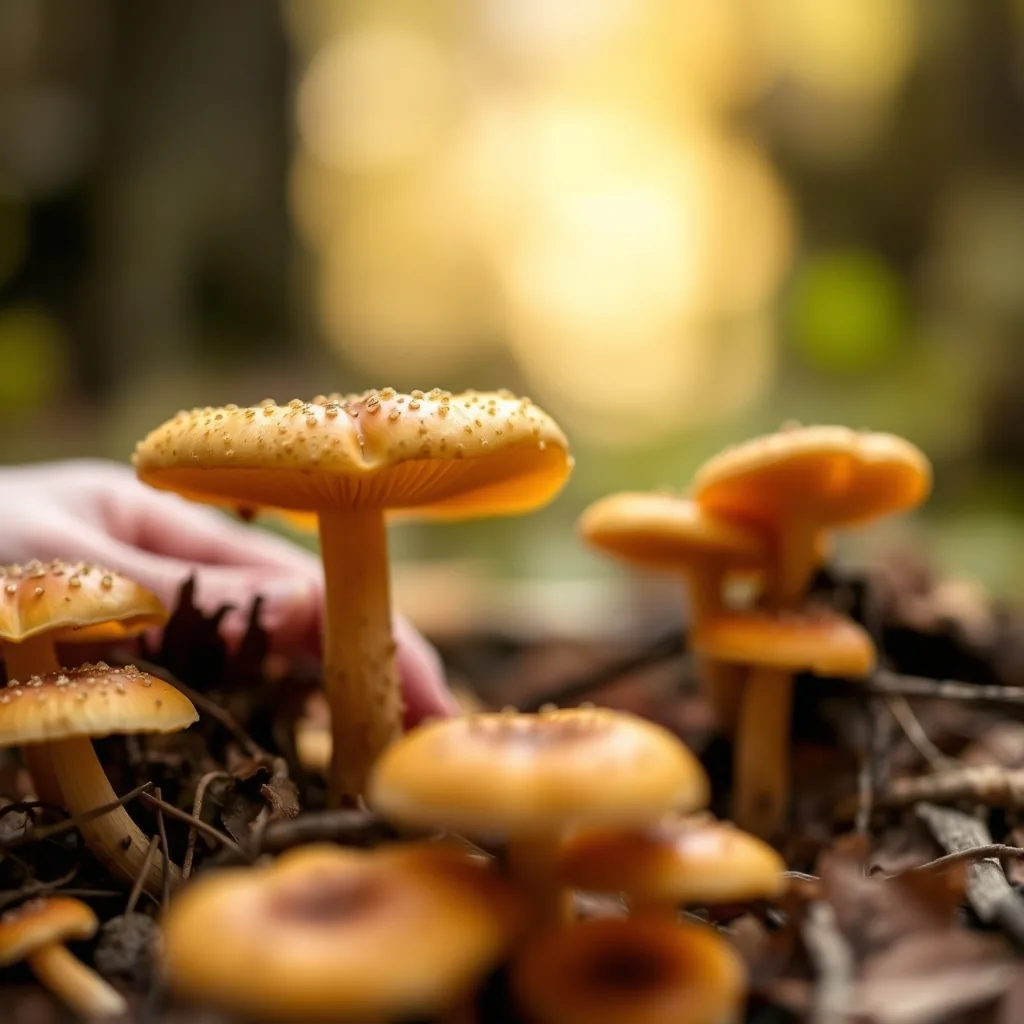
Chanterelles (Cantharellus cibarius and related species) are among the most prized edible wild mushrooms in North America and Europe. They are also the subject of two recurring misidentifications: the false chanterelle (Hygrophoropsis aurantiaca) and the jack-o'-lantern mushroom (Omphalotus olearius in Europe, Omphalotus illudens and Omphalotus olivascens in North America).
Neither misidentification is unavoidable. Chanterelles have multiple distinguishing features that set them clearly apart from their look-alikes when you know what to look for. The mistake happens when foragers rely on a single feature — usually color — instead of building a complete picture. Orange-yellow mushroom in the woods is not a sufficient identification.
This guide covers the specific features that separate true chanterelles from both look-alikes, including how spore prints fit into the identification process and what they can and cannot tell you.
True Chanterelle: The Baseline
Before looking at look-alikes, be specific about what true chanterelles look like. There are multiple species in the Cantharellus genus, and they vary somewhat in color and size, but they share the features that matter for identification:
- Cap color: Egg-yolk yellow to pale golden. Some species are paler. The color is relatively uniform across the cap surface. The cap surface is smooth and slightly wavy at maturity.
- False gills (ridges): The most important structural feature. Chanterelles do not have true gills. Instead, they have forking, blunt-edged ridges that run from the cap margin down the stem. The ridges are the same color as the cap surface. They are not blade-like; they feel like shallow folds. You cannot easily separate them from the cap flesh — they are continuous with it.
- Flesh: White to pale yellow when cut. Dense, not hollow. Does not change color on cutting or bruising.
- Smell: Fruity and apricot-like. This is distinctive and genuine. If you smell nothing or smell something unpleasant, reconsider the identification.
- Habitat: Grows singly or scattered on the forest floor, in leaf litter, in mycorrhizal association with trees (especially oaks, conifers). Does not grow from wood. Does not grow in dense clusters.
- Spore print: White to very pale yellow or cream.
Look-Alike 1: False Chanterelle (Hygrophoropsis aurantiaca)
The false chanterelle is bright orange — more intensely orange than most true chanterelles, which lean toward yellow. This color difference is a useful first signal but not a reliable sole identifier, because chanterelle color varies between species and across developmental stages.
True Chanterelle
- Gills
- False gills — blunt forking ridges, continuous with flesh
- Cap color
- Egg-yolk yellow to pale gold
- Flesh when cut
- White to pale yellow, dense
- Smell
- Fruity, apricot-like
- Growth
- Solitary or scattered, from soil
- Spore print
- White to pale cream-yellow
False Chanterelle
- Gills
- True gills — blade-like, crowded, forking, easily separated from flesh
- Cap color
- Bright orange, often more vivid than chanterelle
- Flesh when cut
- Orange-tinted, softer
- Smell
- Musty or unpleasant, not fruity
- Growth
- Often clustered, frequently near or on decaying wood
- Spore print
- White
Jack-o'-Lantern
- Gills
- True gills — blade-like, crowded, sharp-edged, clearly separable
- Cap color
- Orange to yellow-orange; often large
- Flesh when cut
- Orange or yellow-orange
- Smell
- Unpleasant, chemical, or neutral
- Growth
- Dense clusters, always from wood or buried wood roots
- Spore print
- Cream to pale yellow
The gills vs ridges test for false chanterelle
The gill structure test is the most reliable single feature for separating true chanterelles from false chanterelles. Look at the underside of the cap and try to separate the "gills" from the cap flesh with your fingernail or a knife.
On a true chanterelle, the ridges are continuous with the flesh — you cannot peel them away. They are not blade-like; they are more like the corrugated surface of a fold. They fork repeatedly toward the cap margin. They run down the stem in a decurrent pattern.
On a false chanterelle, the gills are true gills — thin, blade-like, crowded, and separable from the flesh as a distinct layer. They also fork, but they are clearly individual structures, not continuous with the cap tissue.
This test works reliably in the field with no equipment. Develop the habit of checking it on every chanterelle candidate before it goes in the basket.
Look-Alike 2: Jack-o'-Lantern (Omphalotus spp.)
The jack-o'-lantern is more dangerous than the false chanterelle in terms of consequences — it causes severe gastrointestinal illness, not just a disappointing meal. It is also easier to separate from chanterelles if you look at the growth habit.
Jack-o'-lantern toxicity
Omphalotus species contain illudin toxins, which cause violent vomiting and diarrhea within 1–3 hours of ingestion. The symptoms are severe and can require medical intervention. The mushroom is not deadly in typical doses but is not a mushroom to eat by accident.
Growth habit: the decisive feature
Jack-o'-lanterns grow in dense clusters, always from wood. They fruit at the base of living or recently dead trees, from buried roots, or directly from stumps. If you see a large cluster of orange mushrooms emerging from a stump or at the base of a tree, it is almost certainly Omphalotus, not Cantharellus.
True chanterelles do not cluster tightly. They grow singly or in loose scattered groups. They grow from forest soil in mycorrhizal relationship with tree roots — associated with trees, but not fruiting from the wood itself.
The growth habit test is the fastest ruling: if it is growing from wood in a cluster, it is not a chanterelle.
Gills on jack-o'-lanterns
The gills on Omphalotus are true, blade-like gills — crowded, sharp-edged, separable from the cap flesh. They run down the stem (decurrent) and are orange-colored, matching the cap. They are clearly gills, not ridges. The gill-vs-ridge test rules out jack-o'-lantern just as it rules out false chanterelle.
Bioluminescence
Jack-o'-lanterns glow faintly green in total darkness — a faint bioluminescence visible in the gills after dark adaptation of at least 10 minutes. This is a real phenomenon, not a myth. It is not bright enough to see in normal light, but in complete darkness with adapted eyes, the gills emit a faint glow.
This is a useful confirmation if you already suspect jack-o'-lantern, but it is not a practical primary field identification tool — you are not going to take mushrooms into a dark room before deciding to collect them. Treat it as interesting natural history, not ID methodology.
How to Take a Spore Print
A spore print requires nothing more than a piece of paper and a few hours. Cut the cap from the stem. Place it gill/ridge-side down on a piece of paper — use half black and half white paper if you have it, since some prints are too light to see on white and too dark to see on black. Place a bowl or cup over the cap to prevent airflow and drafts. Leave it for 4–12 hours.
The result is a print of spores deposited from the cap. The color is a reliable species-level identifier for many mushrooms.
What the spore prints tell you here
For the three species in question:
- True chanterelle: White to very pale cream or very pale yellow. The print is subtle — it can be difficult to see on white paper, which is why the black-white paper trick helps.
- False chanterelle: White. Virtually identical to chanterelle in spore print color. The spore print alone does not separate these two species.
- Jack-o'-lantern: Cream to pale yellow. Also close to chanterelle in spore print color.
This is the honest limitation of spore prints for chanterelle identification: the three species produce prints that are too similar in color to be a definitive separator on their own. The spore print is a supporting confirmation, not the primary tool in this trio.
Where spore prints are most useful: ruling out entirely different mushroom categories. A dark brown, purple-brown, or black spore print immediately removes any of these three candidates from consideration. If you are hunting chanterelles and find a mushroom that produces a chocolate-brown spore print, that is not a chanterelle and not a chanterelle look-alike — it is something else entirely. Spore prints catch large-category errors effectively.
Regional and Seasonal Notes
Chanterelle season varies significantly by region. In the Pacific Northwest, golden chanterelles fruit reliably from late summer through late fall — October and November are often peak. In the East, the season typically runs July through September. In the Southeast, late fall through winter is common due to milder temperatures.
Jack-o'-lanterns typically fruit in late summer and fall across most of the eastern US, fruiting from oak, maple, and other hardwood roots. Their season overlaps substantially with chanterelles. The overlap is worth knowing precisely because it is when misidentification is most likely — both are present, both are orange, both are in the woods at the same time.
False chanterelles are less seasonal and fruit across a broader range of conditions, often appearing later into fall and tolerating cooler temperatures than chanterelles.
What to Do When You Are Not Sure
Run the full checklist. If any feature does not confirm — the gills feel blade-like, the smell is wrong, the flesh is orange-tinted, the growth is clustered or from wood — do not eat the mushroom.
The risk-reward is not symmetric. A false identification produces at minimum a bad meal, at worst a hospital visit. A correct identification that you decided not to trust produces one missed mushroom. Leave the uncertain ones. Chanterelles are common enough that a pass on a doubtful specimen costs nothing.
Take a spore print and photographs of the underside, the cut flesh, and the base of the stem growing from the substrate. These images, with a spore print, give any experienced forager enough information to confirm or deny your identification remotely. The iNaturalist platform and local mycological societies are both good resources for second opinions on collected evidence.
Foraging gear worth having
We earn a small commission on qualifying eBay purchases. Price you pay is unchanged. Full disclosure.
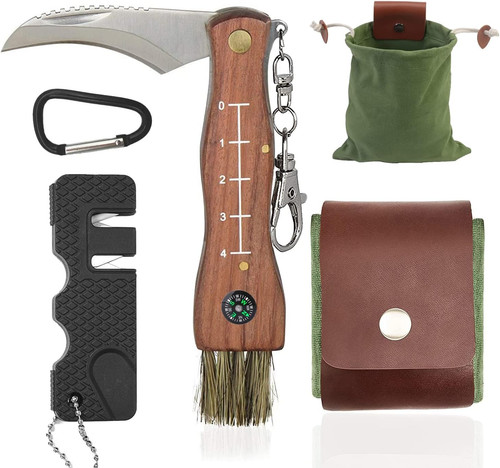 Mushroom knife with brush
Curved blade for cutting at the base + boar-bristle brush for cleaning in the field. The classic European style is the right tool — Laguiole and similar are widely available.
 Wicker foraging basket
Open weave allows spores to drop as you walk, which matters for chanterelles. Avoid sealed bags — they cause the mushrooms to sweat and deteriorate faster.
 Audubon mushrooms field guide
The Audubon Society Field Guide to North American Mushrooms covers regional species with photographs. A regional guide for your specific area is more useful but harder to find.
 Mushrooms Demystified (Arora)
David Arora's comprehensive reference. Heavy to carry in the field but authoritative on difficult identifications. The standard desk reference for serious foragers.
 Mesh harvest bag
Lightweight mesh bags for secondary sorting. Useful for separating different species in the basket and for keeping mud off car seats on the way home.