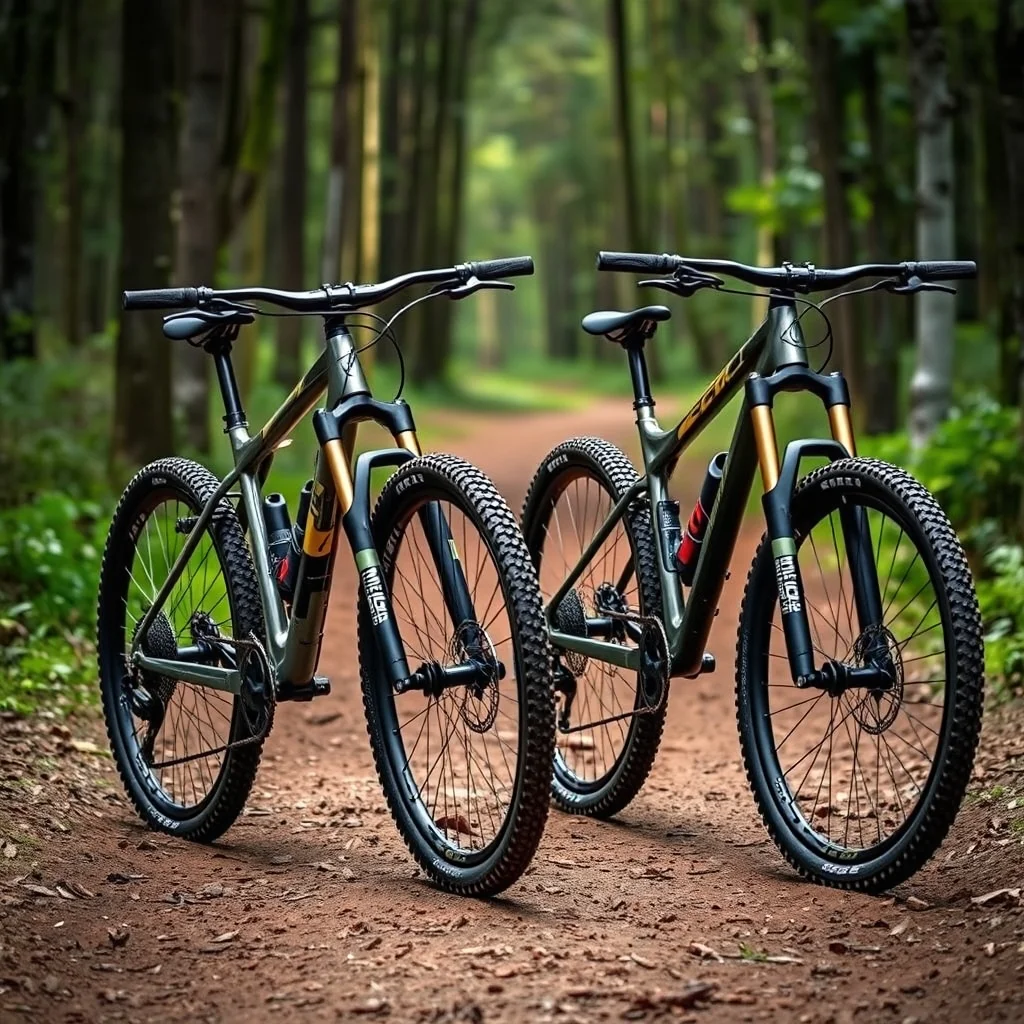
Hardtail vs full suspension: the real distinction
A hardtail has suspension only in the fork — the rear triangle is rigid. A full suspension (FS) bike adds a rear shock and pivoting rear triangle. The difference is not simply "more comfortable vs less" — it's a genuine performance trade-off that depends on terrain.
When hardtails make sense
Hardtails are more efficient pedaling on smooth to moderately rough terrain because the rear end doesn't bob or absorb pedaling energy. They're significantly cheaper for equivalent component quality — a $1,500 hardtail typically runs better brakes and drivetrain than a $1,500 full suspension bike (because the budget doesn't need to cover a rear shock and linkage). Hardtails are also simpler to maintain.
Hardtails are the right choice for: XC racing, buff singletrack without major chunk, cross-country touring, riders building technical skills (the feedback from a hardtail teaches body position), and budgets under $2,000 where FS bikes compromise too heavily on components.
When full suspension makes sense
Full suspension traction and control advantages compound on rough, technical terrain — chunky rocks, rooty descents, large step-downs, high-speed trail. The rear wheel stays on the ground longer, braking traction improves, and the bike stays more stable through rough sections. Above roughly 120 mm travel, FS becomes the clearly superior tool for the terrain.
FS is the right choice for: trail and enduro riding with significant chunk or tech, riders prioritizing descending performance, and anyone regularly riding trails rated Blue to Black+ where rear wheel tracking matters more than pedaling efficiency.
| Factor | Hardtail | Full Suspension |
|---|---|---|
| Pedaling efficiency | Higher on smooth terrain | Lower (some bob) without lockout |
| Descending traction | Lower on rough terrain | Higher — rear wheel tracks better |
| Weight | Lighter at equal budget | Heavier — shock, pivots, linkage |
| Maintenance | Simpler — no pivots, no rear shock | More service points |
| Components at $1,500 | Better — budget goes to drivetrain/brakes | Lower tier components to afford FS hardware |
| Best terrain | XC, green-blue trail, gravel | Blue-black trail, enduro, tech features |
Suspension travel: what the millimeters mean
Suspension travel is the distance a fork or shock can compress. More travel means more capacity to absorb large impacts but typically means a slacker head angle, more weight, and a bike tuned for descending rather than climbing.
- 80–100 mm (XC): Cross-country racing geometry. Steep head angle, light weight, efficient pedaling. Not appropriate for chunk or tech features.
- 100–120 mm (trail hardtail / short-travel trail): The versatile sweet spot for mixed terrain. Most popular for all-day trail riding. Hardtails commonly spec a 100–120 mm fork.
- 120–140 mm (trail FS): The most common full suspension category. Handles technical terrain well while remaining efficient enough for long climbs.
- 140–160 mm (enduro): Built for sustained technical descents. Slack geometry, heavier build. Pedaling is adequate but not efficient — the priority is downhill performance.
- 160–200 mm (DH / gravity): Downhill-specific. Not practical for trail riding due to weight and pedaling penalty.
Shopping for mountain bikes? Browse current eBay listings → (we earn a small commission; your price is unchanged).
Wheel size: 27.5 vs 29
The two mainstream wheel sizes are 27.5" (650b) and 29" (29er). Rider height is one factor but not the only one — the terrain and riding style matter as much.
29" wheels
Larger diameter means better rollover for obstacles. A 29" wheel approaches a root or rock at a shallower contact angle, which reduces the bump's effective height. This translates to faster rolling speed over rough terrain and better traction on loose surfaces (larger contact patch). The trade-off: heavier wheels, slightly less agile handling in tight switchbacks, and often a worse fit for riders under roughly 5'4"–5'6" (the geometry becomes harder to size correctly at shorter heights).
27.5" wheels
More agile handling, lighter wheels, and better proportions for shorter riders. The smaller diameter means faster acceleration and snappier cornering feel. On tight technical trails with many switchbacks, the 27.5 has a handling advantage. The rollover disadvantage vs 29" is real but modest for most recreational riders.
Mullet (29/27.5)
Many enduro bikes now run a 29" front wheel (rollover, stability) with a 27.5" rear (agility, wheel clearance for more rear travel). This is increasingly common in the 150–170 mm travel enduro category. If you see "MX" or "mixed wheel" in a listing, this is what it means.
Drivetrain tiers
Mountain bike drivetrains are dominated by SRAM and Shimano, each with tiered product lines. The practical performance differences between tiers:
- Entry (Shimano Altus/Acera, SRAM SX): Heavier, less precise shifting, adequate for casual riding. Common on bikes under $700. Upgrade path: replace derailleur + cassette together.
- Mid (Shimano Deore, SRAM NX/GX): The value sweet spot. Deore 12-speed in particular offers performance close to higher tiers at a fraction of the price. Bikes in the $1,000–$2,500 range commonly spec Deore or GX.
- Upper-mid (Shimano SLX/XT, SRAM X01): Lighter, more precise, better mud performance. The range where diminishing returns start. Bikes $2,500–$4,000.
- Top (Shimano XTR, SRAM XX1/AXS): Minimal weight savings over XT/X01. AXS electronic shifting is genuinely different — wireless, programmable, automatic shifting modes. Bikes $4,000+.
For most riders, Shimano Deore 12-speed represents the tier above which the gains are marginal for trail riding. Used bikes with SLX or XT components at mid-range price points are often excellent value.
Brakes: what matters on trail
Mountain bike brakes are hydraulic disc — cable actuated disc brakes are adequate for commuting but not appropriate for trail riding where consistent modulation matters in mud and steep descents. The key variables:
- Rotor size: 180 mm front / 160 mm rear is typical for trail bikes. 200–220 mm is common on enduro bikes for heat dissipation on long descents. Larger rotors = more stopping power and heat capacity.
- Brand tier: Shimano MT200 (entry, 2-piston) is adequate; Shimano M520/M6100 (4-piston) is a significant step up for power and modulation. SRAM Code, Guide, and Level are the equivalent tiers.
- Pad compound: Organic (resin) pads are quieter and have better initial bite; metallic/sintered pads last longer and handle heat better. Swap based on your conditions.
Dropper post: the upgrade that changes the ride
A dropper post is a hydraulic seatpost that drops seat height at the press of a remote lever on the bar. It lets you lower the saddle for descents (which dramatically improves body position and control) and raise it for climbing — without stopping.
If a bike you're evaluating doesn't have a dropper and it's in the budget, factor in the cost of adding one ($150–$400 depending on brand and travel). Many entry-level bikes spec a rigid post; buying a used bike with an already-installed dropper at the same price point is often the better value.
Travel: match the dropper travel (how far it drops) to your seat tube length and how much insertion depth you have available. 100 mm is fine for shorter riders; 150–200 mm for taller riders or those who want full saddle-to-bar-height change.
Fit: the spec that actually matters most
Frame size affects reach, stack, and cockpit feel more than any component. Two numbers to focus on:
- Reach: Horizontal distance from bottom bracket to head tube top. A longer reach means a stretched-out, stable position for descending; shorter reach means more upright and maneuverable.
- Stack: Vertical height from bottom bracket to head tube top. Higher stack = more upright.
Manufacturer size charts based on height are a starting point, not a rule. Inseam and torso length create significant variation. If possible, test ride before buying — or use the return policy to verify fit before committing.
Search eBay for mountain bikes and components
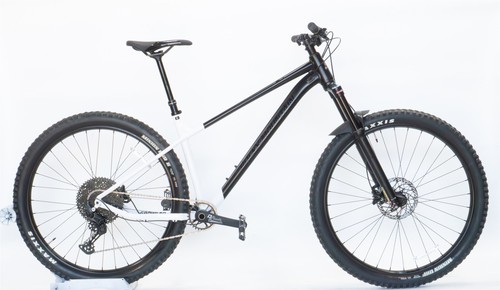 Hardtail Mountain Bike 29"
Best value per dollar for trail riding. Look for Deore or SLX components on used bikes.
Hardtail Mountain Bike 29"
Best value per dollar for trail riding. Look for Deore or SLX components on used bikes.
 Dropper Seatpost
Match seat tube diameter (30.9, 31.6, 34.9 mm) and travel to your frame. Fox Transfer and RockShox Reverb are popular used options.
Dropper Seatpost
Match seat tube diameter (30.9, 31.6, 34.9 mm) and travel to your frame. Fox Transfer and RockShox Reverb are popular used options.
 Full Suspension Mountain Bike
120–140 mm trail FS for most riders. Filter by wheel size and verify shock brand (Fox, RockShox).
Full Suspension Mountain Bike
120–140 mm trail FS for most riders. Filter by wheel size and verify shock brand (Fox, RockShox).