The mechanical pencil as a collectible category
Mechanical pencils occupy an odd position in the writing instrument world: they're commonly found at estate sales (nearly every midcentury American desk had at least one) yet genuinely scarce examples are easy to overlook. The mechanism — how lead advances — is the primary variable collectors care about, alongside material, condition, and maker.
The golden era of American mechanical pencil production runs roughly 1920–1965, overlapping heavily with the fountain pen's heyday. Many pencils were sold as matched set companions to pens, which means single pencils often survive separated from their pen partners and can be bought individually at modest prices.
Mechanism types
Twist-advance
The most common type. Rotating the barrel or a section of it advances the lead one fixed distance per half-turn. These are durable, simple, and produced by the millions. Common twist-advance pencils have minimal collector value unless they're part of a matched set with a collectible pen, or made in a scarce color or material.
Repeating (knock or click) mechanisms
Clicking or pushing the top or clip advances the lead in small, precise increments. Autopoint made this mechanism standard — their pencils use a ratchet-advance internal mechanism activated by pressing the clip. Repeating mechanisms are more mechanically interesting and generally date a pencil to the 1930s onward.
Multi-color
Mechanical pencils with two, three, or four color leads in separate barrels that rotate into position are among the most collectible type. Autopoint's "Twinpoint" (two leads) and "Threepoint" (three leads) are the most commonly encountered American examples. Multi-color pencils were primarily sold to accountants and executives who needed red and black simultaneously. The rotating mechanism must work smoothly in all positions for full value.
Clutch/chuck advance
A chuck or clutch grip holds the lead, released by pressing the button to advance. Common in drafting pencils where precise lead advance control matters. Keuffel & Esser, Staedtler, and Rapidograph drafting pencils use this type. Lead diameter compatibility is critical here — 0.3mm, 0.5mm, 0.7mm, and 0.9mm chucks are not interchangeable.
Major makers and what to know about each
Eversharp
The Wahl-Eversharp Company (Chicago) produced mechanical pencils from the early 1910s through the 1950s. Their most collectible models are:
- Doric (1931–c.1940): Twelve-sided (dodecagonal) faceted barrel in celluloid. The Doric's facets are cast directly in the material, not machined — close inspection shows the slightly irregular surface texture of the original celluloid. Made in multiple colors; green and burgundy are common, while some two-tone patterns are scarce.
- Skyline (1941–c.1948): Streamlined stepped cap with a distinctive hooded clip. Celluloid in blue, black, grey, and burgundy. The Skyline's stepped cap silhouette is immediately recognizable and unambiguous for maker identification.
- Symphony (late 1940s–1950s): Postwar designs, generally less collectible than the Doric or Skyline.
Eversharp pencils typically carry the maker's name on the clip or imprinted on the barrel. The twist-advance mechanism on Eversharp pencils is internal to the barrel and activated by rotating the lower half.
Parker
Parker Pen Company pencils were designed as matched companions to their pens and share design DNA with their pen counterparts:
- Duofold pencils (1920s–1930s): Made in the same hard rubber and celluloid as the Duofold pen. The rarest Duofold pencils are in colors like Mandarin Yellow, Lapis Blue, and Moderne Green — these match the rarest Duofold pen colors and trade accordingly.
- Vacumatic pencils (1933–late 1940s): Laminated celluloid in the distinctive barrel-striped Vacumatic pattern. Twist-advance mechanism. The Vacumatic's translucent striped celluloid is immediately identifiable.
- 51 pencils (1948–1960s): Hooded tip matching the pen. Made in Lustraloy and various cap materials. Functional and well-made but less distinctive than the earlier pens.
Shopping for vintage mechanical pencils? Browse current eBay listings → (we earn a small commission; your price is unchanged).
Autopoint
Autopoint (Chicago, founded 1918, still in operation) made pencils across the spectrum from promotional advertising pieces to quality repeating-mechanism writing pencils. Their mechanical DNA is the ratchet-advance repeating mechanism, which they developed early and refined over decades.
The collectible Autopoint pieces are their multi-color models. The Twinpoint rotates between two lead colors (typically black and red); the Threepoint between three. Both use a twist mechanism to rotate the color barrel. When functioning correctly, the rotation is smooth and each color locks positively into position. A frozen or rough rotation mechanism significantly reduces value.
Autopoint also produced large volumes of promotional advertising pencils with company names imprinted on the barrel — these are a separate sub-category with their own collector following based on the imprinted brand or regional interest rather than the pencil itself.
Other makers worth knowing
- Sheaffer: Pen company with matching pencil lines. Sheaffer's Triumph and Snorkel era pencils have matching set value.
- Conklin: Early crescent-filler pen company; their pencils are relatively scarce since they were smaller-volume than Eversharp or Parker.
- Eagle Pencil Co.: Large manufacturer of both wood and mechanical pencils. Their Mikado and Turquoise drafting mechanical pencils are collectible in the drafting pencil sub-category.
- Keuffel & Esser: Primarily a drafting equipment maker. Their mechanical pencils were precision instruments and survive in reasonable numbers from the technical drawing trade.
Lead size and its implications
Lead size matters to collectors both as a dating tool and for functionality. Common vintage lead diameters:
| Lead diameter | Common use period | Notes |
|---|---|---|
| 1.1mm | 1920s–1940s | Standard for many Eversharp and Parker writing pencils of the era. Still available as "thick" replacement lead. |
| 0.9mm | 1950s–present | Common in late-era repeating and modern drafting pencils. Widely available. |
| 0.7mm | 1960s–present | Standard modern size. Many vintage drafting pencils use this. |
| 0.5mm | 1970s–present | Drafting standard. Rarer in true vintage pieces. |
| 0.3mm | 1970s–present | Fine drafting use. Uncommon in vintage American pieces. |
When evaluating a vintage pencil for use rather than display, check the lead diameter before buying replacement leads. Older 1.1mm leads are available from specialty suppliers but not as conveniently as modern sizes.
Condition criteria
The mechanism must work
A mechanical pencil with a frozen or broken advance mechanism is display-only. Test by inserting a lead of the correct diameter (or verifying the seller has done so) and checking that the advance engages cleanly. For multi-color pencils, confirm all color positions advance smoothly and lock.
Barrel and cap material
Celluloid — the primary barrel material for 1920s–1940s pencils — is vulnerable to shrinkage over time. Check for visible cracks or a barrel that doesn't fit the cap flush. Slight celluloid fading or color shift is normal and accepted; cracks are not.
Hard rubber (ebonite) in earlier pieces fades from black to brown when exposed to UV. Dark brown hard rubber is original coloring affected by light, not a different material — but it reduces visual appeal relative to black.
Clip and trim
Clips on vintage pencils are thin metal and can be bent, cracked at the attachment point, or missing entirely. A missing or damaged clip on a writing pencil is a moderate condition issue; on a matched set piece it's significant. Check the clip attachment point (where it joins the cap or barrel) for stress cracks.
Imprints and barrel markings
Eversharp, Parker, and other maker imprints on barrels are part of the piece's identity. Worn or missing imprints reduce collector interest. Advertising imprints on Autopoint pieces can either add or detract depending on whether the imprinted brand has its own collector following.
Where to find good pieces
Estate sales remain the best source for genuinely undervalued pieces. Mechanical pencils are often sold as part of general desk lots or mixed into boxes of "writing instruments" that sellers don't want to sort individually. Knowing that an Eversharp Doric in a specific color or a Parker Duofold in Mandarin Yellow is worth serious money is enough to justify sorting through these lots carefully.
Online platforms have made specific searching much easier. The key is knowing what to search for — "vintage Eversharp pencil" produces better results than "old pencil." For multi-color pencils specifically, the Autopoint Twinpoint and Threepoint are still consistently underpriced relative to their mechanical interest and scarcity.
Vintage mechanical pencils on eBay
We earn a small commission on qualifying sales, and 90% of it goes to charity (you can pick which); your price is unchanged. Full disclosure.
 Vintage Eversharp pencil
Doric and Skyline models. Check mechanism advance and celluloid for cracks.
View on eBay →
 Parker mechanical pencil vintage
Duofold and Vacumatic lines. Rare colors command major premiums over black or brown.
View on eBay →
Vintage mechanical pencil
Broad search across all makers. Good starting point for discovering lesser-known brands.
View on eBay →
 Autopoint pencil vintage
Twinpoint and Threepoint multi-color models are the collectible targets. Test rotation on all positions.
View on eBay →
 Vintage drafting pencil
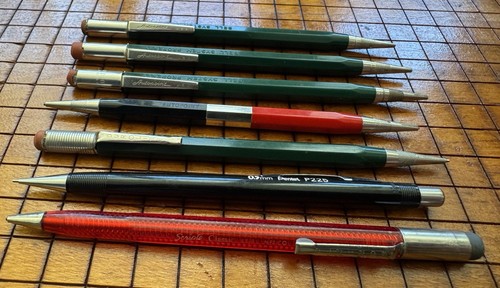
K&E, Staedtler, and Eagle precision instruments. Confirm lead diameter before buying replacement supplies.
View on eBay →