Honey-to-water ratio and OG/FG targets — dry vs semi-sweet vs dessert mead math
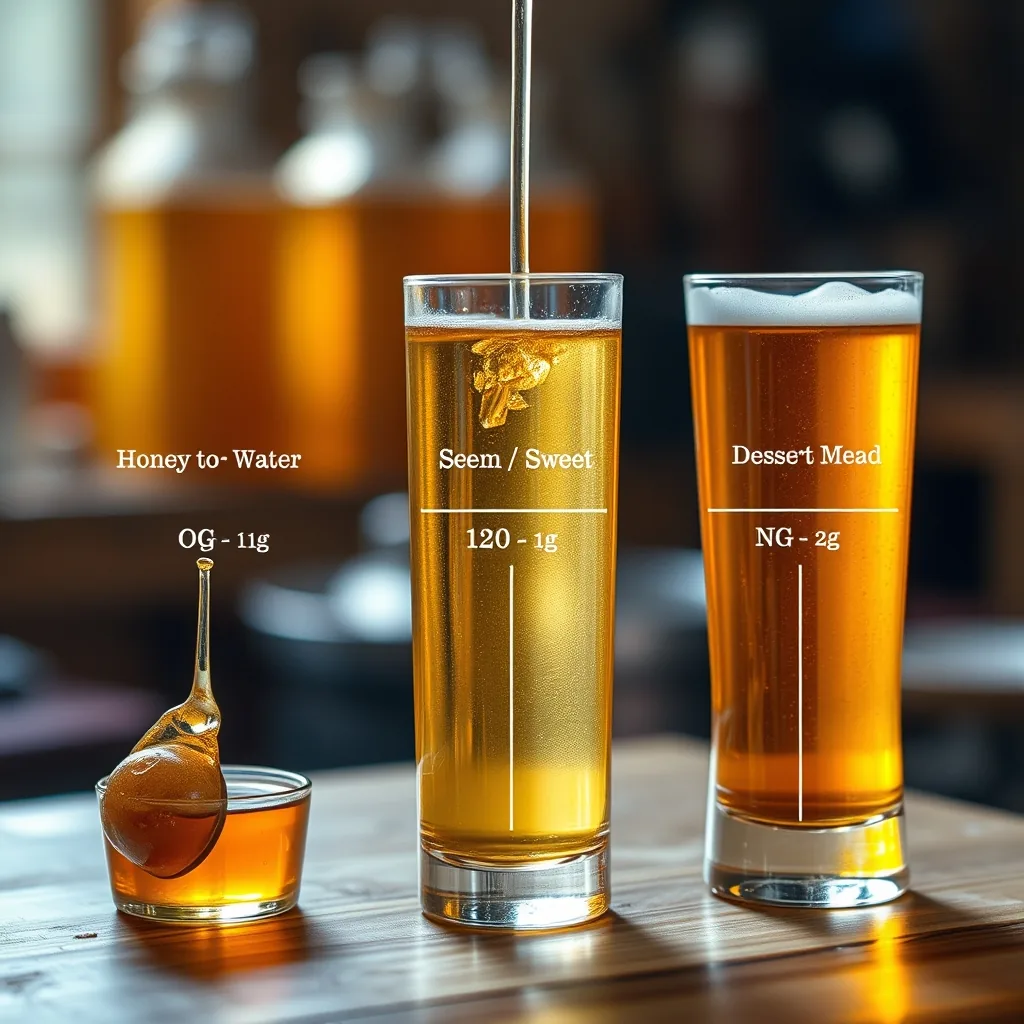
The sweetness of finished mead is set before fermentation starts, by how much honey you use and which yeast you choose. Getting those two variables right — original gravity target and yeast tolerance — determines whether you end up with the mead you intended.
Most beginner mead recipes specify a honey amount without explaining what that amount actually does to the finished product. Three pounds of honey per gallon makes a mead that will ferment dry at around 12–13% ABV, or stay semi-sweet at 10–11% depending on yeast. Four pounds per gallon is the territory of sack mead, where sweetness is almost guaranteed. The number isn't arbitrary.
Understanding the relationship between honey weight, original gravity, and final gravity gives you control over your mead — not just one batch following someone else's recipe, but the ability to plan any sweetness level for any batch.
What OG and FG mean, and how to read them
Specific gravity measures the density of a liquid relative to water. Pure water at standard temperature has a specific gravity of 1.000. Add dissolved sugars — from honey, fruit, malt, or anything fermentable — and the density rises above 1.000.
Original Gravity (OG) is the specific gravity of your must before yeast is pitched. It tells you how much fermentable sugar is present. A higher OG means more sugar available for the yeast to convert to alcohol.
Final Gravity (FG) is the specific gravity after fermentation has completed. If all fermentable sugars were consumed, FG approaches 1.000. If residual sweetness remains — either because fermentation stopped early, or because the yeast hit its alcohol tolerance limit — FG reads above 1.000.
A hydrometer measures specific gravity by how deep it sinks in the liquid. You take readings from a sample in a test tube, not the carboy itself. Record your OG reading the day you pitch yeast and your FG reading when fermentation is stable for several days.
The ABV formula
Once you have OG and FG, alcohol by volume (ABV) is calculated using the standard simplified formula used by homebrewers:
ABV = (OG − FG) × 131.25
Example: OG 1.090, FG 1.004. Difference is 0.086. Multiply by 131.25 = 11.3% ABV.
This formula is accurate enough for homebrew planning purposes. At very high alcohol levels (above 14%), it slightly underestimates; a more precise formula is available but the simplified version is sufficient for recipe planning.
Honey's gravity contribution: the core calculation
The central number you need: one pound of honey dissolved in one gallon of water raises specific gravity by approximately 0.035–0.040 points. The variation comes from honey water content, which ranges from about 15–20% by weight depending on type and source. Most calculations use 0.038 as a practical middle value.
This lets you work backwards from any OG target:
| Honey (lbs per gallon) | Approx. OG | Notes |
|---|---|---|
| 1.5 lbs | 1.057 | Session mead, ~7% ABV when dry |
| 2.0 lbs | 1.076 | Light traditional, ~9–10% when dry |
| 2.5 lbs | 1.095 | Standard dry-to-semi range |
| 3.0 lbs | 1.114 | Traditional; dry or semi-sweet depending on yeast |
| 3.5 lbs | 1.133 | Sweet range; yeast tolerance likely limits FG |
| 4.0 lbs | 1.152 | Sack mead; expect residual sweetness with most yeasts |
These numbers are per gallon of total must volume, not per gallon of water. If you're making a 1-gallon batch, dissolve your honey in enough water to bring the total volume to 1 gallon. If you're making a 5-gallon batch, multiply the honey weight by 5.
Target OG and FG by sweetness tier
The sweetness of finished mead is determined by FG, not OG. OG sets your maximum potential alcohol. FG tells you how much unfermented sugar remains. Here are the standard homebrewing gravity ranges by sweetness tier:
| Style | OG range | FG target | Approx. ABV | Honey (lbs/gal) |
|---|---|---|---|---|
| Dry | 1.065–1.090 | 0.998–1.006 | 8–11% | 1.7–2.4 |
| Semi-dry | 1.080–1.095 | 1.006–1.010 | 9–11% | 2.1–2.5 |
| Semi-sweet | 1.090–1.115 | 1.010–1.020 | 9–13% | 2.4–3.0 |
| Sweet | 1.110–1.130 | 1.020–1.035 | 10–13% | 2.9–3.4 |
| Dessert/sack | 1.130+ | 1.030+ | 12–15%+ | 3.4+ |
Note that OG and FG ranges overlap significantly between adjacent tiers. A mead that starts at OG 1.095 can finish dry (FG 1.002) or semi-sweet (FG 1.015) depending entirely on which yeast you use and whether fermentation completes.
Yeast tolerance: the variable that controls your FG
Yeast ferments until it either consumes all available sugar or reaches its alcohol tolerance limit. When yeast hits its tolerance ceiling, it stops fermenting, leaving residual sugar — and residual sweetness — behind.
This means you can deliberately plan a sweet mead by pitching a low-tolerance yeast into a high-OG must: the yeast will ferment to its limit and stop well before consuming all the sugar. Or you can plan a dry mead by using a high-tolerance yeast in a moderate-OG must: the yeast will ferment all the way to near 1.000.
Common mead yeasts and their approximate alcohol tolerances:
| Yeast | Approx. tolerance | Character | Best for |
|---|---|---|---|
| Lalvin EC-1118 (Champagne) | ~18% | Neutral, attenuative | Dry meads, high-ABV meads |
| Lalvin K1-V1116 | ~18% | Fruity, clean | Dry to semi-dry fruit meads |
| Lalvin 71B | ~14% | Fruity esters, soft | Melomels (fruit meads), semi-sweet |
| Lalvin D47 | ~14% | Creamy, floral | Traditional meads, must ferment below 65°F |
| Red Star Premier Blanc | ~18% | Neutral | Dry, budget-friendly EC-1118 alternative |
D47 carries a specific warning: above 65°F (18°C), D47 produces significant hydrogen sulfide, resulting in a sulfurous off-flavor that takes months to clear. If your fermentation space runs warm, use 71B instead.
Planning example: you want a semi-sweet traditional mead at around 12% ABV. Use OG 1.115 (approximately 3 lbs honey per gallon). Pitch Lalvin 71B (14% tolerance). The yeast will ferment to roughly 14%, but your OG only supports 12–13% of available alcohol — meaning the yeast should ferment dry. To get a semi-sweet result with 71B, you need either a higher OG (more honey) so residual sugar remains when tolerance is hit, or you need to stop fermentation artificially via backsweetening.
Step feeding: why you can't always add all the honey at once
For very high-OG batches (above 1.120), adding all honey at the start creates an osmotic stress problem. High sugar concentration inhibits yeast health from the beginning, often leading to a stuck fermentation that stalls at a mid-range gravity and never completes.
Step feeding solves this by pitching yeast into a moderate-OG must (1.080–1.090) and adding additional honey in stages as gravity drops. Each addition introduces more sugar as the yeast is already active and healthy, rather than overwhelming new yeast before it establishes.
A common step-feed schedule for a target OG of 1.140 (sack mead):
- Pitch yeast into must at OG 1.085
- When gravity drops to 1.040–1.050, add enough honey to raise it back to 1.080
- Repeat once or twice until total honey additions are complete
- Allow to ferment fully or stop at target FG
Step feeding requires patience — each addition extends fermentation time by several days to a week — but it dramatically reduces the likelihood of stuck fermentation in high-gravity batches.
Backsweetening: adding sweetness after fermentation
If you want a sweet mead but don't want to gamble on yeast tolerance stopping at exactly the right point, the reliable method is to ferment dry and then add honey back after fermentation is complete — a technique called backsweetening.
The protocol:
- Allow mead to ferment completely dry (FG 1.000 or below, stable for at least 3 days)
- Add potassium sorbate at the manufacturer's recommended rate (typically 0.5 tsp per gallon) and one Campden tablet (potassium metabisulfite) per 6 gallons. These work together to prevent renewed fermentation.
- Wait 24–48 hours for sorbate and sulfite to fully distribute
- Add honey to taste — typically in small increments, tasting as you go
- Take a gravity reading after each addition to track your FG
Potassium sorbate alone is not reliable — it inhibits yeast reproduction but does not kill active yeast cells. You need both sorbate and sulfite (metabisulfite) together for effective stabilization. Without both, residual yeast can restart fermentation after backsweetening, resulting in pressure buildup in bottles and potentially bottle bombs.
Quick reference: 1-gallon and 5-gallon targets
| Target style | 1-gal honey (lbs) | 5-gal honey (lbs) | Target OG | Yeast |
|---|---|---|---|---|
| Dry (8–10%) | 2.0 | 10.0 | 1.076 | EC-1118 or 71B |
| Semi-dry (10–11%) | 2.5 | 12.5 | 1.095 | 71B or D47 |
| Semi-sweet (11–13%) | 3.0 | 15.0 | 1.114 | 71B + backsweeten |
| Sweet (12–14%) | 3.5 | 17.5 | 1.133 | 71B (hits tolerance) or backsweeten |
| Dessert / sack (14%+) | 4.0+ | 20.0+ | 1.152+ | Step feed + EC-1118 or backsweeten |
These are starting targets. Actual OG varies slightly with honey water content and measurement conditions. Always take a hydrometer reading before pitching — don't rely on calculated gravity alone. The reading is the ground truth.
Gear worth looking at
eBay searches we'd start with ourselves. Small commission on qualifying purchases through these links; price is the same for you. Full disclosure.
 Digital kitchen scale (0.1g precision)
Weighing honey instead of measuring by volume is significantly more accurate. 1 lb of honey by weight is consistent; cups are not, because honey density varies.
 Refractometer (for OG checking)
A refractometer only needs 2–3 drops of must for a reading instead of a hydrometer test tube full. Useful for checking OG before pitching without losing much must.
 Lalvin 71B yeast
The most widely recommended starting yeast for traditional meads. 14% tolerance, fruity esters, forgiving at typical homebrew temperatures. Multi-pack prices are worth it.
 Potassium sorbate + Campden tablets
Essential for backsweetening. Both together inhibit renewed fermentation — sorbate alone is not enough. Stock both before you plan any sweet mead.
 Auto-siphon + racking cane
Racking (transferring to a secondary vessel) reduces lees contact and helps clarity. An auto-siphon makes it one-person work without sucking on a tube.