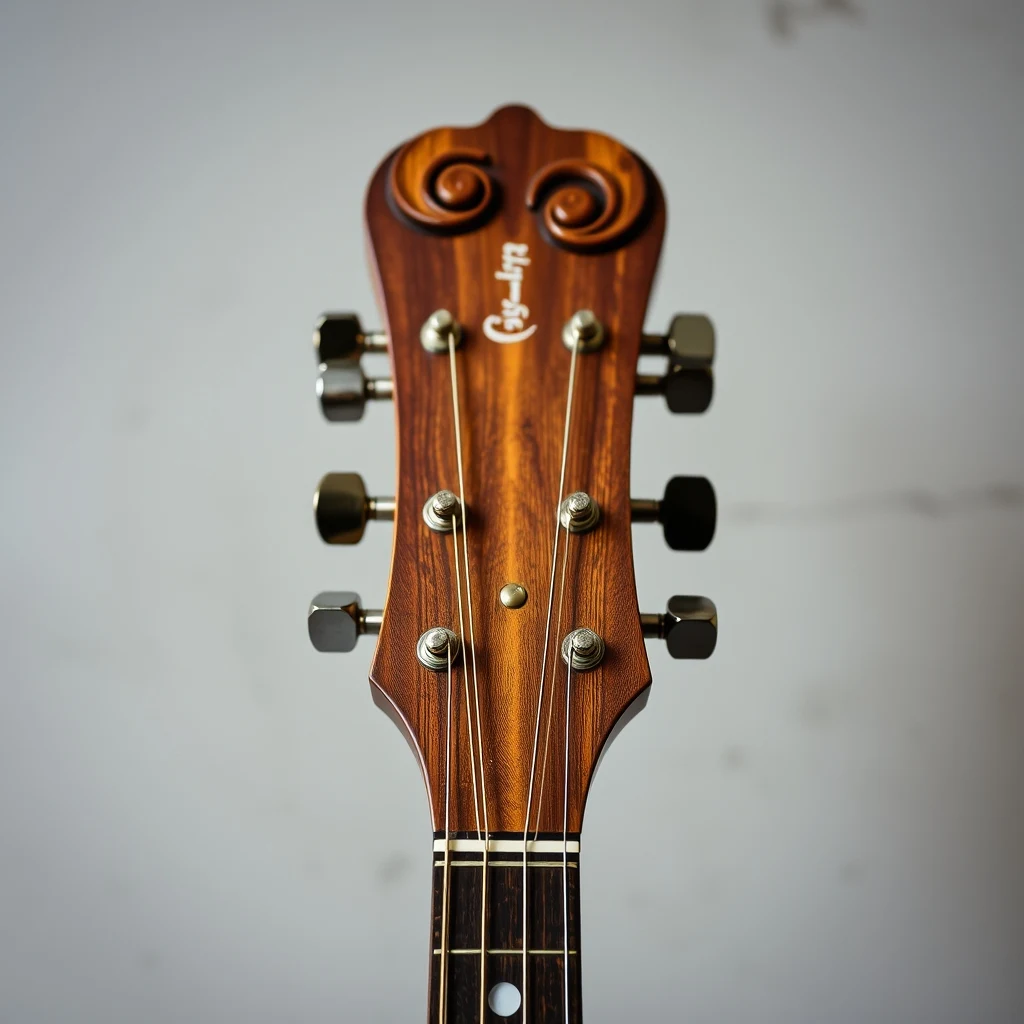
Body style: F vs A vs bowlback
Three distinct mandolin body traditions appear in the vintage market, and they are not variations of the same instrument — they have different construction methods, different tonal characteristics, and different collector communities.
| Body style | Back construction | Top | Primary use |
|---|---|---|---|
| F-style (scroll + points) | Carved arched back | Carved arched spruce | Bluegrass, country |
| A-style (teardrop) | Carved or pressed arched back | Carved or pressed spruce/cedar | Bluegrass, folk, Celtic, everything |
| Bowlback (Neapolitan) | Ribbed bowl, no flat back | Flat spruce top | Classical, Italian folk, parlor |
The F-style's scroll (a curled extension on the treble side of the upper bout) and points (projecting corners) are aesthetic distinctions derived from violin family instrument shapes. They do not themselves determine tone — the carved top, internal bracing, and wood selection do. But F-style instruments are almost exclusively hand-carved on quality examples, and the F-5 model was specifically developed alongside acoustic theory research that produced a genuinely superior acoustic design.
The A-style teardrop body can be found with carved or pressed (laminate) tops, particularly in mid-grade and student instruments. Identifying which you have is crucial to evaluation.
Carved vs pressed tops: the core value distinction
A carved top is hand-carved (or occasionally machine-carved with hand finishing) from a solid piece of spruce. The arched shape is produced by removing material. A pressed top is produced by steaming and pressing a flat piece of wood into an arched shape — or by laminating multiple thin layers of wood and pressing them into shape.
Carved tops are more resonant, develop tone as they age, and respond to dynamic playing differences more expressively than pressed tops. They are also more expensive to produce and more fragile — a carved top can crack if humidity drops severely, as solid wood moves with moisture changes while laminate resists this.
How to tell carved from pressed visually
Look at the interior of the instrument through the f-holes or oval soundhole. On a carved top, the interior surface shows tool marks or slight irregularity — the wood is solid and was worked from the outside. On a pressed top, the edge of the soundhole shows layers if the top is laminate. The thickness of the top at the soundhole edge is also a guide — carved tops are typically 2.5–4mm and taper toward the edges; pressed tops may be more uniform in thickness.
The Gibson A-model line
Gibson's A-model mandolins were produced from the early 1900s through the modern era in several variants. Key designations:
- A (no suffix): The basic A model, with an oval soundhole. Produced across many eras. Pre-war examples with carved tops are the most sought.
- A-1, A-2, A-3, A-4: Decoration grades, not structural differences. A-4 was the highest-trim version with more ornate binding and inlay.
- A-Jr: A smaller, budget-grade model.
- A-40, A-50: Later (1950s–70s) models with different structural specs from the pre-war instruments.
For collector value: carved top, pre-war (pre-1941 approximately) A-models are the tier to focus on. Post-war A-models are players but generally not collector pieces at the same level. The production records and serial number databases for Gibson mandolins are well-developed and should be consulted for any significant purchase.
Shopping for vintage mandolins? Browse current eBay listings → (we earn a small commission; your price is unchanged).
The Gibson F-5 and Lloyd Loar
The Gibson F-5 mandolin was developed by Gibson's acoustic engineer Lloyd Loar (along with other members of the Gibson acoustic research team) and produced primarily from 1922 to 1924 — a two-year window that created some of the most significant acoustic instruments in American music history.
Loar was Gibson's acoustic engineer during this period. His contribution to the F-5 design included the use of f-holes (borrowed from the violin family) instead of the oval hole used on earlier models, a raised fingerboard (elevating the strings above the soundboard plane for better break angle), the asymmetrical bass bar and treble soundpost inside the body (also borrowed from violin family construction), and careful attention to wood selection and voicing.
Lloyd Loar personally signed labels inside some of the instruments produced during his tenure. A mandolin with a Loar-signed label from the 1922–1924 production window is an authenticated piece of acoustic instrument history. These are verified by the label, the serial number, and physical characteristics of instruments from that specific production window.
Post-Loar F-5 production
Gibson continued producing F-5 mandolins after Loar left the company in 1924. The late 1920s and 1930s F-5s and F-7s are capable instruments but are not categorized as Loar-era examples. Gibson also produced the F-12, a somewhat different instrument with the same body shape but different internal construction, from the 1930s through the 1940s.
Post-WWII Gibson F-5 production resumed and continues to the present day. Modern Loar reissues and the current F-5G and F-5L (Loar) models from Gibson are fine instruments in their own right, but they are contemporary instruments, not vintage collectibles.
Bowlback mandolins: the Neapolitan tradition
The Neapolitan mandolin (bowlback or round-back) is the older Italian tradition that preceded the American carved-top instrument. It has a flat spruce soundboard (top) and a rounded bowl back made of ribs — narrow strips of figured wood (maple, rosewood, or other tonewoods) bent into a bowl shape and glued side by side. The internal ribbing gives it the "washboard back" appearance.
These instruments were produced in enormous quantities from roughly 1880–1920 in both Italy and American factories (particularly Lyon & Healy, Washburn, and others). Most examples encountered in estate sales and antique shops are student or mid-grade instruments. Markers of higher quality: ebony fingerboard, tighter rib spacing, more figured wood on the bowl, more decorative inlay.
What to check on bowlbacks
- Top seams: The spruce top is glued around the perimeter; check for separation or lifting at the edges
- Rib separation: Individual ribs in the bowl can separate from each other over time; look for visible gaps between ribs
- Binding integrity: The binding around the perimeter often lifts on old examples
- Neck angle: Bowlbacks are more prone to neck sink than carved-top instruments; check that the neck angle puts the strings at a workable height over the soundboard
Top condition issues in carved-top instruments
For any carved-top mandolin (F or A style), the condition of the top is the primary value variable. Common issues:
- Top cracks: Hairline cracks from humidity fluctuation. Repaired cracks are common and do not eliminate value, but unrepaired cracks that affect structural integrity do reduce it. Interior cleats (small wood reinforcements glued across a crack on the inside) are standard repair.
- Top sinking: The area between the f-holes or soundhole can sink over time as string tension gradually deforms the top. This changes string action and affects playability. Severe sinking requires a neck reset and possibly top reinforcement.
- Finish checking: The lacquer or varnish on very old instruments develops a network of fine cracks ("checking") as it ages differently from the wood. Cosmetically noticeable; does not affect tone.
- Binding condition: Celluloid binding (common on American mandolins) shrinks as it off-gasses over decades, which can cause it to pull away from the body or crack. Binding replacement is a repair that reduces originality value.
Other pre-war American mandolin makers
Gibson dominated quality production but others are collected:
- Washburn (Lyon & Healy): Chicago manufacturer producing both bowlbacks and flat-back mandolins. Some flat-back instruments from the pre-Gibson-dominance era are interesting examples.
- Regal: Produced across a range of qualities, mostly student grade. Some examples have carved tops.
- Martin: Produced mandolins primarily from the 1890s–1920s, largely bowlback and early flat-back types. Collected as Martin instruments, not as mandolin-tradition instruments per se.
The honest bottom line
For a player wanting a vintage carved-top mandolin: a clean pre-war Gibson A-model with an intact carved top is achievable at reasonable cost compared to F-5 prices. The tone of a well-made carved-top A-model is genuinely excellent for most playing contexts outside of competitive bluegrass.
For a collector: the F-5 Loar-era examples are the apex. Authentication is mandatory; the cost of getting it wrong is high. For the bowlback Neapolitan tradition, condition and maker quality drive the market and values are generally accessible.
Either way: confirm carved vs pressed top before anything else. It is the single most important structural fact about any mandolin you're evaluating, and it determines which conversation you're in.
Search eBay for vintage mandolins
 Gibson A mandolin vintage
Confirm carved top via interior inspection. Pre-war examples command the most interest.
Gibson A mandolin vintage
Confirm carved top via interior inspection. Pre-war examples command the most interest.
 Gibson F5 mandolin
Apex of the market. Verify serial number and authentication before purchasing at collector prices.
Gibson F5 mandolin
Apex of the market. Verify serial number and authentication before purchasing at collector prices.
 Bowlback mandolin vintage
Neapolitan tradition. Check top seams and rib integrity. Player examples often affordable.
Bowlback mandolin vintage
Neapolitan tradition. Check top seams and rib integrity. Player examples often affordable.