
What knife steel actually controls
Steel composition determines four properties that matter to an EDC user: edge retention, toughness, corrosion resistance, and ease of sharpening. These four properties are in tension with each other — you cannot maximize all four simultaneously, and the marketing language around premium steels often obscures which tradeoffs were made and why.
The core mechanism is carbide volume. Hard carbides (primarily vanadium carbides and chromium carbides in stainless tool steels) resist abrasion and hold an edge under cutting stress. More carbide volume generally means better edge retention. But carbide particles are also the nucleation points for fractures — higher carbide volume typically reduces toughness, meaning the steel is more likely to chip or crack under lateral stress or hard impacts. Higher chromium content increases corrosion resistance but affects how the steel takes a heat treat and can change its abrasion characteristics.
Understanding this tension gives you the frame to evaluate any steel claim: when someone says Steel X has "excellent edge retention AND excellent toughness," you should be skeptical and look for the controlled test data, not the marketing sheet.
S30V: the workhorse benchmark
CPM S30V (Crucible Particle Metallurgy, produced by Crucible Industries) became the de facto benchmark for production EDC knives in the early 2000s and remains so for many buyers. Composition typically runs around 1.45% carbon, 14% chromium, 4% vanadium, and 2% molybdenum, though verify against manufacturer data sheets for specific production runs.
The vanadium carbides in S30V are small and evenly distributed due to the particle metallurgy process — this gives better edge retention than older stainless steels at the same hardness without the brittleness of steels with large, unevenly distributed carbides. At 59–61 HRC (Rockwell C, the standard hardness scale for knife steel), S30V holds an edge well in typical EDC tasks: cardboard, food prep, rope, package opening.
The practical advantage of S30V for most users: it's easy to sharpen. The carbide volume is high enough for good retention but not so high that refreshing the edge requires diamond abrasives or significant time on a ceramic stone. A leather strop plus a fine ceramic rod handles most maintenance. This matters more than any theoretical retention number for the person who actually sharpens their knife.
M390: the premium tier
Böhler M390 is an Austrian powdered metallurgy stainless steel that outperforms S30V in edge retention in controlled CATRA (Cutting Research and Testing Association) testing. Composition is approximately 1.9% carbon, 20% chromium, 4% vanadium, 1% molybdenum, 0.6% tungsten — the higher chromium content provides excellent corrosion resistance, and the higher carbon and vanadium content drives higher potential hardness and edge retention.
M390 is commonly heat-treated to 60–62 HRC by knife manufacturers. At these hardnesses, it outlasts S30V in pure cutting tests on abrasive materials — the difference is measurable with standardized testing equipment and noticeable to regular knife users who do repetitive cardboard or rope work. The tradeoff: M390 is harder to sharpen than S30V. The same fine ceramic rod that maintains an S30V edge will work but require more strokes, and a dull M390 blade requires more work to bring back to sharp. Diamond stones or high-quality water stones are the practical choice.
MagnaCut: the engineered solution
MagnaCut was developed by Dr. Larrin Thomas and launched commercially around 2021 through Crucible Industries. It represents a deliberate engineering attempt to break the traditional toughness-corrosion resistance tradeoff in knife steel. The approach: eliminate chromium carbides almost entirely, using instead a combination of vanadium, niobium, and nitrogen to achieve hardness and edge retention while keeping chromium in solid solution (where it contributes corrosion resistance) rather than precipitating into carbides (where it would improve hardness but reduce toughness).
The result is a steel that tests at near-M390 edge retention with significantly better toughness than M390, combined with corrosion resistance comparable to H1 (a fully austenitic stainless — essentially rustproof). Composition is approximately 1.15% carbon, 10.7% chromium, 4% vanadium, 2% niobium, 0.25% nitrogen.
For a coastal or high-humidity user, or anyone who carries a knife in wet conditions regularly, MagnaCut's corrosion resistance profile is genuinely different from other high-performance steels. M390's 20% chromium sounds higher, but the way the chromium is distributed matters — MagnaCut's deliberate design keeps more chromium available for corrosion protection.
| Steel | Approx HRC range | Edge retention | Toughness | Corrosion resistance | Sharpening difficulty |
|---|---|---|---|---|---|
| 154CM | 58–60 | Good | Good | Good | Easy |
| CPM S30V | 59–61 | Very good | Good | Very good | Moderate |
| Böhler M390 | 60–62 | Excellent | Moderate | Excellent | Hard |
| CPM MagnaCut | 61–64 | Excellent | Very good | Excellent | Moderate–hard |
154CM: the accessible workhorse
154CM is an American stainless tool steel (Crucible Industries, originally developed for bearing applications) with a long track record in production knives. Composition is roughly 1.05% carbon, 14% chromium, 4% molybdenum. It lacks the vanadium carbides of S30V and the higher overall alloy content of M390, which means lower maximum edge retention — but it also means it's easy to sharpen and takes a very fine, smooth edge that some users prefer for slicing tasks.
154CM remains the steel in a number of classic production knives, and its behavior under a strop is more familiar to users coming from traditional knife sharpening. A well-executed 154CM heat treat at 59–60 HRC produces a blade that's easy to maintain and performs well for typical EDC tasks. It's not a "lesser" steel — it's a different optimization, prioritizing ease of sharpening and a certain quality of edge feel over raw retention numbers.
When carbon steel still makes sense
The stainless steels above dominate the modern EDC conversation, but high-carbon steels (1095, O1 tool steel, 52100 bearing steel) remain legitimate choices for users who sharpen regularly and work in dry environments.
The argument for carbon: simplicity. 1095 sharpens faster and to a finer edge on basic equipment (a DMT diamond stone, a leather strop) than most premium stainless steels. O1 is a tool steel used by woodworkers for chisels and plane irons — the edge geometry and sharpening behavior are well-understood across generations of practice. 52100 (a bearing steel with about 1% carbon and 1.45% chromium) provides outstanding toughness — it's used in Bark River knives specifically because its toughness makes it essentially impossible to chip in hard-use bushcraft applications.
The counterargument: carbon steel rusts. Not slowly and decoratively — it rusts quickly at cut edges and around the pivot pin of a folding knife if not dried and oiled after use. For someone who carries a knife through humid environments, in food prep contexts, or who won't maintain it, carbon steel is a poor choice regardless of its theoretical edge properties. For someone who sharpens weekly and dries their knife, a 1095 working knife can be a genuinely satisfying tool at a fraction of the cost of a premium stainless.
The heat treat variable nobody discusses enough
All the composition data above is moot if the heat treatment is poor. Steel reaches its target hardness through a precise austenitizing temperature, quench rate, and tempering cycle — the specific parameters vary by steel and thickness. A production knife manufacturer running M390 at 58 HRC when the optimal target is 61–62 HRC is not delivering M390's performance. A small custom maker with a well-calibrated oven can execute M390 or MagnaCut better than a high-volume production house cutting costs on heat treat quality control.
This is why users who own knives from makers known for careful heat treatment (Benchmade's CPM-20CV, Chris Reeve's S45VN, Zero Tolerance's S35VN variants) often describe better real-world performance than the paper specs would predict. The best steel, poorly heat-treated, underperforms the second-best steel, expertly executed. For production knives, heat treat reputation matters as much as steel grade.
Practical recommendations by use pattern
Urban EDC, light use, infrequent sharpening
S30V or 154CM. These steels sharpen easily when you eventually do touch up the edge, and the edge retention is more than adequate for opening packages, cutting food, and occasional utility tasks. M390 or MagnaCut's additional retention isn't relevant if you only sharpen twice a year regardless.
Regular cutting tasks, weekly use, comfortable with sharpening
S30V or M390 depending on budget. S30V in a Benchmade AXIS lock (Bugout, 940) or Spyderco's compression lock (Para Military 2) represents excellent value. M390 in a mid-range knife rewards the extra sharpening skill required.
Wet, coastal, or high-humidity environments
MagnaCut or M390. The corrosion resistance difference from S30V is real in saltwater or near-saltwater conditions. MagnaCut has the edge in toughness if you also do hard-use tasks. H1 steel (found in some Spyderco Salt Series models) is an option for extreme corrosion requirements — it's essentially rustproof but trades away edge retention significantly.
Hard-use, bushcraft, or survivalist context
Toughness matters more than retention for batoning, prying, and heavy chopping. Look at 3V, A2, or 52100 rather than the high-retention steels above. The carbide volume that gives M390 its retention also makes it more prone to chipping under lateral stress or tip impact — tasks that fixed blade bushcraft users encounter regularly.
Search eBay for these EDC knives
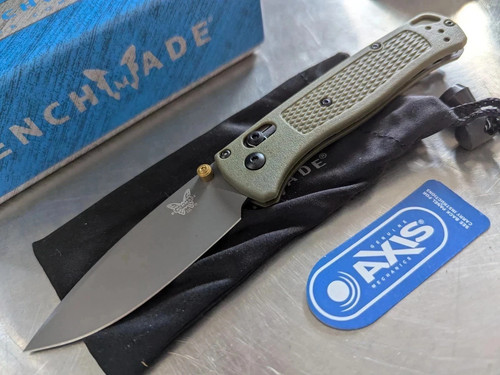 Benchmade Bugout 535
S30V drop-point, AXIS lock. 2.82 oz. The ultralight EDC benchmark.
Benchmade Bugout 535
S30V drop-point, AXIS lock. 2.82 oz. The ultralight EDC benchmark.
 Spyderco Para Military 2
S30V or S45VN. Compression lock. The most-discussed production folder by enthusiasts.
Spyderco Para Military 2
S30V or S45VN. Compression lock. The most-discussed production folder by enthusiasts.
 Microtech Ultratech OTF
Elmax or M390. Double-action OTF. Check state legality before purchase.
Microtech Ultratech OTF
Elmax or M390. Double-action OTF. Check state legality before purchase.
 Chris Reeve Sebenza 31
S45VN, integral titanium frame lock. The semi-custom production reference point.
Chris Reeve Sebenza 31
S45VN, integral titanium frame lock. The semi-custom production reference point.
 Benchmade Mini Bugout
S30V at 1.5 oz total weight. AXIS lock. Smaller format for deeper carry.
Benchmade Mini Bugout
S30V at 1.5 oz total weight. AXIS lock. Smaller format for deeper carry.