Yarn weight + needle size: the gauge chart vs your actual gauge
The gauge printed on a yarn label assumes a hypothetical average knitter. That hypothetical knitter is not you. Understanding why — and how to correct for your own tension — is the difference between projects that fit and projects that get frogged.
What gauge actually is
Gauge is a measurement of stitch density: how many stitches and rows fit into a four-inch square of fabric knitted at a given tension with a given yarn and needle. It's written as two numbers — stitches per four inches and rows per four inches — and it determines the finished size of anything you knit from a pattern.
The important thing about gauge is that it's not a property of the yarn. It's a property of the combination of yarn, needle size, and knitter tension. Two knitters using identical yarn and identical needles can produce swatches that differ by two stitches per four inches — which translates to a finished garment that's three inches wider on one person than the other. Two stitches per four inches sounds small. Over 180 stitches cast on for a sweater body, it's nine full inches of width difference. A size small becomes a size large.
Most knitting problems that get blamed on the pattern or the yarn are actually gauge problems. A hat that won't stretch over an adult head was knit too tight. A scarf that came out eight inches wide instead of six was knit too loose. A sweater with sleeves that hit mid-forearm was calculated in centimeters and knit with a row gauge that was off by two rows per four inches.
The Craft Yarn Council weight system — and what it doesn't tell you
The Craft Yarn Council (CYC) system assigns yarn weights to categories numbered 0 through 7. These categories have associated standard needle sizes and standard gauge ranges:
| Weight (CYC #) | Name | Standard needle (US) | Standard gauge (sts/4in) |
|---|---|---|---|
| 0 | Lace | 000–1 (1.5–2.25mm) | 33–40 |
| 1 | Super fine / sock | 1–3 (2.25–3.25mm) | 27–32 |
| 2 | Fine / sport | 3–5 (3.25–3.75mm) | 23–26 |
| 3 | Light / DK | 5–7 (3.75–4.5mm) | 21–24 |
| 4 | Medium / worsted | 7–9 (4.5–5.5mm) | 16–20 |
| 5 | Bulky | 9–11 (5.5–8mm) | 12–15 |
| 6 | Super bulky | 11–17 (8–12.75mm) | 7–11 |
| 7 | Jumbo | 17+ (12.75mm+) | 6 or fewer |
What the chart doesn't tell you: these gauge ranges are wide enough to drive a garment through. A DK-weight yarn nominally runs 21–24 stitches per four inches — a three-stitch spread that represents a significant size difference across a full garment. Every yarn in a given category will knit at a slightly different gauge, and your tension modifies it further.
The label gauge printed on a ball band is usually the manufacturer's target for their yarn, typically measured in stockinette using the needle size printed on the label, by their sample knitter. It is a reasonable starting point. It is not a specification you will necessarily hit.
Why you're probably not hitting label gauge
Knitting tension varies by individual, and it varies within a single knitter depending on mood, fatigue, material, and even time of day. The most common sources of gauge deviation:
Tight knitters
A tight knitter wraps yarn with more tension, producing a smaller stitch with less space between the loops. The fabric comes out denser than the pattern intends, and the stitch count per four inches is higher than the target. Tight knitters typically need to go up one or two needle sizes to hit a pattern's gauge. If you're consistently a stitch or two above the target gauge per four inches, you're a tight knitter and should size up your needles, not try to physically relax your hands — consciously "knitting loose" is inconsistent and causes uneven fabric.
Loose knitters
A loose knitter wraps yarn with less tension, producing larger stitches and fabric that comes in below the stitch count target. Loose knitters go down one or two needle sizes. Loose knitting is also inconsistent when you try to correct it manually; it's faster to use a smaller needle and knit the way you naturally knit.
The needle material effect
This surprises many knitters: needle material changes gauge. Smooth metal needles (stainless steel, nickel-plated brass) let yarn slide freely and typically produce a slightly looser stitch than grippy bamboo or wood needles. If you switch from a bamboo needle to a metal needle of the same size, your gauge can shift by half a stitch per four inches — which accumulates over a full-width garment. Swatching with the actual needles you'll use for the project is not optional for fitted pieces.
The fiber and construction effect
Woolen-spun yarns (lofty, round cross-section, slight halo) bloom when blocked and can gain a stitch or two per four inches after washing. Worsted-spun yarns (compact, smooth, tightly twisted) hold their gauge more reliably. Yarns with significant synthetic content — nylon or acrylic blends — often behave differently wet than dry and may not respond to wet blocking the same way wool does. A wool/nylon sock yarn will not bloom the way a lofty single-ply merino does.
How to swatch properly
Most knitters swatch too small. A 4×4-inch swatch sounds like enough to measure gauge over four inches, but it isn't. The edges of a knitted swatch curl and distort, and the outermost inch on each side is unreliable. To get an accurate measurement, you need a swatch large enough that you can measure four inches entirely within the interior. That means a swatch at least six inches wide and five inches tall, ideally larger.
The cast-on and bind-off problem
Cast-on and bind-off edges also distort the swatch slightly, which is why row gauge measurements are most accurate when taken well away from those edges. Cast on at least 30 stitches for a worsted-weight swatch — more for finer weights — so the interior has room to breathe.
Wash your swatch
This is the step that most knitters skip and most teachers insist on. Wash and block your swatch the same way you'll care for the finished project, then let it dry fully before measuring. Wool yarns can grow significantly after washing. A DK-weight wool swatch that measures 22 stitches per four inches dry might measure 20 stitches per four inches after a gentle hand wash and blocking — two full stitches tighter-looking at the dry stage, looser after care. If you measure dry and knit a garment, then wash and block it, the garment will be a different size than you intended.
How to adjust when gauge doesn't match
The standard adjustment is to change needle size. One needle size up or down typically changes gauge by about one stitch per four inches — sometimes less for fine yarns, sometimes more for bulky ones. The adjustment is iterative: swatch, measure, adjust, swatch again.
More stitches per four inches than target (fabric is too small)
Go up one needle size. Your tension is tighter than the pattern expects. The larger needle opens the stitches up and brings the stitch count toward the target.
Fewer stitches per four inches than target (fabric is too large)
Go down one needle size. Your tension is looser than the pattern expects. The smaller needle closes the stitches and brings the count up toward the target.
Gauge matches but fabric hand is wrong
Sometimes you can hit a pattern's gauge but the fabric feels wrong — too stiff, too drapey, too open. This is a signal that the needle size for that yarn and your tension produces an unflattering fabric, even if it's technically correct for size. This comes up with garments where fabric hand matters. The practical solution is to choose a different yarn at the same gauge rather than forcing a fabric quality you don't like. Gauge and fabric quality are related but separable problems.
When gauge matters and when it doesn't
Gauge is not equally important for every project. Understanding which category you're in determines how much swatching time is actually worth spending.
Gauge matters a great deal for
- Fitted sweaters and cardigans. A two-stitch-per-four-inch deviation turns a size medium into a size large. The larger the garment, the more this error accumulates.
- Socks. Sock gauge matters because a sock that's even 10% too large won't stay up and a sock 10% too small won't go on. Fingering-weight sock gauge is usually 8 stitches per inch — small deviations matter.
- Mittens and gloves. Same logic as socks: fits a hand or doesn't.
- Colorwork (stranded knitting). Carrying two strands across the back of work almost always tightens gauge compared to plain stockinette. Swatching in colorwork pattern — not stockinette — is necessary for accurate results.
Gauge matters very little for
- Scarves and cowls. A scarf that comes out seven inches wide instead of six is still a functional scarf. The variation is visible but rarely problematic.
- Dishcloths and washcloths. Square cotton pieces have almost no fit requirement. Close enough is fine.
- Blankets. Unless a blanket is sized to fit a specific space exactly, two inches of width difference is not worth multiple swatching rounds.
- Decorative items. Ornaments, stuffed animals, and similar projects tolerate gauge variation well. The structure holds regardless.
Row gauge: the underrated half of the equation
Most knitters pay attention to stitch gauge (stitches per four inches horizontally) and ignore row gauge (rows per four inches vertically). For many patterns, this is fine — armhole depths, yoke heights, and body lengths are often given in inches rather than row counts specifically so that row gauge variation doesn't create problems.
Row gauge matters significantly in two situations: top-down raglan construction, where the rate of increases determines yoke shaping, and colorwork patterns with large vertical motifs, where the horizontal and vertical scale of the pattern depend on both stitch and row gauge matching simultaneously. If you're knitting a Fair Isle sweater with a bird motif and your row gauge is off, the birds will be fat or skinny regardless of correct stitch gauge.
Changing needle size affects stitch gauge more than row gauge. Needle length has almost no effect on gauge. The fiber and stitch pattern both influence row gauge independently. The most reliable fix for a wrong row gauge is choosing a different yarn or a different needle material — metal vs. wood, for example — rather than simply sizing the needle up or down.
What the pattern's gauge is actually telling you
When a pattern specifies 20 stitches and 28 rows = 4 inches in stockinette on a US 7 needle, it's giving you a target, not a recipe. The needle size is suggestive — it's what the sample knitter used. You may need US 6 or US 8 to hit the same numbers. The material is what the designer worked with, but it's the gauge that determines fit. Hit the gauge with whatever needle gets you there.
Some patterns specify gauge in a textured stitch rather than stockinette. If a cable pattern specifies gauge over the cable panel, swatch the cable panel — not stockinette. Cables pull in horizontally, and gauge measured in stockinette will not accurately predict finished measurements in cabled fabric. This catches many knitters off guard on their first cable project.
Gear actually worth buying
Smart eBay searches for gauge and needle work. Small commission on qualifying sales; your price is the same either way. Full disclosure.
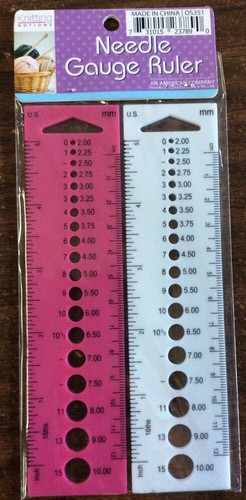 Needle gauge + swatch rulerA metal gauge plate with a 4-inch window for measuring stitches and rows simultaneously. The Clover and Knit Picks versions are the two worth buying — rigid enough that they don't distort.
 ChiaoGoo Red Lace circularsThe interchangeable set used by the majority of serious knitters. Stainless steel tips, flexible cable, reliable join. The needle size you need is actually in the set — others have gaps.
 Blocking wires + T-pinsAfter washing your swatch, pins hold it flat while it dries so you're measuring the actual finished gauge — not a curled, contracted dry estimate. The most skipped step in the whole workflow.
 Knit Picks Options set (budget)The affordable entry to interchangeable circulars. Nickel-plated tips, several cable lengths, covers US 4–11. A good set for trying multiple needle sizes during gauge swatching without buying individual needles.
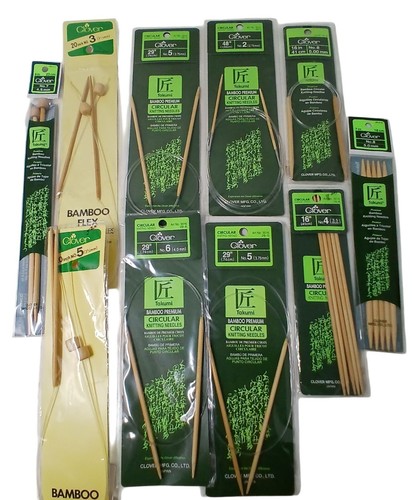 Bamboo needles (for loose knitters)If you knit loose, bamboo's grip adds tension without changing needle size. Clover Takumi bamboo circulars are the standard. Useful to have one size down in bamboo alongside metal needles for comparison swatching.