Tap Water EC and the Nutrient Solution Baseline — When to Start at 0.4 mS/cm vs 0.0
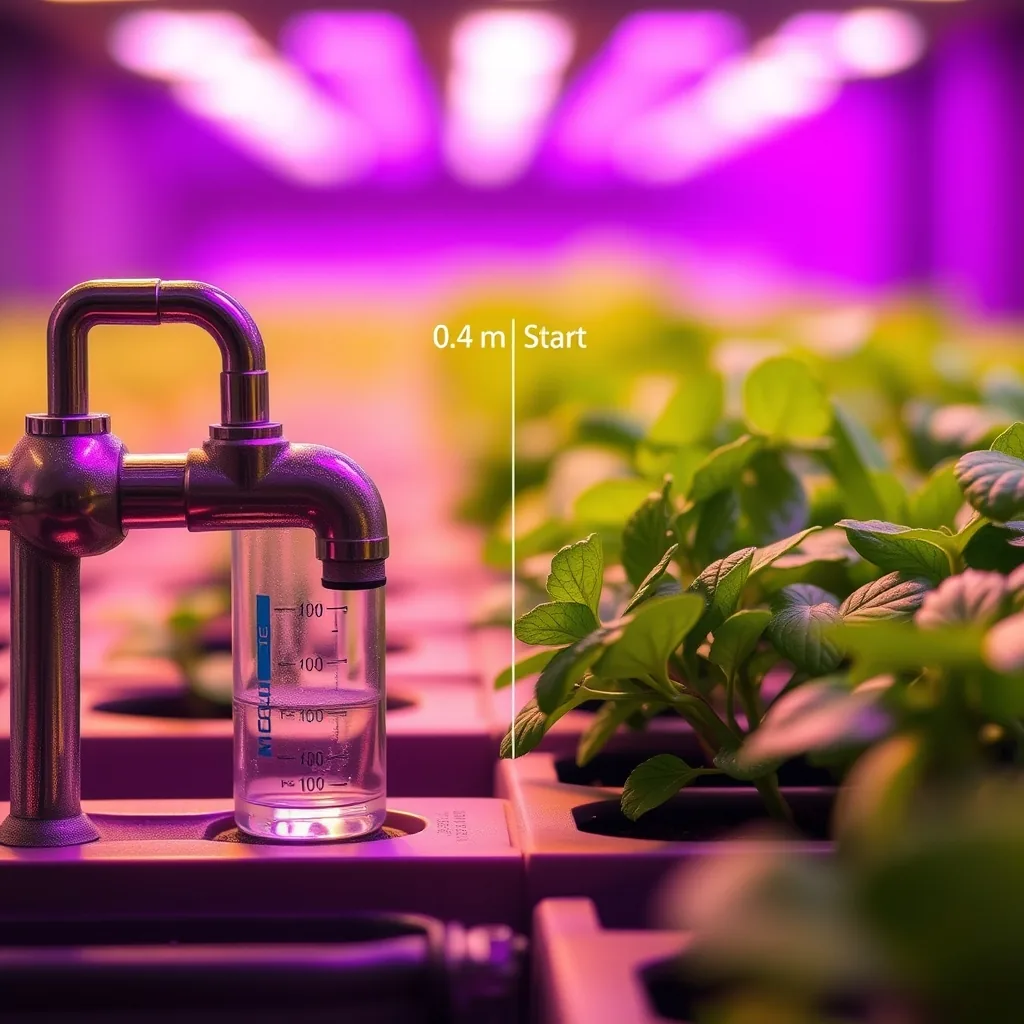
Your EC meter reads your tap water before you add anything. That number — whatever it is — is your baseline. It represents dissolved minerals already in the water: calcium, magnesium, sodium, chloride, and whatever else your municipality uses to treat it. When a nutrient schedule says "mix to 1.2 mS/cm," it means 1.2 total — your tap water EC is already part of that budget, and the nutrients you add must stay within the remainder.
What EC Actually Measures
Electrical conductivity (EC) is a measure of how well a solution conducts electricity, expressed in millisiemens per centimeter (mS/cm) or microsiemens per centimeter (µS/cm — 1 mS/cm = 1,000 µS/cm). Pure water conducts electricity very poorly; dissolved mineral salts and ionic compounds conduct it very well. A higher EC reading means more dissolved solids are present.
The connection to plant nutrition is indirect but reliable. The minerals plants eat in hydroponics — nitrogen (as nitrate or ammonium), phosphorus (as phosphate), potassium, calcium, magnesium, sulfur, iron, and the trace elements — are all ionic salts that contribute to EC. So a higher EC generally means more nutrients are available, up to the point where salt concentration becomes stressful to roots.
EC does not tell you which minerals are present or in what ratio. It tells you the total ion concentration. This is why you need to know what's already in your tap water: the minerals already there are invisible to your nutrient schedule but are being read by your meter and absorbed by your plants.
Tap Water EC: What the Numbers Mean
Municipal tap water EC typically falls between 0.1 and 0.8 mS/cm, though outliers exist in both directions. Rainwater and high-quality RO water read near 0.0. Some well water in arid areas can read above 1.0 mS/cm.
| Tap water EC range | Classification | What it means for hydroponics |
|---|---|---|
| 0.0 – 0.2 mS/cm | Very soft / RO-like | Essentially blank slate. You have full nutrient budget available. May need to add calcium and magnesium (CalMag) to bring mineral levels up to minimum for plant function. |
| 0.2 – 0.4 mS/cm | Soft tap | Low baseline. Treat similarly to soft water — you have most of your nutrient budget available. Start nutrient mixes from the lower end of recommended ranges. |
| 0.4 – 0.8 mS/cm | Moderate tap | Common range for municipal water. Your nutrient additions should be reduced by the tap water EC to hit target. At 0.6 baseline targeting 1.4 total, you add nutrients to raise EC by 0.8. |
| 0.8 – 1.2 mS/cm | Hard tap | Significant mineral load. You have limited budget before reaching stress thresholds for sensitive crops. Lettuce and herbs may struggle at target EC with a high starting baseline. |
| > 1.2 mS/cm | Very hard / problematic | Likely above usable threshold for seedlings and light-feeding crops without dilution. Consider RO blending or full RO filtration. Well water in alkaline regions often reads here. |
When to Start at 0.4 mS/cm vs 0.0 mS/cm
This is the core practical question. The answer depends on your water source and what your crop needs.
Starting at 0.0 (RO or distilled water)
When you use reverse osmosis water or distilled water, your baseline is essentially 0.0 mS/cm (typically 0.01–0.04 mS/cm in practice). You have complete control over what goes into solution. Every mS/cm your meter reads was added by you through nutrient concentrate.
This is the preferred starting point for:
- Precise feeding by growth stage, where hitting exact EC targets matters (DWC tomatoes, peppers, cannabis)
- Crops sensitive to sodium or chloride that may be elevated in your tap water
- Situations where your tap water EC fluctuates seasonally (common in surface-water municipalities)
- Diagnosing nutrient problems, where you need to eliminate water chemistry as a variable
The drawback of RO water is that it strips calcium and magnesium along with everything else. These two elements are required at baseline concentrations for cell wall integrity, enzyme function, and chlorophyll production. Most hydroponic nutrients assume a minimum of 20–30 ppm calcium in the water before nutrients are added. When starting from 0.0, you need to either use a nutrient line formulated for RO water, or add a dedicated CalMag supplement to build that foundation before adding the main nutrient package.
Starting at 0.4 mS/cm (typical moderate tap water)
With a tap water baseline of 0.4 mS/cm, you already have roughly 200 ppm of dissolved minerals in solution. What that 0.4 consists of depends on your municipality — it may be heavy in calcium and bicarbonate, or it may include sodium and chloride if your area uses chloramines. You generally do not know the exact mineral breakdown without a water report or a detailed water test.
For most crops and most setups, this baseline is usable without modification. The practical adjustment is:
- Measure your tap water EC before mixing any nutrients. Write it down — it may vary slightly by season.
- Subtract your tap water EC from your target EC to get the "nutrient EC" you need to add.
- Mix nutrients to that reduced target, then verify total EC with your meter.
Example: Target EC for mid-growth lettuce is 1.2 mS/cm. Your tap water reads 0.4 mS/cm. Add nutrients to bring the solution up by 0.8 mS/cm — your meter should read 1.2 when you're done.
Target EC by Crop and Growth Stage
These are the total solution EC targets including your tap water baseline. If your baseline is 0.4, the "nutrient contribution" column shows what you're adding with your concentrate.
| Crop | Growth stage | Total EC target (mS/cm) | Nutrient EC to add at 0.4 baseline |
|---|---|---|---|
| Lettuce | Seedling | 0.8 – 1.0 | 0.4 – 0.6 |
| Lettuce | Vegetative | 1.2 – 1.6 | 0.8 – 1.2 |
| Basil / herbs | All stages | 1.0 – 1.6 | 0.6 – 1.2 |
| Spinach | All stages | 1.0 – 2.0 | 0.6 – 1.6 |
| Strawberries | Vegetative | 1.2 – 1.8 | 0.8 – 1.4 |
| Strawberries | Fruiting | 1.8 – 2.4 | 1.4 – 2.0 |
| Tomatoes | Seedling | 1.0 – 1.5 | 0.6 – 1.1 |
| Tomatoes | Vegetative | 2.0 – 2.8 | 1.6 – 2.4 |
| Tomatoes | Fruiting | 2.5 – 4.0 | 2.1 – 3.6 |
| Cucumbers | Vegetative | 1.5 – 2.2 | 1.1 – 1.8 |
| Cucumbers | Fruiting | 2.0 – 3.0 | 1.6 – 2.6 |
| Peppers | All stages | 1.8 – 3.0 | 1.4 – 2.6 |
Seedlings and young transplants are sensitive to high EC — root cells osmotically stressed by over-concentrated solution show as wilting, yellowing, or tip burn even when watered frequently. It's better to start low and raise EC as plants establish than to start at full target strength.
The Top-Off Problem and Why It Matters
In a recirculating system (DWC, RDWC, NFT), plants consume water faster than nutrients during hot weather or under intense light. The reservoir level drops. When you top off with tap water, you're doing two things at once:
- Adding water (which dilutes the nutrient concentration and lowers EC)
- Adding the minerals in your tap water (which partially replaces the dilution)
This creates a creeping mineral accumulation problem over time. Each top-off deposits tap water minerals that are not being consumed by plants at the same rate as the nutrients you formulated. Sodium and chloride are the main offenders — they build up across reservoir cycles because plants have no meaningful uptake mechanism for them.
Signs of accumulating tap-water mineral load:
- Reservoir EC rises even when you haven't added nutrients recently
- Plants show calcium or magnesium deficiency symptoms despite adequate EC (the calcium-magnesium ratio is being displaced by other cations)
- White mineral deposits form on net pots, reservoir walls, and root surfaces (mostly calcium carbonate from bicarbonate-heavy tap water)
The solution is to perform full reservoir changes every 7–14 days rather than continuously topping off indefinitely. Use the old solution to water outdoor plants (diluted appropriately) — it's not waste.
High EC Tap Water: When You Actually Need RO
If your tap water reads consistently above 0.8 mS/cm, you have limited space to work in before hitting stress thresholds for light-feeding crops. Lettuce targeting 1.4 mS/cm total with a 0.9 baseline can only contribute 0.5 mS/cm of nutrients — which may not be enough nitrogen to support rapid growth.
Options for high-EC tap water:
- Blend with RO water. A 50/50 blend of tap and RO halves your baseline EC. If your tap reads 1.0, the blend reads 0.5 — a manageable starting point.
- Use full RO for sensitive crops (lettuce, herbs, strawberries) and tap for heavy feeders (tomatoes, peppers) where the baseline EC takes less of the total budget.
- Collect rainwater. In most climates rainwater EC is 0.02–0.05 mS/cm — essentially RO without the equipment cost.
pH and EC: The Two Numbers You Track Together
EC tells you how much is dissolved. pH tells you whether the plant can access it. The two are related but independent — a solution can have perfect EC at the wrong pH, and root cells will still be locked out of key nutrients.
For most hydroponic crops, the pH range is 5.5–6.5. Within this range, all essential minerals remain soluble and plant-available. Outside it:
- Below 5.5: iron and manganese become hyper-soluble and can accumulate to toxic levels; phosphorus availability drops sharply below 5.0
- Above 6.5: calcium and magnesium begin to precipitate as carbonates; iron and manganese become unavailable
- Above 7.0: multiple micronutrient lockouts occur simultaneously — plants show complex mixed deficiency symptoms that look like root disease
Tap water with high EC often also has high alkalinity (bicarbonate buffering capacity), which pushes pH upward in your reservoir over time. A tap water EC of 0.6–0.9 mS/cm from a hard-water source typically means you'll be adding more pH-down product per reservoir change than someone growing with low-EC municipal water. Factor this into your consumables budget.
The Practical Starting Protocol
- Measure your tap water before your first grow. Fill a clean container with tap water, let it sit for 30 minutes (off-gassing chlorine slightly changes pH), then measure EC and pH. Write these down.
- Check seasonal variation. Tap water chemistry changes with the water source. Surface-water municipalities (rivers, reservoirs) shift more than groundwater (wells, aquifers). Check at least once in summer and once in winter if you grow year-round.
- Decide your water treatment strategy before buying nutrients. If you're on RO, choose a nutrient line formulated for soft water. If you're on hard tap, choose a line formulated for use with mineral-containing water.
- Calculate target EC as total, not additive. When a nutrient guide says "feed at 1.6," that means your meter should read 1.6 after mixing — not that you should add 1.6 worth of nutrients on top of your baseline.
- Change reservoirs on a schedule. Top-off indefinitely only if you're testing EC and pH daily and the numbers stay in range. Otherwise, weekly or biweekly full changes prevent accumulation problems before they become visible.
Some gear links below are affiliate (eBay Partner Network). Commission doesn't change your price.
Gear for managing water chemistry
What you actually need to measure, adjust, and maintain EC and pH. Commission if you buy; price doesn't change. Full disclosure.
 Bluelab Combo Meter (EC + pH)
The Bluelab Combo reads EC and pH in one unit and holds calibration reliably. Apera PC60 is the strong budget alternative. Both stay accurate between calibrations in a way that cheap combo pens don't.
Bluelab Combo Meter (EC + pH)
The Bluelab Combo reads EC and pH in one unit and holds calibration reliably. Apera PC60 is the strong budget alternative. Both stay accurate between calibrations in a way that cheap combo pens don't.
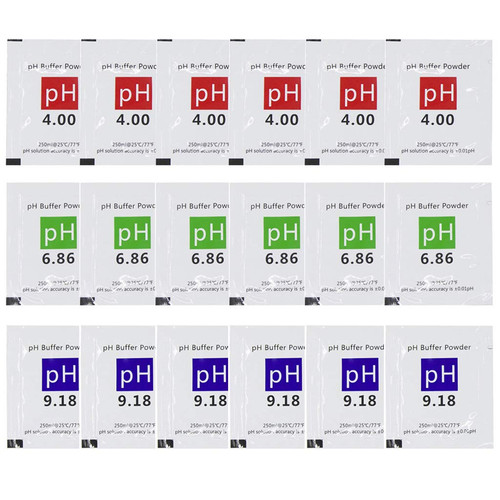 pH calibration solution (4.0 + 7.0)
A two-point calibration with 4.0 and 7.0 buffer solution is the minimum for accurate hydroponic pH work. Calibrate weekly or whenever readings seem off.
pH calibration solution (4.0 + 7.0)
A two-point calibration with 4.0 and 7.0 buffer solution is the minimum for accurate hydroponic pH work. Calibrate weekly or whenever readings seem off.
 RO filter (75–100 GPD)
A 75–100 gallon-per-day under-sink RO unit produces enough water for a small grow room. iSpring and APEC are the reliable mid-price options. Replace membrane every 2–3 years.
RO filter (75–100 GPD)
A 75–100 gallon-per-day under-sink RO unit produces enough water for a small grow room. iSpring and APEC are the reliable mid-price options. Replace membrane every 2–3 years.
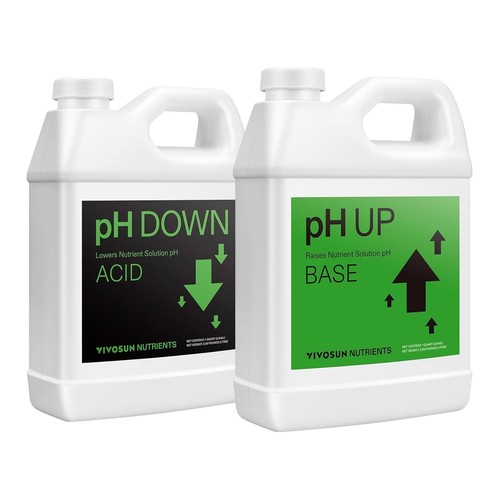 pH down (phosphoric acid)
Hard tap water requires consistent pH-down addition because bicarbonate alkalinity buffers pH upward. General Hydroponics pH Down is the standard. A quart lasts a moderate-size system several months.
pH down (phosphoric acid)
Hard tap water requires consistent pH-down addition because bicarbonate alkalinity buffers pH upward. General Hydroponics pH Down is the standard. A quart lasts a moderate-size system several months.
 CalMag supplement
Required when growing with RO or soft water — the tap water baseline that usually provides calcium and magnesium is gone. General Hydroponics CALiMAGic and Botanicare Cal-Mag Plus are the two most-used products.
CalMag supplement
Required when growing with RO or soft water — the tap water baseline that usually provides calcium and magnesium is gone. General Hydroponics CALiMAGic and Botanicare Cal-Mag Plus are the two most-used products.