Antenna SWR vs feedline loss: when a "bad" SWR is fine and a "good" one isn't
SWR alone does not tell you how much power reaches your antenna. A 2:1 SWR with five feet of coax wastes almost nothing. A 1.1:1 SWR through 100 feet of lossy coax can waste 40% of your power before the signal reaches the antenna. The number most operators obsess over is the wrong number.
What SWR actually measures
Standing Wave Ratio is a measure of impedance mismatch between your transmitter's output (usually 50 ohms) and the load it sees at the end of the transmission line. When the impedances are matched, all the power the transmitter generates travels forward through the coax and gets radiated. When they're mismatched, some fraction of that power reflects back toward the transmitter.
The SWR number expresses that mismatch as a ratio. A perfect match is 1:1. A 2:1 SWR means the antenna's impedance is either 100 ohms or 25 ohms (double or half of 50 ohms). A 3:1 SWR means 150 ohms or ~17 ohms. The mismatch causes a standing wave pattern in the feedline — voltage and current peaks and nulls at fixed points along the cable — which is where the name comes from.
What SWR does not tell you: how much power is actually being lost. That depends on the interaction between the SWR and the feedline's own loss characteristics. Understanding this distinction is what separates operators who chase perfect SWR readings from operators who actually get good signal out.
The reflected power math that changes everything
The fraction of power reflected by a mismatch is smaller than most operators assume, especially at moderate SWR values. The reflection coefficient (gamma) and reflected power percentage for common SWR values:
| SWR | Reflected power (%) | Forward power reaching antenna (%) |
|---|---|---|
| 1.1:1 | 0.2% | 99.8% |
| 1.5:1 | 4% | 96% |
| 2:1 | 11% | 89% |
| 3:1 | 25% | 75% |
| 5:1 | 44% | 56% |
| 10:1 | 67% | 33% |
At 2:1 SWR — the number at which most operators start worrying — only 11% of power reflects. That 11% doesn't disappear: in a lossless feedline, reflected power bounces back toward the antenna and gets re-radiated. The actual additional loss from a 2:1 mismatch, in a short feedline, is less than 0.5 dB. That is not detectable on the other end of a QSO.
The amateur community's fixation on SWR comes partly from early solid-state final amplifier designs that would fold back or shut down above 2:1 to protect themselves. Modern rigs handle elevated SWR gracefully. The real protection goal was the amplifier, not the antenna system's efficiency.
Why "bad" SWR can be completely acceptable
The 11% reflected power at 2:1 SWR gets re-presented to the antenna on its next forward trip down the feedline. In a short, low-loss coax run — say, 20 feet of RG-8X — that reflected power loses almost nothing on its second pass and gets another chance to radiate. The system's total efficiency might be 97–98% even with a 2:1 SWR. That is functionally identical to 1:1 for practical HF operating.
This is why end-fed half-wave antennas, off-center-fed dipoles, and many portable antennas operate at elevated SWR on some bands without meaningful performance penalty. The mismatch at the antenna feedpoint doesn't cost you much if the feedline is short and well-made. You use an antenna tuner to give your transmitter a 50-ohm load — protecting the final stage — while accepting that the actual antenna-feedline interface may have a significant mismatch that wastes very little power in practice.
Why "good" SWR can hide serious loss
This is the counterintuitive part that many operators never grasp. A high-loss feedline can absorb reflected power so aggressively that the SWR measured at the transmitter end looks excellent — even when the antenna end has a significant mismatch.
Here's the mechanism: your SWR meter is usually at the transmitter, not at the antenna feedpoint. It reads the impedance the transmitter sees. If the coax between the meter and the antenna is lossy enough, the reflected wave gets attenuated before it reaches the meter. A feedline with 6 dB of matched-line loss (which is substantial, but achievable with thin coax on 10 meters or higher) will cut reflected power to 1/4 of its original level before it reaches your meter. A severe antenna mismatch looks nearly flat at the radio end.
What the good SWR reading conceals: you're losing 75% of your transmitter power in the feedline before it gets to the antenna, and another chunk reflecting back from the mismatched antenna — only to be absorbed by the lossy coax again on the return trip. The antenna system is inefficient. The SWR meter is telling you the transmitter sees a clean load. It is not telling you how much RF is actually going into the air.
A real example that illustrates the trap
Suppose you're running 100 watts on 10 meters through 100 feet of RG-58 coax (the cheap thin coax that came with cheap equipment for decades). RG-58 has roughly 4.5 dB of loss per 100 feet on 10 meters. That means you lose more than half your power just getting it to the antenna — only about 35 watts reach the feedpoint. Now suppose your antenna has a 3:1 mismatch. 25% reflects. But of that reflected power, 65% is absorbed by the lossy coax on the return trip. The meter at your radio sees an SWR around 1.6:1 — which looks reasonable. The actual power radiated might be 25 watts. You started with 100.
If you replace that RG-58 with LMR-400 (about 1 dB of loss per 100 feet on 10 meters), the same antenna's true 3:1 mismatch shows up clearly at the radio — your meter reads something closer to 2.5:1. The system is also far more efficient: you're getting 75 watts to the feedpoint and losing a fraction to the mismatch. The "better" looking system was actually worse by 4–5 dB of real-world performance.
Feedline loss by cable type and frequency
The numbers below are approximate matched-line loss in dB per 100 feet at common HF and VHF frequencies. This is the loss you incur even when SWR is perfect — the baseline you cannot get below regardless of tuning.
| Cable | Loss/100ft at 7 MHz (40m) | Loss/100ft at 28 MHz (10m) | Loss/100ft at 144 MHz (2m) |
|---|---|---|---|
| RG-58 | ~1.1 dB | ~2.4 dB | ~5.6 dB |
| RG-8X | ~0.7 dB | ~1.5 dB | ~3.5 dB |
| RG-213 / RG-8 | ~0.5 dB | ~1.1 dB | ~2.6 dB |
| LMR-400 | ~0.25 dB | ~0.5 dB | ~1.2 dB |
| LMR-600 | ~0.16 dB | ~0.34 dB | ~0.77 dB |
At HF (40 meters and below), even RG-58 is acceptable for short runs. The loss numbers stay low enough that the feedline itself is rarely the dominant problem. On 10 meters and VHF bands, cable choice matters enormously. A 100-foot run of RG-58 on 2 meters loses 5.6 dB — that's nearly 75% of your power gone before it reaches the antenna, no matter what your SWR reads.
When to actually chase a lower SWR
SWR matters in two situations that are distinct from general efficiency concerns:
Protecting your final amplifier. Older solid-state rigs and linear amplifiers have SWR fold-back protection that reduces output power when SWR exceeds 2:1 or 3:1. If your rig is throttling itself to protect the finals, you're not running your intended power level. Tuning the antenna to reduce SWR lets your transmitter run at full output.
Long VHF/UHF feedline runs. At 2 meters and above with more than 50 feet of coax, the mismatch loss multiplied by feedline loss can become significant. A 3:1 SWR through 100 feet of poor coax on 70cm can lose more than half your power to feedline heating. On VHF and higher, both the feedline loss and the SWR loss compound in ways that matter for real-world performance.
For normal HF operating with quality coax under 100 feet, an SWR under 3:1 is acceptable in practice. Chasing 1.2:1 perfection while using marginal coax is rearranging deck chairs.
How to actually measure what's happening
The NanoVNA is a $50–80 vector network analyzer that has changed antenna work for hobbyists. Unlike a simple SWR meter at the radio, the NanoVNA connects directly to the antenna feedpoint and shows you the actual impedance at the antenna, independent of the feedline. You can see whether your antenna is resonant at the right frequency, what the true feedpoint impedance is, and whether a mismatch is in the antenna itself or introduced by feedline issues.
When you measure SWR only at the radio, you're seeing a feedline-transformed version of the antenna's impedance — and a lossy feedline distorts that picture significantly. Measuring at the feedpoint with a NanoVNA (or any antenna analyzer) tells you what the antenna is actually doing. Then you can calculate or simulate how a specific feedline length and type will transform that impedance to the radio end.
The combination of a NanoVNA at the feedpoint and a real power meter (not just an SWR meter) at the radio gives you a complete picture of where power is going. Most operators never measure actual delivered power — they measure SWR and assume it translates to efficiency. It doesn't.
The practical decision framework
Here's how to think about your feedline and SWR situation for any antenna installation:
- Short run, HF bands: SWR under 3:1 is fine. Focus on coax quality and connector weatherproofing, not chasing resonance.
- Long run (100+ feet), HF bands: Coax loss becomes more important. Upgrade to LMR-400 or equivalent before worrying about SWR beyond 3:1.
- Any VHF/UHF run: Both coax quality and SWR matter simultaneously. Minimize feedline length, use low-loss coax, and tune for low SWR. The losses compound.
- Transmitter protecting itself: Tune the antenna or use a tuner. The goal is giving the final amp a clean 50-ohm load, not maximizing radiated efficiency — those are different problems.
- Suspicious flat SWR with poor signal reports: Measure feedline loss directly. Wet coax, corroded connectors, and damaged feedline all absorb the reflected wave and hide the damage from your SWR meter.
One thing worth remembering
The best antenna system you can build is a resonant antenna with quality feedline of appropriate type for the frequency and run length. SWR will take care of itself. But when a compromise is necessary — multiband antenna not resonant on all bands, non-standard impedance feedpoint, portable operating with whatever wire is available — understanding the interaction between feedline loss and SWR tells you which compromise costs more and which is acceptable. The answer is almost always that feedline quality matters more than SWR perfection, especially on HF.
A well-made dipole at a poor height with quality feedline will outperform a perfectly-tuned antenna connected by corroded RG-58 every time. The SWR meter won't tell you that. Knowing how it works will.
Gear actually worth buying
Smart eBay searches for antenna and feedline work. Small commission on qualifying sales; your price is the same either way. Full disclosure.
 NanoVNA antenna analyzerThe $50–80 tool that replaced $300 analyzers. Connects directly to the feedpoint and shows actual impedance, not the feedline-transformed version your SWR meter sees.
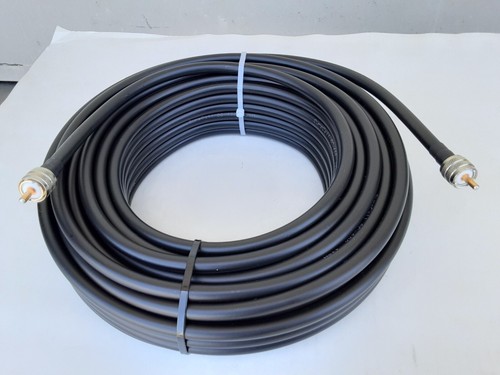 LMR-400 coax cableThe right upgrade when coax run length or frequency demands it. Half the loss of RG-213 at the same diameter. Buy with factory-terminated connectors when possible.
 SWR / wattmeter (dual)A combined SWR and forward/reflected power meter lets you read both simultaneously. MFJ and Diamond make the common inline meters. Knowing reflected wattage is more useful than SWR ratio alone.
 PL-259 connectors (quality)A corroded or poorly-installed connector will read as a feedline problem your SWR meter can't distinguish from an antenna problem. Amphenol and Amphenol-branded connectors are worth the extra dollar each.
 Antenna tuner / ATUGives the transmitter a clean 50-ohm load on multiband antennas without forcing resonance. An autotuner at the feedpoint (remote mount) minimizes feedline loss more than a shack-end tuner.