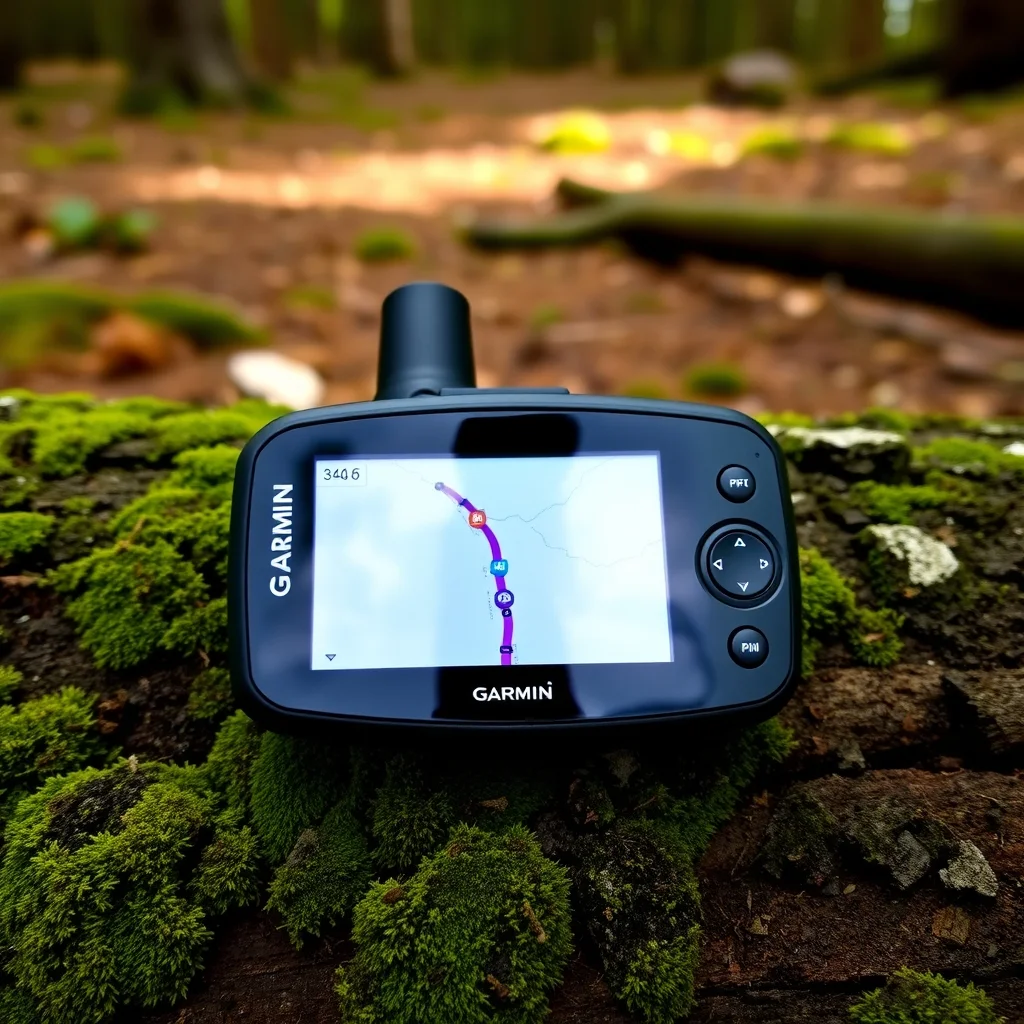
Phone vs dedicated GPS: an honest comparison
The official Geocaching app (by Groundspeak) runs on iOS and Android and gives you access to the full cache database, real-time navigation, and live hint unlock. For urban caches, suburban parks, and trail systems with decent tree cover, a modern phone's GPS chipset delivers accuracy in the 3–5 meter range under clear sky — which is more than adequate for most traditional, multi, and mystery caches.
Where phones fall short is predictable: battery life, cold and wet weather reliability, and deep canopy. A dedicated Garmin unit running on AA batteries can operate for 25+ hours continuously; a phone in active GPS navigation might last 6–8 hours and gets there faster when temperatures drop below freezing. In dense forest or deep canyon terrain, a receiver that combines GPS, GLONASS, and Galileo satellite systems will maintain a fix that a phone — with its single-frequency chipset and smaller antenna — will lose.
| Factor | Phone + App | Dedicated GPS |
|---|---|---|
| Upfront cost | Low (app free or $30/yr premium) | $100–$450 depending on model |
| Accuracy (open sky) | 3–5 m typical | 3–5 m typical (similar) |
| Accuracy (heavy canopy) | Degrades significantly | Better with multi-GNSS |
| Battery life | 6–8 hrs active GPS | 20–30 hrs (AA batteries) |
| Waterproofing | Varies; most are IPX3–IPX8 | IPX7 standard on Garmin handhelds |
| Paperless geocaching | Native in app | Supported on eTrex 32x and above |
| Offline maps | Available (requires premium or download) | Preloaded basemap; upgradeable to topo |
Understanding GPS accuracy specs
Manufacturers quote accuracy figures like "3 meters CEP" (Circular Error Probable) or "less than 10 feet with WAAS." CEP means that 90% of reported positions fall within the stated radius; the other 10% can be further. In practice, real-world geocaching accuracy is driven more by satellite geometry (the spread and count of visible satellites) and obstructions than by chipset specs.
WAAS (Wide Area Augmentation System) is a differential GPS correction signal broadcast by the FAA over North America. It brings horizontal accuracy down to around 3 meters for most receivers when the signal is available. GLONASS is the Russian constellation; supporting both GPS and GLONASS doubles the satellite pool, which improves accuracy under tree cover by giving the receiver more geometry options. Galileo (the EU system) adds further improvement; the Garmin eTrex 32x supports all three.
Multi-band GPS (L1 + L5 signals) is the next tier, now appearing in premium handhelds and high-end phones. L5 has better multipath resistance in urban canyons, but for forest geocaching the improvement over multi-constellation single-band is modest.
The Garmin lineup: which models matter
Garmin dominates the handheld GPS market for geocaching. Here's how the relevant models stack up:
eTrex 22x / 32x
The eTrex 22x is the entry point for dedicated geocaching hardware. It adds GLONASS to the basic eTrex line and supports paperless geocaching (loading full cache descriptions via GPX files from Geocaching.com). The 32x adds a 3-axis compass and barometric altimeter — useful for hiking but not strictly necessary for cache hunting. Both run on 2 AA batteries for up to 25 hours.
GPSMAP 64sx / 66sr
The GPSMAP line adds GPS + GLONASS + Galileo support, better antenna design for canopy performance, wireless sharing, and a more capable map interface. The 64sx is the practical choice for serious geocachers who want better canopy performance than the eTrex offers. The 66sr adds multi-band L1/L5 GPS for improved accuracy but costs significantly more.
Oregon 750 / 800
Touchscreen units with larger color displays, camera integration on the 750, and topo maps preloaded. Better for cache hunts combined with hiking or orienteering where map reading matters. Battery life is lower than eTrex (roughly 16 hours) due to the color display.
Battery life in the field
The AA battery format of the eTrex and GPSMAP 64 series is a practical advantage that gets overlooked. You can carry spare batteries, use lithium AAs in cold weather (alkalines lose capacity below freezing), and recharge NiMH rechargeables at home. The Oregon series and newer units use rechargeable internal batteries — more convenient for day trips but a liability on multi-day adventures without charging access.
Lithium AAs are worth noting specifically: at -20°C, alkaline batteries lose roughly 90% of capacity while lithiums retain most of theirs. If you geocache in winter or at altitude, the battery format choice matters more than chipset choice.
Preloaded maps vs downloaded topos
Entry-level Garmin units ship with a basemap — world outline, major roads, cities. For urban cache hunting this is fine. For trail navigation to a cache at a specific elevation or on a remote trailhead, you want topographic maps. Garmin sells 1:24,000 topo map subscriptions for North America; these load onto a microSD card in the device.
The free alternative: OpenStreetMap-based topo tiles are available through sites like OpenTopoMap and can be downloaded as Garmin-compatible .img files. Quality varies by region but is often excellent for North America and Europe. For most geocaching purposes, free OSM topos are fully adequate.
Cache containers: what actually keeps a log dry
The container is the geocache owner's responsibility, but understanding containers helps you know what to expect when you find one — and what to buy if you're placing your own.
The standard container hierarchy by size:
- Nano / micro: Bison tubes (aluminum screw-cap) and magnetic nano containers. Log sheet only — no swag. Bison tubes are the gold standard for micro durability; the rubber O-ring gasket holds up for years. Cheap magnetic nanos leak in rain within months.
- Small: 35mm film canisters (largely obsolete now) and Lock & Lock food storage boxes. Lock & Lock with the four-latch gasket seal is excellent waterproofing for small caches.
- Regular: Ammo cans and large Lock & Lock boxes. Military surplus ammo cans (0.30 cal and 0.50 cal) are the most waterproof regular container option — the rubber gasket on the lid is the same design used to keep rounds dry in humid conditions.
- Large: Pelican cases and purpose-built geocache containers. Overkill for most placements but nearly indestructible.
Shopping for geocaching gear? Browse current eBay listings → (we earn a small commission; your price is unchanged).
Trackables: what they are and what to carry
Trackables (Travel Bugs and Geocoins) are physical items with a unique tracking code. When you pick one up from a cache and move it to another cache, you log the move on Geocaching.com and the item's journey gets recorded. Some trackables have specific goals — "travel to a cache near the ocean" or "reach every US state."
If you want to place your own trackable, you buy a Travel Bug dog tag (the code is on the tag), attach it to a physical item, and drop it in a cache. Geocoins are collectible trackables — coins produced in limited runs with unique artwork that geocachers trade and collect. The secondary market on eBay for geocoins is active, particularly for retired designs.
Common mistakes when buying GPS hardware
- Buying an eTrex 10 specifically for geocaching. The eTrex 10 lacks paperless geocaching support and GLONASS. It's the one model to avoid in the eTrex line for this use case.
- Assuming a high accuracy spec means better real-world performance. A "2.5 meter CEP" spec is measured under ideal conditions. Under heavy canopy, all consumer receivers degrade similarly — constellation count matters more than rated accuracy.
- Ignoring the used market. Garmin handhelds hold up well; a used eTrex 32x in good condition is a solid buy and typically sells for a fraction of new price.
- Buying cheap cache containers. A nano container with a poor gasket will flood within a year. The cost difference between a quality Bison tube and a generic alternative is small; the failure rate difference is large.
The honest decision framework
Start with the phone app. Find 50 caches. If you consistently hit situations where phone battery died, the GPS drifted significantly under canopy, or you were in conditions where a phone wasn't practical (cold, wet, long multi-day route), that's your signal to buy hardware.
If you do buy: the eTrex 32x covers most geocachers well. It's compact, multi-GNSS, paperless geocaching capable, and runs on AAs. The GPSMAP 64sx is the step up for serious trail-and-cache hiking where better canopy performance and more robust build quality matter. Avoid the Oregon series unless you specifically want a touchscreen and are doing route planning alongside cache hunting.
Search eBay for geocaching gear
 Garmin eTrex
Most popular entry-point dedicated GPS for geocaching. Check for the 22x or 32x models specifically.
Garmin eTrex
Most popular entry-point dedicated GPS for geocaching. Check for the 22x or 32x models specifically.
 Waterproof Cache Containers
Bison tubes, Lock & Lock boxes, and ammo cans. Buy quality gaskets — cheap containers fail in months.
Waterproof Cache Containers
Bison tubes, Lock & Lock boxes, and ammo cans. Buy quality gaskets — cheap containers fail in months.
 Trackables & Geocoins
Travel bugs and collectible geocoins. Active secondary market for retired designs.
Trackables & Geocoins
Travel bugs and collectible geocoins. Active secondary market for retired designs.