Gardening — Composting
Compost C:N ratios: why your pile stinks, and the fix by feedstock
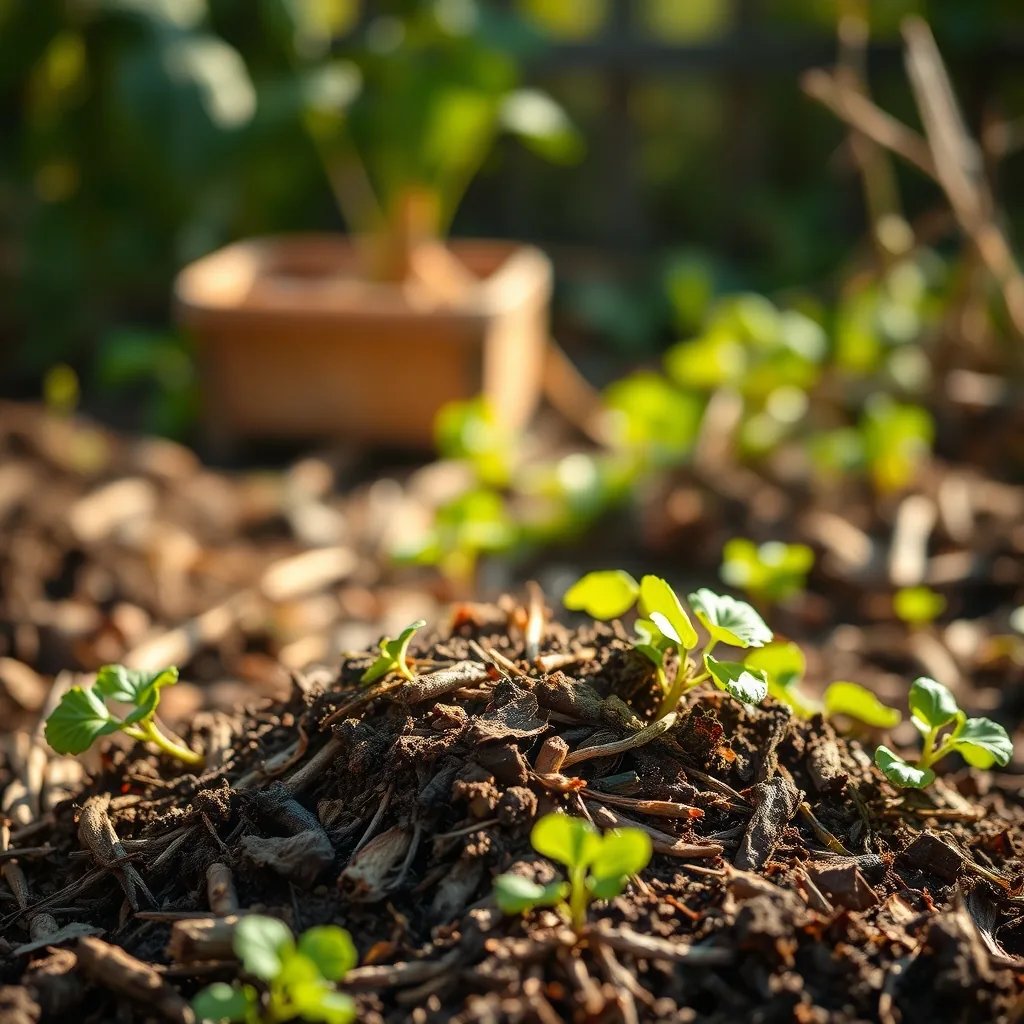
A stinky compost pile has a specific cause. Usually it's too much nitrogen — too many greens relative to browns — creating conditions where anaerobic bacteria dominate and produce ammonia and hydrogen sulfide instead of the CO₂ and water that aerobic decomposition produces. The fix is mechanical, not mysterious: adjust your feedstock ratios.
What C:N ratio actually means
Carbon-to-nitrogen ratio describes the mass of carbon relative to the mass of nitrogen in a material. Microbes need both: carbon as their energy source and nitrogen to build proteins and reproduce. The ideal ratio for active aerobic composting is roughly 25:1 to 30:1 — about 25–30 units of carbon for every 1 unit of nitrogen by mass.
When the ratio is too low (too much nitrogen, below ~15:1), you have excess nitrogen that the microbes can't use. It escapes as ammonia gas — the sharp smell. The pile may also become anaerobic as nitrogen-rich materials tend to be wet and compact, cutting off oxygen and triggering the second class of bad smells: hydrogen sulfide (rotten egg) and butyric acid (vomit-adjacent).
When the ratio is too high (too much carbon, above ~40:1), the microbes don't have enough nitrogen to reproduce. Decomposition slows to a crawl. The pile just sits there, dry and inert, not heating up. This isn't smelly — it's just slow.
The 30:1 target is a working approximation. In practice, anywhere from 20:1 to 40:1 will produce an active pile. The literature uses 30:1 as the center of the practical range.
C:N ratios of common feedstocks
Most people know that "greens" are nitrogen-rich and "browns" are carbon-rich. But the actual ratios vary enormously within each category, which is why generic advice like "add more browns" can leave you still stuck. Here's what the materials actually look like:
| Material | Approx. C:N | Category |
|---|---|---|
| Fresh grass clippings | 15–20:1 | Green (nitrogen-rich) |
| Food scraps (vegetable/fruit) | 15–20:1 | Green |
| Coffee grounds | 20:1 | Green (borderline) |
| Fresh chicken manure | 5–10:1 | Very nitrogen-hot |
| Horse manure (with bedding) | 25–30:1 | Often near ideal on its own |
| Cow manure (composted) | 20:1 | Green |
| Seaweed / kelp meal | 19:1 | Green |
| Dried leaves (autumn) | 40–80:1 | Brown (carbon-rich) |
| Straw (wheat, oat) | 80–100:1 | Brown |
| Wood chips (fresh) | 200–500:1 | Very carbon-heavy |
| Sawdust (untreated) | 300–500:1 | Very carbon-heavy |
| Cardboard (plain, no ink) | 350–500:1 | Very carbon-heavy |
| Newspaper (black ink only) | 170:1 | Carbon-heavy |
| Aged wood ash | ~400:1 (mostly mineral) | Raises pH, use sparingly |
The practical implication: you can't fix a pile of fresh grass clippings (15:1) by adding a handful of dried leaves. At 15:1 base, you need roughly twice as much leaf material by carbon mass to hit 30:1. In volume terms (since leaves are much less dense), that's a substantial pile of leaves.
Why the pile smells: diagnosis by smell type
Ammonia smell (sharp, eye-watering)
Classic nitrogen-overload. Too many greens, not enough browns. Common culprits: a pile that's mostly grass clippings, a batch of kitchen scraps added without enough carbon material, or fresh manure without bedding material. The microbes are working fine — aerobically, even — but the excess nitrogen is volatilizing as ammonia instead of being incorporated.
Fix: Add carbon material. Dried leaves are the most available high-carbon material for most gardeners. Add by volume until the ratio looks more even, then turn the pile to incorporate. For a pure-grass-clippings pile, you typically need an equal or greater volume of dried leaves to balance it.
Rotten egg smell (hydrogen sulfide)
Anaerobic conditions. The pile is wet, compacted, or both, and oxygen has been excluded. Anaerobic bacteria produce hydrogen sulfide and butyric acid as byproducts. This can happen independently of the C:N ratio — a well-balanced pile that gets too wet and compact will go anaerobic.
Fix: Turn the pile to reintroduce oxygen. Add coarse carbon material (wood chips, straw, shredded cardboard) that creates air pockets. If the pile is wet, add dry browns and turn. This smell usually clears within a day or two of turning if oxygenation was the only issue.
No smell but no heat, no decomposition
Not a problem with smell, but it means the pile isn't working. Usually too dry, too carbon-heavy, or too small to retain heat. The pile needs to reach internal temperatures of 130–160°F to decompose actively. Below a cubic yard in volume, most piles won't hold heat.
Fix: Add water (a wrung-out sponge is the right moisture reference — damp but not dripping). Add nitrogen materials if the pile is mostly browns. Turn to add oxygen. If the pile is under-mass, consolidate.
Practical ratio math
You don't need a spreadsheet for this, but the rough math is useful to internalize. The target is 30:1 by carbon and nitrogen mass — not by volume. Since greens are typically much denser and wetter than browns, the volume ratios you actually use are skewed toward more brown material than you'd expect.
A rough working rule: by volume, most active compost piles run at roughly 3–4 parts browns to 1 part greens. That's for typical materials. If your greens are very nitrogen-hot (fresh chicken manure, pure grass clippings) or your browns are very carbon-heavy (fresh wood chips, sawdust), adjust accordingly.
The easiest system for backyard composters: maintain a pile of dried leaves, straw, or shredded cardboard next to your active pile. Every time you add kitchen scraps or grass clippings, add an equal or greater volume of the brown material on top, then turn or fork the top layer to integrate.
Feedstock-specific fixes
Grass clippings (most common problem feedstock)
Fresh grass clippings are simultaneously very nitrogen-rich (15–20:1), very wet, and prone to matting into an anaerobic layer. Piling them in bulk is one of the fastest ways to create a smelly, slimy compost problem.
Fix: never add more than 2–3 inches of grass clippings in a layer without alternating with a thick layer (4–6 inches) of dry leaves or straw. Better yet, let clippings dry on the lawn for a day before collecting — they lose much of their moisture weight and are easier to mix in without compacting.
If you have a surplus of clippings and insufficient browns, spread clippings as a thin mulch layer around plants rather than adding them all to the pile. They decompose quickly in a thin layer and add nitrogen to the soil surface without the management burden.
Kitchen scraps
Vegetable and fruit scraps run ~15–20:1. Coffee grounds are often cited as acidic, but this is mostly a myth — fresh grounds are mildly acidic (pH ~6.5) and the brewing process removes most acid. Used grounds are close to pH neutral and are a good nitrogen source. Add them in moderation (no more than 20% of your pile by volume) because like grass clippings, they can mat if overloaded.
Meat, dairy, and cooked food with oils are not recommended for open backyard piles — not because they're inherently harmful to the pile, but because they attract rodents and produce more persistent odors than plant-based materials.
Chicken and other poultry manure
Chicken manure is extremely nitrogen-hot (5–10:1 or lower). Used directly, it will cause ammonia volatilization and can burn plants. It needs to be either hot-composted (turns the nitrogen into stable organic forms) or heavily diluted with high-carbon material. A ratio of 1 part chicken manure to 5–8 parts straw or wood chip bedding by volume is a workable starting point.
If your chickens are on bedded litter, the bedding (straw, wood shavings) is already doing some of this work. Bedded litter with a C:N approaching 30:1 can go directly into a compost pile with little adjustment.
Wood chips and sawdust
Wood chips are excellent for creating aeration structure in a pile, but their C:N ratios (200–500:1 for fresh chips) are so extreme that they will tie up nitrogen in the pile temporarily as microbes try to process them. Partially aged or composted wood chips (chipper output left in a pile for 6–12 months) is a much easier material to work with — the ratio drops significantly as it weathers.
Fresh sawdust from untreated wood can be added in small amounts. Sawdust from pressure-treated lumber should not be composted — it may contain copper-based preservatives that don't break down and can accumulate in soil to phytotoxic levels.
Pile size and turning frequency
Ratio is one variable. Pile mechanics are another. An active aerobic pile needs to be at least 3 feet × 3 feet × 3 feet (roughly a cubic yard) to generate and retain the heat needed for rapid decomposition. Smaller piles lose heat too quickly. If you're in a cold climate, larger is better during winter — the interior of a 4-foot pile can remain active at ambient temperatures well below freezing.
Turning frequency: a pile turned every 5–7 days will decompose to finished compost in 4–8 weeks under good conditions (proper ratio, proper moisture, adequate mass). A pile turned monthly takes 3–6 months. A pile never turned may take 12–18 months or more, and the product is often uneven. For backyard use without the time for frequent turning, a 3-bin system — where material moves from bin 1 (active additions) to bin 2 (aging) to bin 3 (finished) — is a practical structure.
The finished product check
Finished compost smells like dark earth — not like any specific feedstock, not like ammonia, not rotten. It should be dark brown to black, crumbly, and relatively uniform. You should not be able to identify individual materials (if you can still see identifiable grass blades or vegetable pieces, it needs more time). The temperature in the pile's center should be close to ambient — an active, hot pile is not finished.
Partially finished compost is fine to use as a mulch on top of soil where it will continue to decompose in place. It should not be incorporated into a seed-starting mix or used in close contact with plant roots — the active decomposition can temporarily tie up nitrogen and produce compounds that inhibit germination.
Gear relevant to this article
Smart eBay searches for composting equipment discussed above. We earn a small commission on qualifying purchases; your price doesn't change. Full disclosure.
 Open compost bin (large volume)A 3-foot bin or larger is the minimum for heat retention. Wire mesh bins, wood pallet bins, and stackable plastic bins all work — the material matters less than the volume.
 Compost thermometer (long probe)A 20-inch probe lets you read internal pile temperature without disturbing it. Target 130–160°F for active decomposition. Remin and Kompostana are reliable.
 Compost turning fork or aeratorA 4-tine pitchfork handles most turning jobs. Corkscrew-style aerators work for smaller bins where turning in place is the only option.
 Straw bale (high-carbon brown)Wheat straw (80–100:1 C:N) is the most available high-carbon material for balancing nitrogen-heavy piles. One bale goes a long way. Avoid hay — it introduces weed seeds.
 Worm castings (finished, dense)Vermicompost (worm castings) is the highest-density finished compost available. Use as a seed-starting amendment or top-dress at 10–20% mix rate. Expensive per pound — worth it for containers and starts.