Lumens vs candela vs throw: when 1,000 lumens is worse than 400 for what you actually need
Flashlight marketing lives and dies by lumens. The number is real — it measures something — but it's the least useful spec for most real use cases. Candela and throw tell you what you actually want to know, and once you understand what all three measure, you'll stop comparing lights on the wrong axis.
What the three numbers actually measure
Lumens is a measure of total light output — the total amount of light emitted in all directions from the source. A 1,000-lumen light puts out twice as much total light as a 500-lumen light. If you were inside a perfect reflective sphere, lumens would be exactly what you'd care about. Outside in the dark, pointing a flashlight at something you need to see, lumens is only part of the picture.
Candela is a measure of luminous intensity — the concentration of light in a specific direction. It's the same total lumen output, but shaped by the reflector and lens into a beam. A light with a tight reflector that focuses all its output into a narrow column will have a very high candela rating even if its total lumens is moderate. A light that floods the area with diffuse, wide-angle light will have a lower candela number despite potentially higher total lumens.
Throw is the practical outcome of candela. Measured in meters, it's defined by ANSI as the distance at which the beam produces at least 0.25 lux at the target — roughly the amount of light from a full moon. Throw is calculated directly from candela: throw (in meters) equals the square root of (candela × 4). A light with 10,000 candela throws to about 200 meters. A light with 40,000 candela throws to 400 meters.
The flooder vs thrower spectrum
Every flashlight sits somewhere on a spectrum from pure flooder to pure thrower. The reflector diameter and depth, the LED die size, and the lens design all determine where a given light lands.
A flooder uses a shallow reflector or a wide-angle TIR lens to spread light evenly over a wide area. You get high lumens, low candela, and short throw. These are excellent for close-range work: reading, camp tasks, illuminating a tent interior, working under a car hood. The wide beam means you can see everything in front of you at close range without hot spots. The trade-off: nothing past 20–30 meters is usefully lit.
A thrower uses a deep, smooth reflector (or a tight-beam TIR) and a small LED die to concentrate light into a tight, intense column. You get moderate lumens, very high candela, and long throw. These are excellent for searching across a field, spotlighting game at distance, scanning a trail ahead at 100+ meters. The trade-off: the beam is narrow, so close-up the hot spot blinds you to everything else around it, and the spill is weak.
Most practical EDC and utility lights are a compromise: a reflector that gives a usable hotspot for mid-range work with enough spill to illuminate nearby surroundings.
The use-case matrix
Finding your footing on a dark trail
You need throw here — not extreme throw, but enough to see 20–40 meters ahead so you don't walk into something. A flooder aimed at your feet doesn't help you see what's coming. A light in the 15,000–30,000 candela range with a useful hotspot is the right tool. Total lumens is almost irrelevant; 400 lumens with good throw is better than 1,000 lumens of pure flood.
Working in a garage or under a hood
This is a flooder use case. You need even, shadow-free illumination of a small space. A thrower creates a blinding hotspot exactly where you're looking and leaves the edges dark. A high-lumen flooder or work light — or a headlamp with a wide flood beam — is what you want. Here, lumens matters more than candela.
Searching for something at 50–100 meters
A lost dog in a field, a sound in the tree line, a trail junction you can't see clearly — this is where throw and candela are everything. You need a light that can deliver 10+ lux at 50 meters, which requires around 10,000 candela minimum. Many popular "1,000 lumen EDC lights" produce only 5,000–8,000 candela because their reflectors are tuned for close-range use. A light marketed as 400 lumens with a deep reflector and small die can easily produce 25,000+ candela and throw to 300 meters.
Everyday carry in a pocket
EDC is mostly close-range: navigating a dark room, checking under a car, reading a sign. A balanced light with a decent hotspot and good spill handles this. The candela number matters less here than runtime on a practical mode and the UI (can you access a useful low mode without cycling through turbo?). The 150–500 lumen range with a general-purpose beam covers almost all EDC tasks.
Search and rescue or emergency preparedness
This is the scenario where you genuinely need both. A dedicated search light with high candela for distance work, plus a headlamp with good flood for close-range task work. Single-light solutions usually compromise both and are ideal for neither. If you're buying one flashlight for genuine emergency preparedness, prioritize a versatile beam profile over raw lumens.
Why "turbo mode" lumens are often misleading
Manufacturers rate lumens at turbo — the maximum output mode that most lights can only sustain for 30–90 seconds before thermal protection steps the output down. After the stepdown, a "1,000 lumen" light may be putting out 300–400 lumens for the remainder of its runtime.
More useful numbers to look for: the output at the sustained "high" mode (what the light actually runs at after the initial stepdown) and the runtime at that level. A light rated "1,000 lumens / 30 seconds, 400 lumens / 90 minutes" is a fundamentally different object from a light that sustains 1,000 lumens for 2 hours — but both will be advertised as "1,000 lumen flashlights."
Brands that publish ANSI FL1 standardized output data (including the 30-second, 2-minute, and runtime measurements) are giving you real information. Spec sheets that only list the peak turbo number are hiding something.
How LED emitter type shapes all three numbers
The LED die itself matters as much as the reflector. The two broad categories you'll encounter:
- Smaller, high-intensity dies (like the Luminus SFT-40, SST-40, or older Cree XP-L HI) have a smaller emitting surface area, which makes them easier to focus into a tight beam. These are thrower emitters — relatively modest total lumens but excellent candela.
- Larger, high-output dies (like the Cree XHP-70 or Luminus SBT-90) put out enormous total lumens but the large die is harder to focus. These are flooder emitters — impressive lumens numbers, lower candela for the lumen output.
This is why a 2,000-lumen floodlight and a 2,000-lumen thrower are completely different purchases even when the spec sheet shows the same headline number.
The battery equation that changes throw in practice
High-candela, high-throw lights typically need more power to drive the emitter at the intensity required. This has two practical consequences: they usually require 18650 or larger cells (more energy density than AA or AAA), and their turbo modes are hard on batteries and runtimes.
The 18650 platform is the practical sweet spot for any light you want to use regularly at meaningful outputs. An 18650 cell holds 3–4x the energy of an AA alkaline at much lower internal resistance, meaning the battery can actually supply the current a high-output light demands. AA-powered lights physically cannot deliver 1,000 sustained lumens; the cell simply can't supply the current. When you see a "1,000 lumen" AA light, it's hitting that number for about 30 seconds on fresh lithium batteries.
What to actually look for when buying
Start with your use case rather than the lumen number. If you're buying for close-range tasks (under 15 meters), look for a wide flood beam angle (90°+ or TIR optic labeled "flood") and a good low mode. The lumen count doesn't matter much above 300–400 for this range.
If you're buying for mixed indoor/outdoor use and want a general-purpose light, look for a stated candela or throw number. A light with 15,000–25,000 candela handles most practical outdoor distances (15–300 meters) while still being useful at close range. Check that there's a reliable low mode (5–30 lumens) for close-range work without blinding yourself.
If you specifically need long-range search capability, look for lights explicitly described as "throwers" with stated candela above 50,000. These trade spill and close-range usability for reach. They're specialized tools, not general-purpose EDC lights.
The honest version of the buying decision: most people who think they need 1,000+ lumens actually need 200–400 lumens and a better beam profile. The light you'll actually use regularly is the one that fits your pocket, has a UI you can navigate in the dark, and turns on at a useful low mode rather than defaulting to blinding turbo.
Visit the flashlights tools and calculators for the lumens vs throw calculator and battery cost comparison.
Gear actually worth buying
Smart eBay searches we'd start with ourselves. We earn a small commission on qualifying sales through these links; the price you pay is the same. Full disclosure.
 Balanced EDC thrower (Fenix PD36R class)The PD36R is one of the most honest all-around 18650 lights: real sustained output, a useful low mode, and USB-C charging. Good candela for its class without sacrificing spill.
High-lumen flooder (Emisar D4 class)Quad-emitter flooder for maximum close-range output. 4,000+ lumen burst for when you need to light up a full space. Niche but correct for garages and search-in-close work.
Balanced EDC thrower (Fenix PD36R class)The PD36R is one of the most honest all-around 18650 lights: real sustained output, a useful low mode, and USB-C charging. Good candela for its class without sacrificing spill.
High-lumen flooder (Emisar D4 class)Quad-emitter flooder for maximum close-range output. 4,000+ lumen burst for when you need to light up a full space. Niche but correct for garages and search-in-close work.
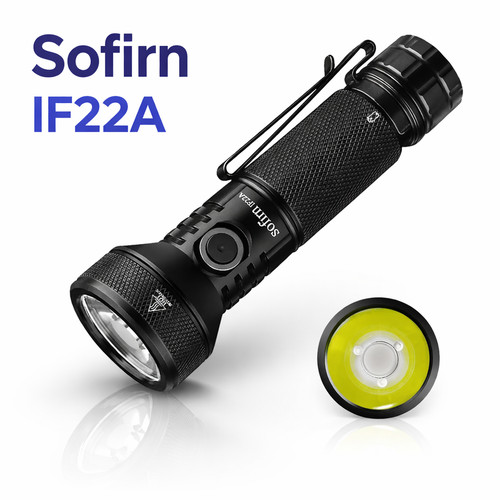 Long-throw spotlight (Sofirn C8G class)A dedicated thrower with high candela and narrow beam. Reaches 300+ meters. Not for close-range use — this is the right tool specifically when you need to see far.
Quality 18650 cells (Samsung 30Q / Molicel)The battery matters as much as the light. Samsung 30Q, Sony VTC5A, and Molicel P26A are the high-drain cells that let a good light actually perform. Avoid unbranded rewraps.
Long-throw spotlight (Sofirn C8G class)A dedicated thrower with high candela and narrow beam. Reaches 300+ meters. Not for close-range use — this is the right tool specifically when you need to see far.
Quality 18650 cells (Samsung 30Q / Molicel)The battery matters as much as the light. Samsung 30Q, Sony VTC5A, and Molicel P26A are the high-drain cells that let a good light actually perform. Avoid unbranded rewraps.
 Four-slot 18650 charger (Nitecore UM4)Individual bay monitoring catches a bad cell before it damages others. The UM4 handles 18650, 21700, and AA/AAA chemistry in one unit — the one charger worth owning.