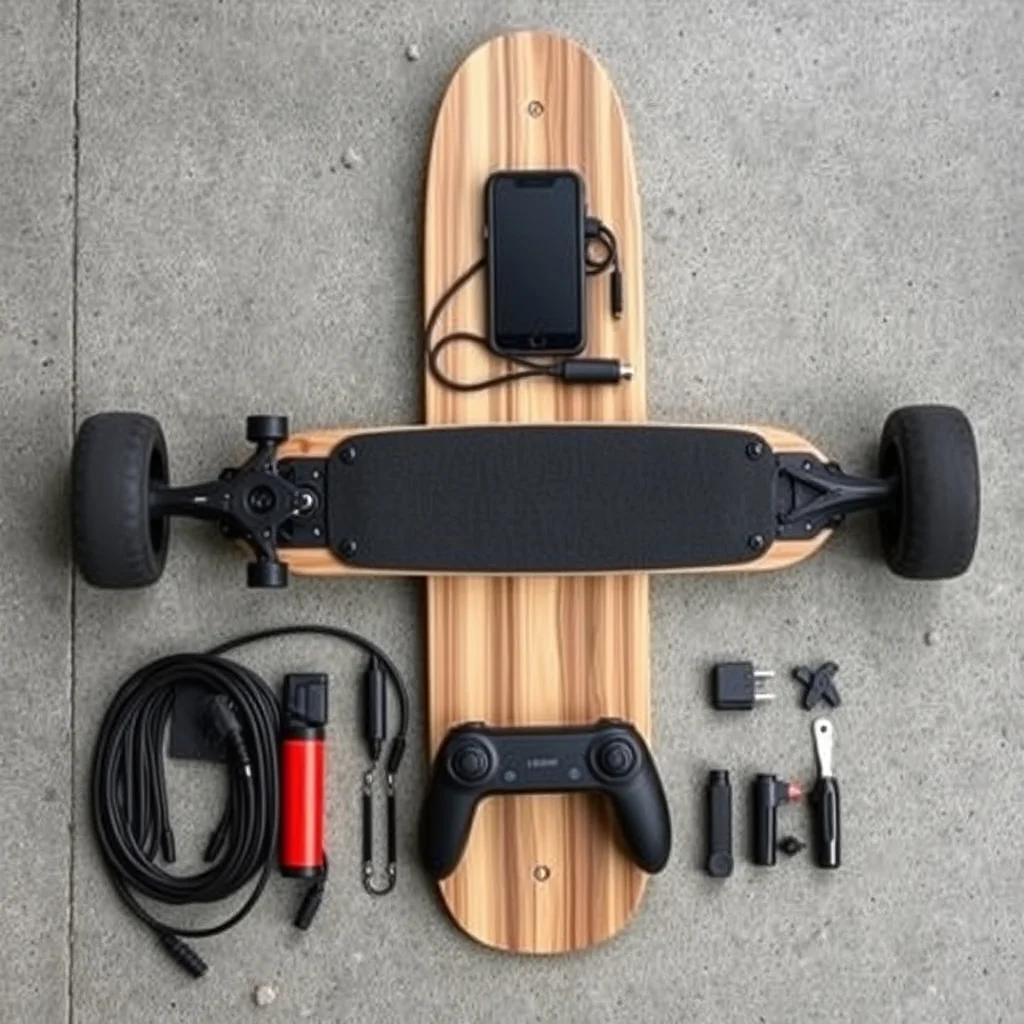
Hub motors vs belt drive: the fundamental choice
The motor system is the biggest decision in electric skateboard selection and shapes everything else: ride feel, wheel options, maintenance, heat management, and ultimately the board's longevity.
Hub motors
Hub motors are integrated directly into the wheel. The motor is the hub. This means there are no external gears, belts, or pulleys. Advantages: quieter ride, lower rolling resistance when the board is off (you can kick-push a hub drive without excessive drag), simpler drivetrain, and a cleaner look. Disadvantages: wheels can only be swapped for hub-compatible options (the urethane sleeve goes around the motor can), motors run hotter because the heat source is inside the wheel with limited airflow, and hub motors typically produce less torque per watt than belt drives.
Belt drive
External motors drive the wheel via a toothed belt and gear ratio system. The pulleys and belts are exposed under the board. Advantages: more torque (especially on hills), ability to run almost any longboard wheel, better motor cooling (motor sits in airflow, separate from the wheel), and a tunable gear ratio. Disadvantages: louder, belt wear requires periodic replacement (belts are inexpensive but need attention), and rolling resistance when unpowered is higher.
| Factor | Hub Motor | Belt Drive |
|---|---|---|
| Noise level | Quiet | Moderate (belt whine) |
| Torque on hills | Moderate | Higher |
| Wheel options | Hub-compatible only | Most longboard wheels |
| Motor heat | Higher (enclosed in wheel) | Lower (open airflow) |
| Rolling when off | Low resistance | Higher resistance |
| Maintenance | Minimal | Belt replacement periodically |
A third option — direct drive — sits between the two: external motors without a belt, coupling directly to the wheel axle through the motor. Less common, but increasingly found on premium boards like the Trampa Hypa and some Enertion Raptor derivatives.
Reading range specs honestly
Range is where electric skateboard marketing is most misleading. Rated range is measured under controlled conditions: light rider (typically 150–165 lbs), flat terrain, constant moderate speed (around 12–15 mph), and a new battery. Divide that number in half and you have a conservative real-world estimate for a 180-lb rider with some hills at 18–20 mph.
The honest spec to compare between boards is battery capacity in watt-hours (Wh). A 10S4P battery pack (10 cells in series, 4 in parallel) at 216 Wh is comparable to any other board with 216 Wh regardless of what range the manufacturer claims. For commuting up to 10 miles round trip, a 150–200 Wh pack is typically sufficient. For longer rides or heavier riders on hilly terrain, 250 Wh+ is more appropriate.
Deck flex, length, and concave
The deck determines how the board feels underfoot. Electric skateboard decks are typically bamboo, maple, carbon fiber, or composites of these materials.
Deck length
Longer decks (38–46 inches) are more stable at speed and more comfortable for longer rides. Shorter decks (28–34 inches) are more maneuverable in urban environments and easier to carry. Most commuter-focused electric skateboards lean toward the 38–42 inch range. DIY and performance boards often use longer platforms.
Flex
A flexible deck absorbs vibration and provides a more comfortable ride on rough pavement. The tradeoff: flex creates energy loss under acceleration (the deck stores and releases energy rather than transmitting it immediately to the trucks). Stiffer decks are more efficient and responsive; softer decks are more comfortable. Most production electric skateboards use a medium-flex bamboo or maple/bamboo composite as a compromise.
Concave
Concave (the upward curvature across the width of the deck) affects how locked-in your feet feel. More concave gives better foot retention during carving and braking; flatter decks feel more platform-like and are easier to reposition your feet during long commutes.
Shopping for an electric skateboard? Browse current eBay listings → (we earn a small commission; your price is unchanged).
Wheels: diameter and durometer
Wheel diameter is measured in millimeters. Larger diameter wheels (90–107 mm) roll over pavement cracks, pebbles, and road debris more easily and feel smoother at speed. Smaller wheels (70–83 mm) are more responsive and give more ground clearance for the trucks, but catch cracks more easily.
Durometer measures wheel hardness on the A scale (lower = softer). For electric skateboards on typical urban pavement, wheels in the 75–85A range offer a good balance of grip and roll speed. Very soft wheels (65–74A) grip well and absorb vibration but roll slower; harder wheels (86A+) feel fast on smooth surfaces but buzz over rough pavement.
For belt drive boards: the urethane wheel is separate from the motor, so you can experiment with wheel diameter and durometer freely. For hub motors: the motor can is inside the wheel, and the urethane sleeve that wraps it is thinner than a standard longboard wheel. This means hub motor wheels are inherently harsher-riding than belt drive wheels of the same nominal size — the thinner urethane provides less cushioning.
Pneumatic wheels
Some high-end and off-road electric skateboards (Trampa, Evolve GTR All-Terrain, Lacroix) use pneumatic (air-filled) tires similar to go-kart tires. These provide dramatically better terrain handling and a cushioned ride, but at the cost of extra weight and more maintenance (flats are possible). Board clearance is also significantly higher, which affects how the board handles at speed.
The remote: what actually matters
The remote is your only point of control over a board that's carrying you at speed. A poorly designed remote is a safety problem, not just an inconvenience.
Key features to evaluate: a dead-man switch (the board cuts power or slows if you drop or release the remote — not universal, but strongly preferred); clear battery indication for both the board and the remote itself; ergonomics for single-hand operation with a gloved hand in the dark; and reliable connectivity (Bluetooth remotes can have pairing dropouts under some radio conditions; 2.4 GHz ARCA-sport protocol remotes are more consistent).
Trigger-style remotes (like a gun trigger) give precise throttle control and are popular with experienced riders. Thumb-wheel remotes are easier for beginners. The Hoyt Puck and VX4 Pro are popular aftermarket remotes in the DIY community for their quality and reliability.
Common buying mistakes
The most expensive mistake: buying based on top speed rather than the full spec picture. A board rated for 30 mph on flat ground may be underpowered on hills, have an undersized battery, or use inferior cells that degrade quickly. Top speed is easy to market; sustained performance up a 10% grade is a better stress test.
Second: ignoring waterproofing ratings. Most electric skateboards are not truly waterproof — they're splash resistant at best. Riding in wet conditions without knowing your board's IP rating can damage the ESC or battery. Boards with IP65 or better enclosures are meaningful upgrades for urban commuters who can't always avoid wet roads.
Third: buying a board from a brand with poor customer support or discontinued parts. When a board's ESC or battery fails in two years, you need to either get parts from the manufacturer or have access to a compatible aftermarket. Brands like Boosted (now defunct), Zero (defunct), and others have left riders with expensive bricks. Prioritize brands with active communities and documented repair resources.
Electric skateboard gear on eBay
We earn a small commission on qualifying sales; your price is unchanged. Full disclosure.
 Electric Skateboard
Check motor type and battery Wh.
View on eBay →
Electric Longboard
Longer platform; better stability.
View on eBay →
Belt Motor Kit
More torque, any wheels.
View on eBay →
Electric Skateboard
Check motor type and battery Wh.
View on eBay →
Electric Longboard
Longer platform; better stability.
View on eBay →
Belt Motor Kit
More torque, any wheels.
View on eBay →
 Remote Control
Verify ESC compatibility.
View on eBay →
Remote Control
Verify ESC compatibility.
View on eBay →
 Replacement Wheels
Urethane or pneumatic; check motor type first.
View on eBay →
Replacement Wheels
Urethane or pneumatic; check motor type first.
View on eBay →