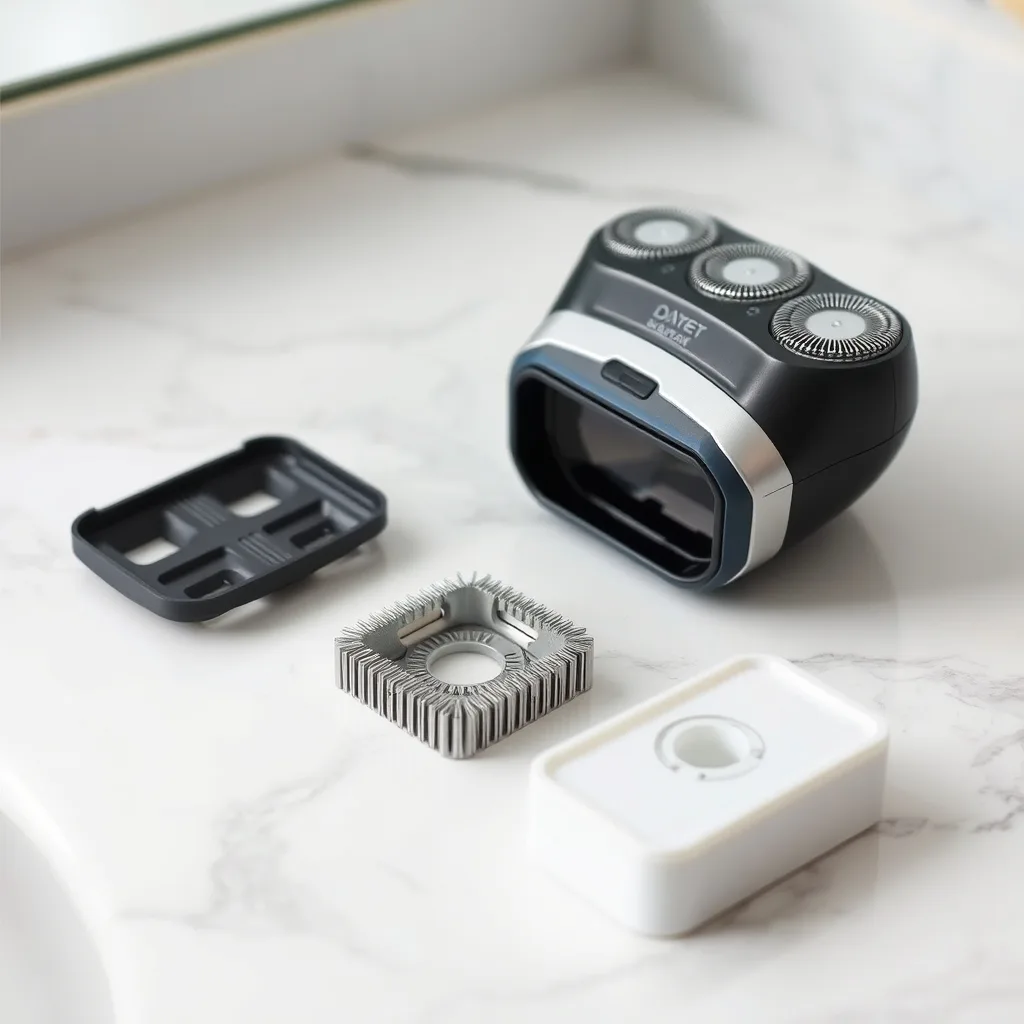
Foil vs rotary: the foundational choice
The most important decision when buying an electric shaver is head type. Everything else — battery, wet/dry, cleaning system — is secondary. Getting the head type wrong means returns, or living with a shave that never feels quite right.
Foil shavers use a thin, perforated metal screen stretched across a cutting block. As the shaver passes across skin, hair enters through the holes and a reciprocating cutter slices it flush with the foil surface. The motion is typically side-to-side. Foil shavers deliver a close, flat shave — they excel on straight jawlines, upper lips, and anyone who shaves daily or every other day. Because the cutting geometry is consistent, they're also generally gentler on sensitive skin.
Rotary shavers use three (occasionally four) independent spinning heads arranged in a triangular or arc pattern. Each head pivots independently, allowing the shaving head to flex and follow facial contours. The recommended shaving motion is circular. Rotary shavers handle longer stubble more tolerantly and adapt better to pronounced jawlines, cheekbones, and chin clefts. They're typically slower to produce an edge-sharp line but require less technique on contouring.
| Feature | Foil shaver | Rotary shaver |
|---|---|---|
| Best for | Flat faces, daily shavers, sensitive skin | Contoured faces, longer stubble, flexible users |
| Shaving motion | Up-down or side-to-side | Circular |
| Stubble handling | Best with 1–3 days' growth | Tolerates 4–5 days better |
| Line definition | Sharper edges | Less precise at borders |
| Cleaning effort | Moderate — foil lifts off for rinse | Moderate — heads detach for rinse |
| Noise level | Higher (reciprocating motor) | Lower (spinning heads) |
What wet/dry actually means
A "wet/dry" electric shaver carries an IPX waterproofing rating — almost always IPX5 or IPX7. IPX5 means the unit can withstand water jets; IPX7 means it can be submerged up to 1 metre for 30 minutes. In practical terms, both ratings allow safe use in the shower and rinsing under a running tap.
The benefit of wet/dry is the ability to shave with foam, gel, or oil. Many people find foam reduces irritation, particularly on sensitive skin, and the lubrication can improve the closeness of cut. If you already use foam with a cartridge razor and want to keep that routine, a wet/dry shaver is the direct equivalent.
The cost is real: wet/dry capability typically adds meaningfully to the price compared to a dry-only model at equivalent motor quality. If you shave dry and have no irritation issues, the waterproofing buys you convenience in the shower but not necessarily a better shave. If you have reactive skin or prefer a foam-assisted shave, it's worth the premium.
Battery and charging: the specs that matter
Electric shaver battery specs are quoted in two ways: charge time and runtime. Runtime is the useful number. A typical mid-range shaver delivers 45–60 minutes of runtime per full charge, which equals roughly 15–20 shaves for a daily user. High-end models often claim 60–90 minutes.
Charge time varies by charging method:
- Full charge (standard): typically 1–2 hours via the supplied stand or cable
- Quick charge: many models offer a 5-minute quick charge that delivers one shave — useful if you've forgotten to charge
- Travel lock: a separate feature from charging, but worth checking — prevents accidental activation in luggage
Li-ion batteries (now universal at mid and upper price points) hold calibration better than older NiMH batteries. One tip: avoid running the battery completely flat repeatedly, as it modestly degrades cell lifespan over years of use.
Shopping for electric shavers? Browse current eBay listings → (we earn a small commission; your price is unchanged).
Cleaning stations: worth it or not?
Cleaning stations (Braun's Clean & Charge, Philips SmartClean, and equivalents) automatically clean, lubricate, dry, and charge the shaver head in one dock cycle. They're a genuine convenience: the head stays lubricated, which extends blade life and maintains shave quality over months of use.
The practical cost is the cleaning cartridge, which the station consumes on each cleaning cycle. Cartridges typically cover 30–60 cleanings and are a recurring consumable expense. Some users run one cartridge cycle weekly and rinse manually on other days — a reasonable middle ground.
If you're buying for travel or minimalism, a station is bulk you don't want. If you shave daily and want to remove maintenance friction entirely, the station pays for itself in blade longevity and consistency.
Motor quality: what the spec sheet doesn't say
Electric shaver motors are rated by their cutting speed (measured in strokes per minute for foil; RPM for rotary). Higher speeds generally produce a closer cut in a single pass and reduce the need for repeated strokes. Premium foil shavers typically run at 70,000–80,000 strokes per minute across all cutting elements.
What specs don't capture is motor consistency under load. Entry-level motors slow noticeably on thicker stubble, which increases irritation through repeated passes. This is the real performance gap between budget and mid-range models — not listed on the box.
Blade and foil replacement
Foils and cutting blocks wear and should be replaced periodically — most manufacturers recommend every 12–18 months for daily users. Replacement foil and blade sets are a real ongoing cost and vary significantly by brand and model. Check replacement part availability and price before committing to a model: some brands make parts easily available and priced reasonably; others effectively obsolete older models.
Rotary heads are replaced similarly, typically as a set of three cutting rings plus the comb. Replacement frequency and cost are roughly comparable to foil models at the same market tier.
Price tiers and what they actually buy
Electric shaver pricing spans a wide range. Broadly:
- Entry tier (under approximately $50–60): basic foil or rotary, dry only, fixed-speed motor, basic cleaning. Gets the job done for occasional use or coarse-stubble types who aren't sensitive.
- Mid tier (approximately $60–130): wet/dry waterproofing common, improved motor consistency, quick-charge, pop-up trimmer for sideburns. The practical sweet spot for most daily users.
- Upper tier (approximately $130–250+): multi-direction flexing heads, pressure sensors, advanced foil geometry, cleaning station bundles, premium build materials. Marginal improvement over mid-tier for most users; meaningful for sensitive skin or very high shave frequency.
Common mistakes when buying
- Choosing head type by brand rather than face geometry. Brand loyalty matters less than matching foil vs rotary to your actual shaving pattern and face shape.
- Ignoring the adaptation period. Skin acclimates to electric shaving over roughly 2–3 weeks. A new shaver may feel inferior to a cartridge razor initially — this typically resolves.
- Buying a cleaning station without checking cartridge cost. Cartridges are brand-specific and not interchangeable. Verify ongoing cost before committing.
- Assuming wet/dry means waterproof charging. The shaver body is waterproof; the charging cable and station are not. Don't charge in the shower.
- Skipping replacement part availability check. A shaver with discontinued foils is a dead-end purchase after 18 months.
Related searches on eBay
 Foil electric shavers
Side-to-side cutting, flat-face geometry, daily shavers
Rotary electric shavers
Three-head flex, contoured faces, longer stubble
 Wet/dry shavers
IPX5–IPX7 waterproof, foam and gel compatible
 Electric razors for men
Browse both head types across price tiers
 Shavers with cleaning station
Auto-clean, lubricate, and charge dock