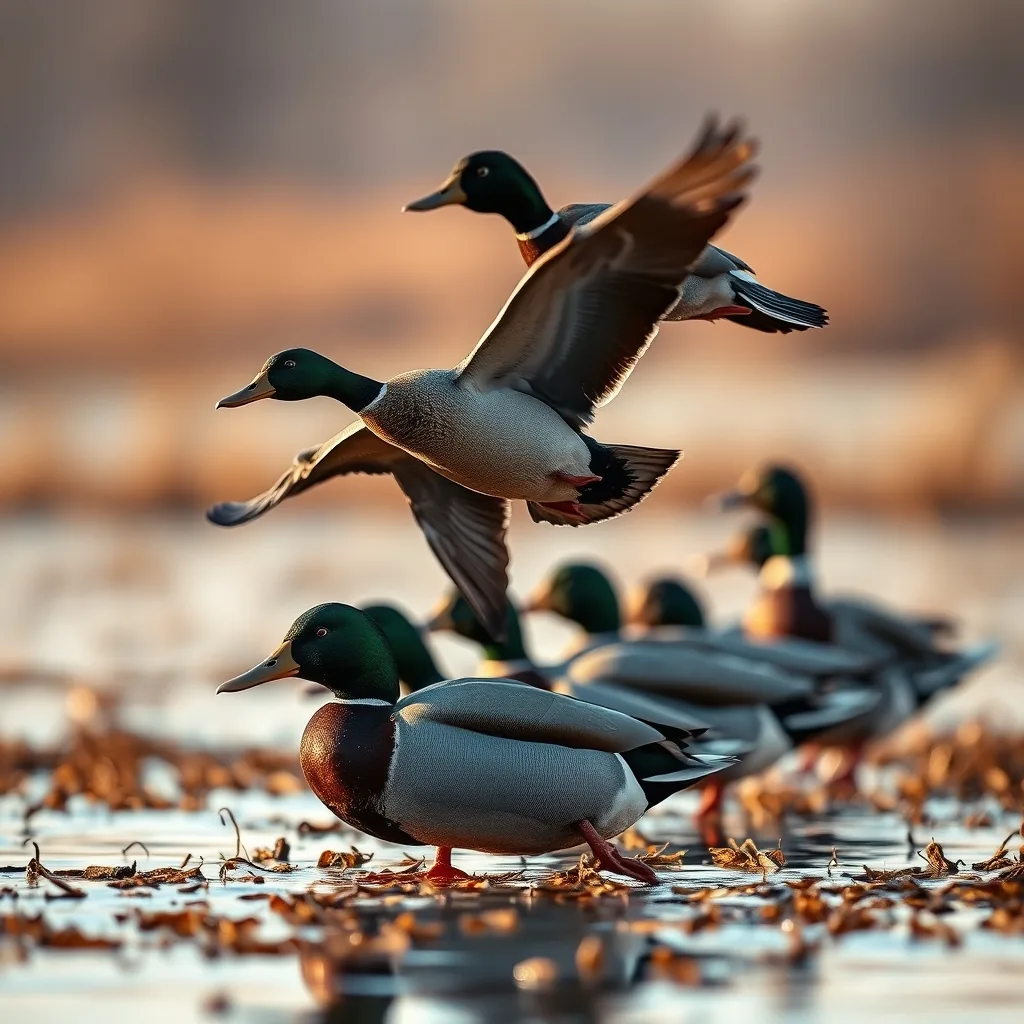
Most failed decoy spreads don't fail because of the wrong brand of decoys or the wrong number. They fail because the shape of the spread communicates something inconsistent — the wrong social signal for what ducks are actually doing, or a layout that forces birds to approach against wind in a way that doesn't feel natural.
Understanding what each spread configuration is trying to imitate, and when each one works and fails, gives you a framework that adjusts to conditions rather than a fixed recipe that only works in ideal setups.
How Ducks Read a Spread
Ducks approaching a decoy spread are reading several things simultaneously: the size of the group (indicating how safe and attractive the area is), the posture and activity of individual birds (feeding, resting, alert), the presence of birds in motion (indicating landing or leaving), and the approach path relative to wind (ducks land into the wind almost always, at least for their final approach).
A decoy spread that presents a large static group with no motion, no landing birds, and no clear landing lane reads as either a trap or a fully occupied feeding area with no room. Birds that work the decoys hard and then flare off without committing are often reading exactly that signal.
The three spread configurations address these signals differently:
- Paired spreads imitate a small group of feeding or resting ducks — calm, low-activity, low-threat signal. Best for attracting singles or small groups that are looking to join a quiet area.
- Traffic spreads (J-hook, C-curve, or hook shapes) imitate a larger active group with birds moving through. The open pocket in the hook shape creates an apparent landing zone. Best for working large migrating flocks or birds that are moving and need a clear destination.
- Landing zone spreads imitate birds actively landing — flared wings, spread positions, a clear open water gap in the kill zone. Best late in migration when birds are committed to specific areas and need visual confirmation of a safe touchdown spot.
Paired spread
- Signal
- Small calm group, feeding or resting
- Size
- 6–18 decoys, grouped loosely in pairs
- Landing zone
- Open water toward shooter; birds land into the group naturally
- Best species
- Mallards, teal, wood ducks (timber)
- Best conditions
- Light wind, flooded timber, small ponds, pressured birds
- Fails when
- Wind is strong or shifty; large flocks need a bigger visual target
J-hook / traffic
- Signal
- Active group with open landing slot
- Size
- 18–60+ decoys; the curve creates the visual
- Landing zone
- The open pocket inside the hook, upwind of the curve
- Best species
- Mallards, pintail, wigeon, canvasback
- Best conditions
- Moderate to strong consistent wind; open water; high-volume migration days
- Fails when
- Wind shifts 90°+ mid-morning; the hook pocket no longer aligns with approach
Landing zone
- Signal
- Birds actively committing; gap = safe touch-down
- Size
- Varies; a few landing-posture decoys near the gap is the key addition
- Landing zone
- Explicit open gap near the blind, upwind
- Best species
- Late-season mallards, geese (with full-body decoys)
- Best conditions
- Late season, when birds are educated and need visual confirmation
- Fails when
- Used too early in season; naive birds don't need this level of detail
Paired Spreads: What They Do and When They Work
A paired spread is exactly what the name implies: decoys placed in loose pairs across the set area, with reasonable spacing between pairs (roughly 3–5 feet between birds in a pair, and 8–12 feet between pairs). This replicates the natural resting and feeding posture of ducks that have been settled in an area for some time — they're not bunched up nervously, and they're spread out as comfortable birds tend to be.
The paired configuration works especially well in tight quarters: flooded timber, small beaver ponds, narrow creek bends. In these environments, the available water surface doesn't support a large spread anyway, and birds dropping into a small slough are usually coming in singles or pairs themselves — they don't need to see 40 birds, they need to see a couple of calm birds feeding. The paired spread matches that.
Why it underperforms in open water and high wind
On open water, a small paired spread can be hard for approaching birds to locate at distance. The visual target is small, and without a clear open landing zone directing birds to a specific approach, they may circle wide trying to find an entry point. In high or variable wind, paired spreads also don't create a defined pocket — birds want to land into the wind in a spot that looks clear, and a scattered paired spread gives them no obvious target area.
Spacing and motion
In a paired spread, a single spinning-wing or jerk-string motion decoy adds disproportionate value because there are no other motion cues. The motion makes the small spread visible at range and adds the "birds are happy and feeding" signal. In a large traffic spread, a single motion decoy adds less marginal value because the spread itself already has visual weight.
J-Hook and Traffic Spreads: The Mechanics
The J-hook is the most common spread shape taught in duck hunting courses and used on large open-water marshes. The concept: place your decoys in a curved line (the J-shape), with the opening of the hook pointing into the wind. The open pocket inside the hook is the "landing zone" — it's where incoming birds will naturally try to set down, and it should be positioned within comfortable shooting range of the blind.
The physics are straightforward. Ducks land into the wind. They will approach from downwind, swing around, and land heading upwind into the pocket. If the pocket is 20–30 yards from the blind, that's your shot window. If the pocket is 45 yards out because you placed the hook wrong, your shots will be at the edge of ethical range.
Building the J correctly
The fatal error in J-hook setups is placing the pocket too far from the blind. Place the upwind end of the J — the open throat — closest to the blind, roughly 15–20 yards out. The curve of the J extends downwind, away from the blind. The long tail of the J can extend 30–40 yards downwind with denser decoys to create visual weight at range.
The outer edge of the curve should have your most visible, largest decoys — these are the birds that approaching ducks see first from a distance. The inside of the curve, near the pocket, can have feeding or resting posture decoys. Landing-posture decoys (heads up, wings slightly spread) belong at the throat of the pocket, confirming that birds are committing to that exact spot.
Wind shift problem
A J-hook is optimized for a specific wind direction. If wind shifts 90 degrees or more mid-morning — common in transitional weather — the pocket no longer aligns with how birds want to approach. Birds will work the spread, look for a landing option, and often swing off. This is the primary failure mode of a committed J-hook in variable wind days. The solutions are either to deploy a more symmetrical spread (a standard U-shape or even the paired approach), or to reposition the spread if conditions change early enough to make it worth it.
Landing Zone Spreads: When and Why
A landing zone spread is more of a modification to any spread than a standalone configuration. The essential element is an explicit gap in the decoys near the blind — an open water area of 15–25 feet — with landing-posture decoys (wings spread, heads down, bodies low) positioned at the edge of that gap. This arrangement tells incoming birds: "birds are actively landing right here."
Early in the season, with naive birds that have rarely seen decoy spreads, this level of detail is unnecessary. A J-hook or simple cluster will work because the birds don't have a strong threat-detection system for unusual spread shapes.
Late in the season — particularly the last third of the season after significant hunting pressure — ducks have been educated. A large symmetrical spread with no landing-posture decoys and no clear open zone can read as suspicious. Late-season birds often approach very cautiously, swing far off to the side, and require something closer to what a real group of ducks actually looks like when they're committed to a spot.
Landing decoys and posture
Landing-posture decoys with flared wings (sometimes called "flapper" decoys or dedicated landing decoys) contribute most when placed at the gap edge facing into the wind — as if they've just touched down and are settling in. Placing them facing away from the wind (as if they've just taken off) sends the wrong signal. This is a small detail that matters late in the season when birds are reading everything carefully.
Species-Specific Considerations
Mallards
Mallards are the most decoy-responsive species and work across all three configurations. On migration days, a J-hook with visual weight works best. On pressured days in late season, a smaller, more natural-looking landing zone spread outperforms the large cookie-cutter J. Mallards, particularly late-season local birds, have seen the big J-hook hundreds of times by December.
Teal (blue-wing and green-wing)
Teal are fast, social, and respond to motion more than to specific spread geometry. A tight cluster of teal-size decoys (they're smaller than mallard decoys) with strong motion — jerk cord or spinning wing — outperforms elaborate geometric shapes. Teal seasons are typically early (September in the US), birds are naive and responding to group size and motion. A paired spread with motion works; a J-hook also works; the spread shape is not the primary driver.
Pintail
Pintail are wary and often work a spread for longer before committing than mallards. They respond well to a J-hook on open water but are particularly sensitive to decoy quality — flat, lifeless foam pintail decoys are more likely to flare late-season pintail than to attract them. If you're targeting pintail specifically, higher-quality decoys and attention to landing-posture placement near the pocket pays off more than it does for mallards.
Canvasback and diving ducks
Diving ducks don't use the same landing approach as puddle ducks. They typically run along the surface to land rather than dropping in from above. This changes spread design: you need a long open-water runway pointing into the wind, not a pocket. A raft-style spread — a large dense cluster of decoys with the shooting side toward open water — is more appropriate for divers than a J-hook designed for puddle duck approach angles.
Wood ducks
Wood ducks in flooded timber follow a nearly fixed flight path dictated by the trees. Spread shape matters less in timber than anywhere else — the birds are coming in to specific openings regardless of how you've arranged the decoys. A small paired spread or simple cluster in a timber hole, positioned where you want the birds to look when they come through the canopy, is the right approach. A large J-hook is impossible to set and unnecessary in timber.
Decoy Count: How Many Is the Right Number
More decoys provide more visual weight at range, which matters on big open water and on high-volume migration days when birds are covering large distances and making quick decisions about where to land. But more decoys also mean more setup time, more gear, and in some hunting situations, a spread that looks unnatural because the water or timber can't support 60 birds naturally.
A practical guideline by water type:
- Small ponds and beaver sloughs (under 1 acre): 6–18 decoys. Any more crowds the water unnaturally.
- Flooded fields and shallow marshes: 18–36 decoys. Visual weight matters here; the field is large and birds are choosing among multiple feeding spots.
- Open lakes and large river impoundments: 36–72 decoys. On open water, you need volume for the spread to be visible at distance and to compete with natural rafts.
- Flooded timber: 6–12 decoys. Timber holes are small; birds are locked into flight paths by the trees, not by the spread size.
When Spreads Fail: What to Adjust First
When birds work the spread repeatedly but don't commit — they circle, approach, then flare — the most common causes in order of frequency:
- Pocket position is wrong for the actual wind direction. Birds are trying to land into the wind but the pocket isn't where the wind says it should be. Recheck wind and reposition the pocket.
- There's no clear landing zone. The spread has no obvious open water gap where a bird can reasonably land. Add open space near the blind and move nearest decoys out.
- Human movement or disturbance. Flaring birds are sometimes reacting to movement in the blind or a dog that shifted. Rule this out before adjusting the spread.
- Spread is too dense or too symmetrical. A very even, symmetric spread can look artificial to educated birds. Introduce irregular spacing and pull some decoys out of the landing zone area.
- Wrong species mix. Mallards in a pintail spread or vice versa is not catastrophic, but mismatched species in the dominant decoy positions can cause hesitation in species-selective late-season birds.
Duck hunting gear worth buying
We earn a small commission on qualifying eBay purchases. Price you pay is unchanged. Full disclosure.
 Mallard decoys (foam keel, dozen)
Foam-keel decoys self-right in wind chop and hold position better than water-keel in variable wind. Dakota and GHG are the workhorses in the mid-range.
Mallard decoys (foam keel, dozen)
Foam-keel decoys self-right in wind chop and hold position better than water-keel in variable wind. Dakota and GHG are the workhorses in the mid-range.
 Spinning-wing motion decoy
Adds the flash of wing movement visible at long range. Most effective early season and on migration days. On pressured late-season birds, it can actually spook — consider using selectively.
Spinning-wing motion decoy
Adds the flash of wing movement visible at long range. Most effective early season and on migration days. On pressured late-season birds, it can actually spook — consider using selectively.
 Decoy anchors with coiled cord
Coiled cord doesn't tangle in the decoy bag the way fixed-length cord does. Texas-rig style weights hold in current; mushroom anchors for still water.
Decoy anchors with coiled cord
Coiled cord doesn't tangle in the decoy bag the way fixed-length cord does. Texas-rig style weights hold in current; mushroom anchors for still water.
 Mesh decoy bag / backpack
Mesh drains water so you're not hauling soaked decoys out of the blind. A pack-style bag keeps hands free for the dog and gun.
Mesh decoy bag / backpack
Mesh drains water so you're not hauling soaked decoys out of the blind. A pack-style bag keeps hands free for the dog and gun.
 Duck call (acrylic, double-reed)
Acrylic calls cut through wind and distance better than wood. A double-reed call is more forgiving for beginners and still effective in experienced hands — RNT, Buck Gardner, and Zink are established names.
Duck call (acrylic, double-reed)
Acrylic calls cut through wind and distance better than wood. A double-reed call is more forgiving for beginners and still effective in experienced hands — RNT, Buck Gardner, and Zink are established names.