Encounter balancing: CR is broken, what to use instead at low and high levels
Challenge Rating is a useful concept that the Dungeon Master's Guide implements badly. The XP budget system built on top of it produces encounters that are too easy in some configurations and unexpectedly lethal in others — most notoriously with low-level characters against multiple enemies and high-level characters against single boss monsters. Here's what the failure mode looks like and what experienced DMs actually use.
What CR is supposed to do
Challenge Rating is meant to give a DM a rough signal: a creature with CR equal to the average level of a four-player party should pose a medium challenge, consuming roughly 20–25% of the party's resources (hit points, spell slots, class features) without threatening to kill anyone outright.
The DMG builds on this with the XP budget system. Each encounter has a difficulty tier (Easy, Medium, Hard, Deadly) determined by comparing the encounter's total XP (with a multiplier for multiple enemies) against thresholds based on party level and size. In theory: add up the XP values, apply the multiplier, compare to threshold, done.
The system works reasonably well for a narrow band: four players, levels 5–10, fighting one or two enemies of appropriate CR in a standard dungeon corridor. Outside that band, it breaks down systematically.
The low-level problem: action economy destroys the math
At levels 1–4, the XP multiplier system dramatically underestimates how dangerous large groups of weak enemies are. Here's why.
A party of four level-1 characters has roughly 32–40 total hit points (8–10 per character on average). Each goblin (CR 1/4) has 7 HP and deals 1d6+2 damage per attack (4.5 average). The XP budget says a "Hard" encounter for a level-1 four-player party is around 200 XP. Four goblins cost 200 XP × the 2× multiplier for 4 enemies = 400 XP adjusted, putting it at "Deadly."
In practice? Four goblins with advantage from hiding can deliver 4 attacks per round averaging 4.5 damage each = 18 damage per round. A level-1 character who gets hit twice can be downed in a single round. The goblins get four turns for every one turn each player character gets. Action economy — the number of turns, the number of dice rolled — is fundamentally not captured by the XP comparison.
The multiplier the DMG uses (2× for 3–6 enemies, 2.5× for 7–10) still underestimates the problem at levels 1–3. A group of 8 goblins facing a four-player level-2 party is genuinely dangerous in ways the 2.5× multiplier doesn't fully capture, because each individual goblin attack has a meaningful chance of downing a character, and the party runs out of resources before the goblins do.
The high-level problem: nova rounds and single-monster pinatas
At levels 11+, the opposite problem emerges with single high-CR creatures.
A level-11 party can output enormous burst damage in round one: the Fighter attacks three or four times, the Wizard casts a 6th-level spell, the Barbarian rages and swings twice, the Cleric uses a Channel Divinity or high-level spell. In optimal conditions, a coordinated party of four level-12 characters can deal 200–300+ damage in the first round through concentration of force.
A CR 17 Adult Red Dragon has 256 hit points. The damage math says it should last 4–6 rounds. In round one, against a party that knows what it's doing, it dies. This isn't a meaningful encounter — it's a math problem the players solve immediately, then wait for the next one.
The XP system assigns that dragon to "Deadly" territory for a level-12 party. "Deadly" is supposed to mean "risk of character death, serious resource drain." Instead it means "the party burns every nova resource they have and the dragon dies at the end of round 1 or early round 2 having done some damage but never threatening anyone's life."
The single-creature multiplier (0.5× for 1 enemy) makes this worse — it suggests a single monster costs half its XP toward the difficulty calculation, implying it's easier than its XP value suggests. This is almost never true for high-level single monsters, where the party's action economy advantage is even more pronounced.
What actually works: three better approaches
Adjusted monster HP, not adjusted CR
The quickest fix for boss fights is to multiply the monster's HP by 1.5–2×. A 256 HP dragon that takes 350 HP to kill can actually get turns in. It can use its Legendary Actions between player turns. It can breathe fire twice before dying. The CR and XP budget values remain unchanged — only the durability changes.
This is a rougher approach than it sounds because monster damage is balanced against a certain expected hit-point total. A dragon that lasts twice as long deals twice as much damage total, which can tip the encounter the other way. The counter-trick is to reduce the monster's per-attack damage slightly while increasing HP, keeping expected damage output roughly constant while extending the encounter duration.
Legendary Actions and Lair Actions as the real solution
The official D&D solution to the action economy problem for big monsters is Legendary Actions: the creature gets to take 1–3 actions at the end of each other creature's turn. This gives a CR 17 dragon effectively 5–8 turns per round instead of 1. Against a four-player party, this makes the math fundamentally different.
The problem: many DMs run older monsters from pre-5e sourcebooks, third-party content, or homebrewed creatures without Legendary Actions, and the action economy problem hits them hard. The fix is to give any solo boss monster Legendary Actions even if the stat block doesn't include them. Two Legendary Actions per round (Detect + Attack or Move) is a reasonable baseline that doesn't break anything.
Lair Actions, taken on initiative count 20, add another turn per round and add environmental danger that the party must respond to. A boss fight in a carefully designed lair is a fundamentally different encounter than the same boss in an empty room — the terrain forces positioning decisions that consume player actions without adding to enemy damage output.
Count actions, not XP
The approach that consistently produces the most accurate difficulty predictions is action economy counting. The framework, which appears in several third-party D&D tools and blog posts under different names, is:
- Count the total number of attacks the enemy side can deliver in a round (accounting for multi-attack)
- Compare to the total number of attacks the party can deliver in a round
- Estimate average damage per attack on both sides
- Calculate how many rounds each side takes to reduce the other to zero HP
This is more work than the XP budget, but it produces far more reliable difficulty predictions. The XP comparison tells you nothing about whether a goblin mob can down a character in round 1; the action count calculation tells you exactly how many characters are likely to go down and when.
The practical DM toolkit for the table
A few adjustments that experienced DMs apply without rebuilding the system from scratch:
Low levels (1–4): limit mob size, not CR
At levels 1–4, the safest rule is no more than one enemy per player character for a Medium encounter, and no more than 1.5 per player for Hard. If you want a "goblin horde" feel, use minion mechanics: each goblin has 1 HP and dies on any hit, but there are 20 of them. This preserves the fantasy of fighting a mob without the action economy death spiral.
Mid levels (5–10): the XP budget works reasonably well here
This is the sweet spot for the RAW system. Use the DMG XP thresholds, apply the multiplier, and trust the output. Monster HP and action economy are more in balance with party resources at this tier. The most common problem here is DMs underestimating spell slot burn — a Hard encounter might not threaten HP but burns every 3rd-level slot the Wizard has, which matters for the rest of the day.
High levels (11–20): give every boss Legendary Actions and minimum 2× HP
At tier 3 and 4 play, treat single-monster encounters as fundamentally broken unless the monster has Legendary Actions. Add them. Add Lair Actions if the setting supports it. Run the monster intelligently — it will use legendary saves on disabling spells, target concentrating casters, and retreat if it can. A boss that acts tactically is more dangerous than one with double HP and acts randomly.
The most dangerous high-level encounters are the ones that mix monster types: a high-CR boss plus a small number of elite minions who can absorb concentration-breaking attacks and apply conditions while the boss does damage. This structure plays to the boss's strengths (single powerful attacks) while protecting it from the party's strength (concentration spells).
The honest verdict
CR is useful for the same reason any rough guide is useful: it gives you a starting point faster than building from first principles every time. A CR 5 creature is a plausible medium challenge for a five-player level-5 party in the same way that a recipe calling for "medium heat" is a useful instruction even though stoves vary. Use it as a guide, not a guarantee.
The DMs who run consistently engaging combat encounters are mostly doing two things: checking action economy against party resources (not just XP totals), and adjusting boss HP and Legendary Action counts at the table based on how round 1 goes. Running a fight is a live calibration problem, not a pre-game math problem. The system gives you a starting condition; what you do with the first round determines whether the encounter becomes a grind, a threat, or a rout.
Visit the D&D tools and calculators for the encounter difficulty calculator and dice set buying guide.
Gear actually worth buying
Smart eBay searches we'd start with ourselves. We earn a small commission on qualifying sales through these links; the price you pay is the same. Full disclosure.
 Dungeon Master's Guide (5e)The XP budget system lives here, but so does useful content on lair design, magic items, and world-building. Worth owning in physical form for reference mid-session.
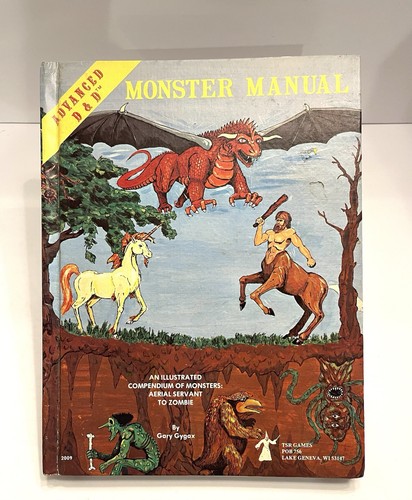 Monster Manual (5e)The definitive enemy reference. CR, HP, actions, and Legendary Actions for every core creature. Physical copy opens faster than D&D Beyond at the table.
 DM screen (Deluxe)The official Deluxe DM Screen has useful condition, action, and table reference panels. The physical barrier between DM notes and players is practical, not just theatrical.
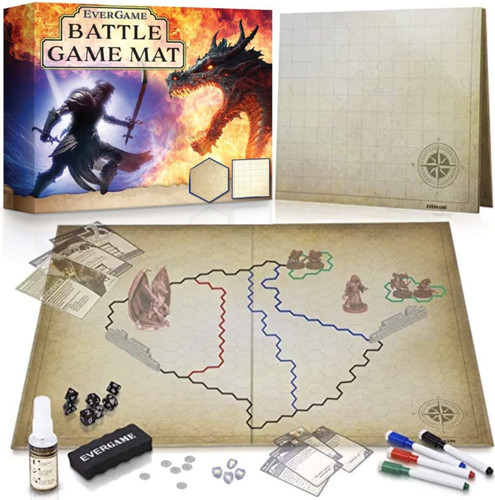 Vinyl battle mat (grid/hex)A dry-erase or wet-erase vinyl mat lets you draw any encounter map in 2 minutes. More flexible than printed tiles; cheaper than 3D terrain for most tables.
 Condition cards and initiative trackerPhysical condition reminder cards eliminate "wait, what does Restrained do?" interruptions. Paired with a visible initiative tracker, they speed combat materially at any table size.