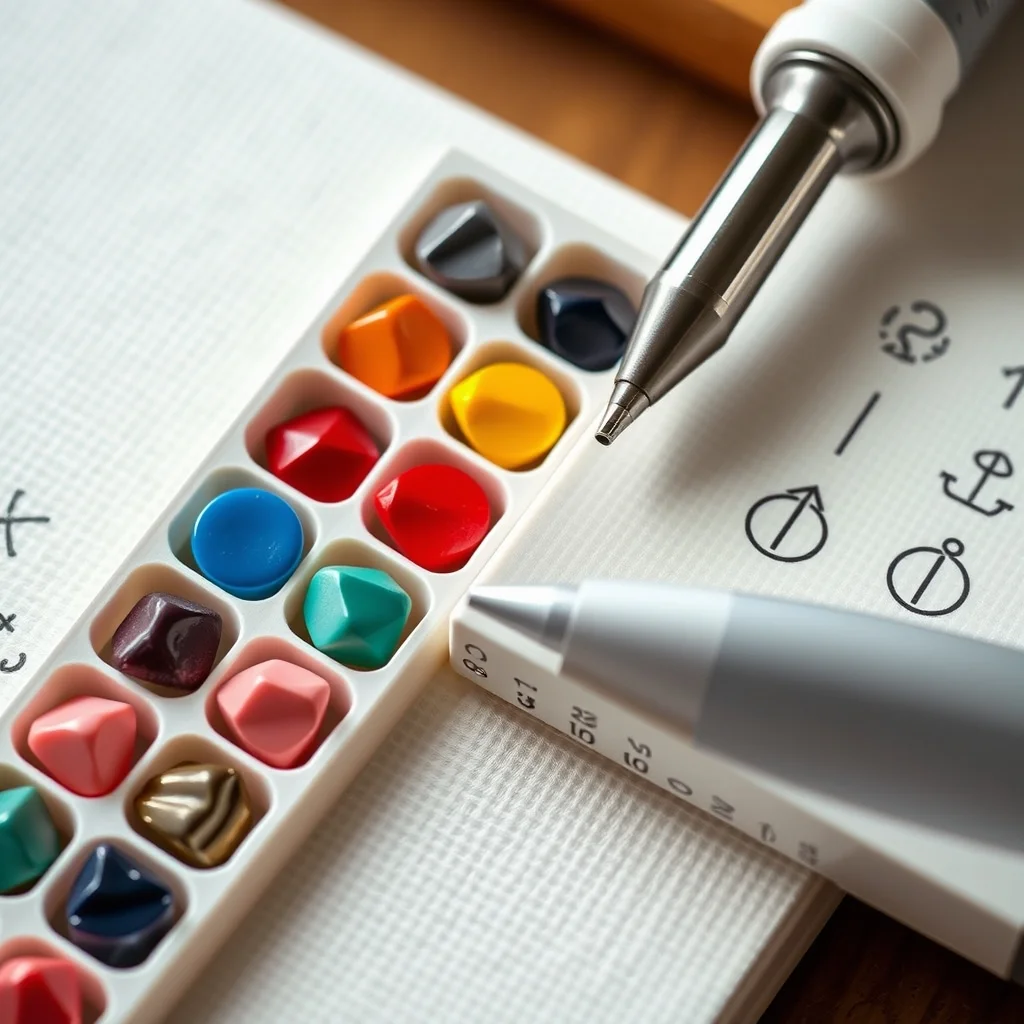
Round vs square drills: the decision that shapes everything else
The two drill shapes are not interchangeable, and most beginners don't know this until they've bought the wrong type for their goals. Round drills have a faceted dome top and fit into the canvas adhesive quickly — they snap into position without precise alignment. The result is slightly gapped coverage, similar to a mosaic with visible grout lines. Round drills are faster to place, easier on beginners, and well-suited for larger canvases where you're covering big fields of a single color.
Square drills (also called square resins or princess cut) have four flat sides that fit flush against each other, filling the canvas completely with no gaps. The finished result looks denser and more polished, with the satisfying "click" of edges aligning. Square drills demand more placement precision — a slightly off-angle drill disrupts the row. They're typically chosen by experienced crafters who want display-quality results and are willing to work more carefully.
Drill size: 2.5mm vs 2.8mm
Most kits use 2.8mm drills. A minority of suppliers (particularly some Chinese manufacturers selling under their own brand) use 2.5mm drills. Smaller drills on the same canvas mean more individual pieces to place, but the result is similar. The issue arises when you mix drills from different kits — sizes aren't interchangeable on a given canvas grid.
Full drill vs partial drill: coverage area
A full-drill canvas covers the entire image area — every symbol zone is filled with drills. A partial-drill canvas covers only part of the image (typically a central focal point), with the outer areas printed directly onto the canvas background.
Partial drill kits look less impressive as finished pieces because the unpainted canvas border is visible at close range. They're cheaper and faster to complete. Full-drill kits take more time and drills but produce results that are genuinely displayable as framed art. For gifting or display, full drill is almost always the right choice.
Canvas quality: what to look for and what to avoid
The canvas is the most important component in any kit, and it varies more than any other part. A bad canvas can peel, lose adhesion mid-project, or have blurry symbol printing that makes color matching unreliable.
Adhesive layer strength and longevity
Quality canvases use a peel-back protective film over a pressure-sensitive adhesive layer. The adhesive should hold drills firmly without requiring excessive pressing — if drills fall out when the canvas is tilted, the adhesive is too weak. Conversely, very high-tack adhesive can be hard to reposition a misplaced drill. A well-calibrated canvas lets you pick up and reposition a drill two or three times before it loses grip.
A known problem with lower-quality kits: the adhesive degrades over a multi-week project as the exposed area collects dust and skin oils. Better manufacturers use a thicker adhesive layer and a full-coverage protective film that you peel back section by section. If you're choosing between two otherwise equal kits, check whether reviewers mention drills falling out mid-project — that's a canvas adhesive failure.
Symbol printing resolution
Each canvas square is marked with a symbol or number corresponding to a drill color. On lower-resolution prints, symbols run together or bleed at the edges, making it hard to identify where one color ends and the next begins. Higher-quality canvases use crisp, high-contrast symbol printing. This matters most for complex designs with many color transitions in a small area.
Canvas rigidity and backing
Rolled canvases arrive with curl, and some never fully flatten. Thicker canvas material (typically described as "high-density canvas" in kit listings) flattens more reliably when taped to a work surface or mounted in a frame. Thin canvas can bubble or wrinkle under drills if not kept flat, particularly in humid environments.
Shopping for diamond painting supplies? Browse current eBay listings → (we earn a small commission; your price is unchanged).
Tools: what actually matters
Most kits include a single-tip applicator pen, a wax pad, a tray, and a pair of tweezers. The wax pad is used to coat the pen tip so drills adhere to it for pickup — it's the one consumable in the kit. Here's what's worth upgrading and what isn't.
Multi-head applicator pens
Single-tip pens place one drill per stroke. Multi-head pens (5-tip, 9-tip, or larger) place multiple drills simultaneously, which speeds up large single-color fills significantly. The tradeoff is that multi-head pens don't work well in tight color-boundary areas. Experienced painters typically use a single-tip pen for detail work and switch to a multi-head for large flat areas. A 5-tip pen is the most useful upgrade for the majority of kits.
Light pads
A light pad (thin LED panel placed under the canvas) illuminates the symbol grid from below, making it significantly easier to read symbols — especially for complex designs with similar symbols or small grid squares. This is genuinely useful for eye comfort during long sessions and is especially helpful for anyone with reading glasses. A5 pads are adequate for smaller canvases; A4 pads give more working area for canvases over 30×40 cm.
Roller tools and sealing
After completing a canvas, drills can be pressed more firmly into the adhesive using a rolling pin, a specialized diamond painting roller, or by placing the canvas face-down under heavy books. This is particularly important for square drills — without rolling, some drills will sit proud of the surface and pop out during framing. If you plan to frame and display your work, sealing with a dedicated diamond painting sealer (brush-on or spray) locks drills permanently and adds sheen.
Storage containers
Kits often include individual bags per color, but these are awkward to work from. Sorting containers with small individual compartments (the kind used for fishing tackle or seed storage) are the practical solution. A 64-compartment round-slot container lets you open all colors at once and pour cleanly back into the bag from the pour spout. This is a cheap upgrade that meaningfully reduces fumbling.
Image size and complexity: the real difficulty scale
Canvas dimensions are listed in centimeters. A 20×20 cm canvas is a small beginner project (roughly 8×8 inches); a 60×80 cm canvas is a several-week undertaking. Complexity is driven more by color count than canvas size — a large canvas with 10 colors is easier than a medium canvas with 60 colors, because fewer color swaps means faster rhythm.
For first-time buyers, a 30×40 cm full-drill round-drill canvas with under 30 colors is a practical starting point. It's large enough to feel satisfying but completable in a reasonable number of sessions.
What to verify before buying
- Full drill or partial? Check the description explicitly — many listings don't highlight this clearly.
- Round or square drills? The thumbnail image often shows square drills even when the kit ships round.
- Canvas dimensions in centimeters (not just "large" or "small" marketing language).
- Color/symbol count — listed as DMC color count on better kits; higher count means more sorting time.
- Protective film coverage — does the kit include a full roll of clear film or just paper cover strips? Full film is better for long projects.
- Drill shape in photos — zoom in on review images to verify shape, since round and square drills look similar in thumbnail views.
Shop diamond painting supplies on eBay
Kits, tools, and storage options. We earn a small commission on qualifying sales; your price is unchanged. Full disclosure.
 Diamond painting kit
Complete kits with canvas, drills, tray, and pen. Look for listings that specify drill shape and canvas dimensions in the description.
View on eBay →
Diamond painting kit
Complete kits with canvas, drills, tray, and pen. Look for listings that specify drill shape and canvas dimensions in the description.
View on eBay →
 Diamond painting full drill
Full-drill coverage for display-quality finished pieces. More time investment than partial-drill, but the result is worth it.
View on eBay →
Diamond painting full drill
Full-drill coverage for display-quality finished pieces. More time investment than partial-drill, but the result is worth it.
View on eBay →
 Diamond painting tools kit
Multi-head pens, light pads, and roller tools. The 5-tip pen and an A4 light pad are the most impactful upgrades for speed and comfort.
View on eBay →
Diamond painting tools kit
Multi-head pens, light pads, and roller tools. The 5-tip pen and an A4 light pad are the most impactful upgrades for speed and comfort.
View on eBay →
 Diamond painting storage box
64+ compartment containers for color sorting. Round-slot trays pour more cleanly back into bags than square-slot versions.
View on eBay →
Diamond painting storage box
64+ compartment containers for color sorting. Round-slot trays pour more cleanly back into bags than square-slot versions.
View on eBay →
 Diamond art accessories
Sealers, frames, canvas rolls, and light pads. A sealer is essential if you plan to frame and handle finished work without losing drills.
View on eBay →
Diamond art accessories
Sealers, frames, canvas rolls, and light pads. A sealer is essential if you plan to frame and handle finished work without losing drills.
View on eBay →