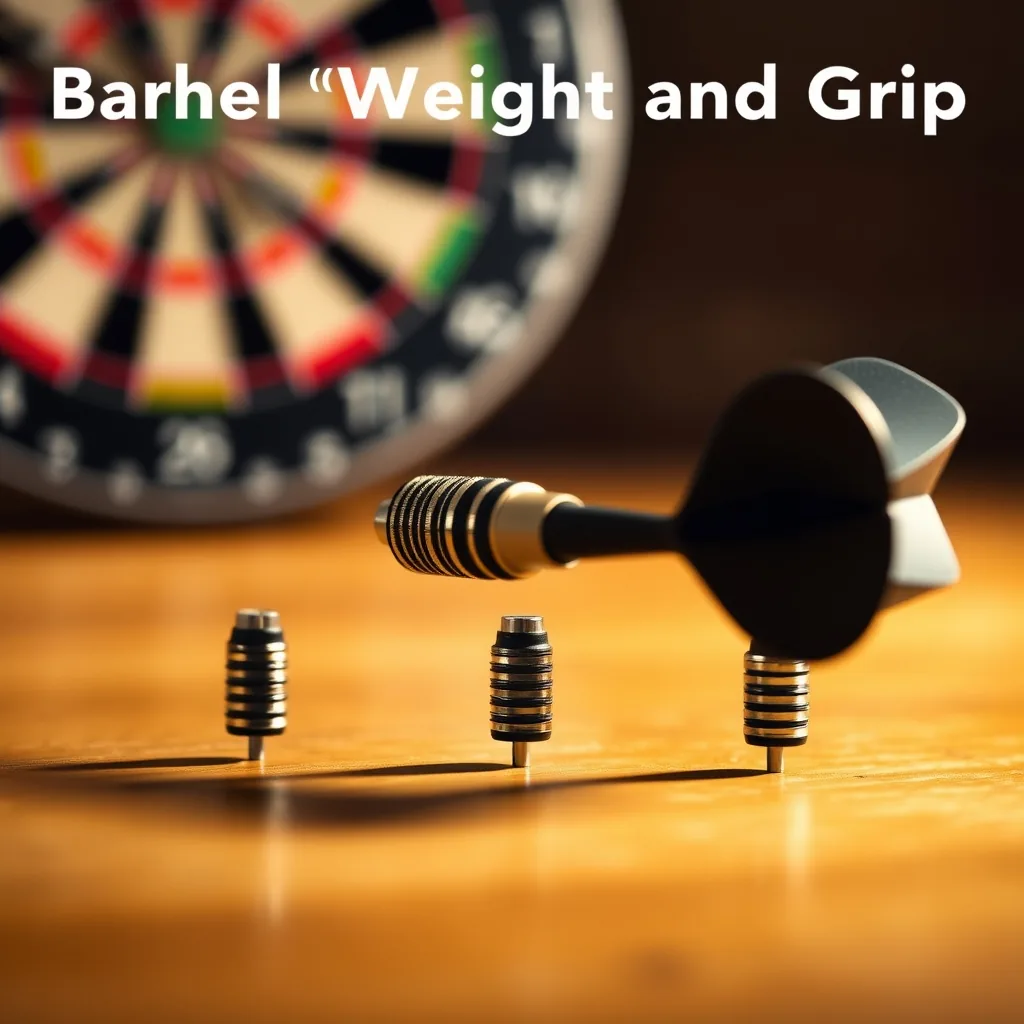
Walk into any dart shop and you'll find weights from 12 grams up to 50 grams, with most recreational and league players clustered between 18 grams and 28 grams. The dominant range — the one most players settle into after experimenting — is 22 to 26 grams. Within that range, the differences are real but more nuanced than "heavier is more stable" or "lighter gives you more speed."
This article breaks down what the weight change actually does to your mechanics, why the grip texture and balance point often matter more than the weight number itself, and how to run a short self-test to find your actual starting weight rather than guessing.
What Weight Does and Does Not Control
Dart weight affects how much force you need to apply to reach the board at the right arc and velocity. Heavier darts require more deliberate acceleration; lighter darts respond more quickly to small variations in release force. Neither is inherently better — what matters is whether the dart's momentum profile matches your throwing style.
What weight does not directly control:
- Accuracy on its own. A heavier dart thrown with poor form groups no better than a lighter dart thrown with poor form. Weight doesn't compensate for mechanical inconsistency.
- Bounce-outs. Bounce-outs are primarily a function of dart tip sharpness and board condition, not weight. A heavier dart doesn't punch through a sisal board more reliably than a lighter one.
- Fatigue over a single match. The weight difference between a 22g and 26g dart — 4 grams — is not meaningful for hand fatigue in a typical session. Grip tightness and throw tension are the real culprits for arm fatigue, both of which are style corrections, not equipment solutions.
What weight does meaningfully affect:
- Arc trajectory. Heavier darts fly on a flatter arc at the same release angle. This matters for players who throw at a consistent upward angle and need the dart to flatten out before the board, or who throw flatter and need a weight that maintains momentum without dropping early.
- Feedback sensitivity. Lighter darts amplify small inconsistencies in release. A player with a very controlled, smooth release may find lighter darts more responsive. A player with a more forceful or variable release often finds heavier darts more forgiving because they absorb minor release inconsistencies without veering as much.
- Grouping clearance. Heavier barrels are physically larger in diameter for a given length, which affects how close grouped darts can land. This is particularly relevant for tight treble-20 groupings — the third dart in a cluster may deflect off the second if barrel diameter is too wide.
The 22g, 24g, and 26g Profiles
22 grams
- Throw style fit
- Smooth, wristy, fast-release throwers
- Arc behavior
- More pronounced arc; needs consistent release angle
- Feedback
- High — small release changes produce larger grouping variance
- Barrel profile
- Often narrower, easier clustering at treble
- Who it suits
- Players with refined mechanics and consistent wrist snap
24 grams
- Throw style fit
- Mid-range — works across most styles
- Arc behavior
- Moderate; predictable with most release styles
- Feedback
- Medium — forgiving enough for developing players, responsive enough for intermediate
- Barrel profile
- Middle-diameter; balanced clearance
- Who it suits
- The largest population of recreational and league players
26 grams
- Throw style fit
- Deliberate, arm-driven, lower release speed
- Arc behavior
- Flattest arc in this range; less arc correction needed
- Feedback
- Low — absorbs release inconsistency; forgiving for powerful styles
- Barrel profile
- Wider; clearance matters more in tight groups
- Who it suits
- Players who throw with more arm and less wrist, or who prefer deliberate placement
The 24g profile genuinely fits the most players. If you have no strong reason to be at either end of this range — no specific mechanical quirk, no clear preference from experience — start at 24 grams and adjust from there based on what you observe, not what feels theoretically correct.
Grip Texture: The Variable That Changes Feel More Than Weight Does
Two darts at the same weight with different grip textures will feel more different from each other than two darts at 22g and 26g with the same grip. The grip surface is the interface between your fingers and the barrel — it directly shapes how the dart releases, how consistently you can hold it through the throw, and how fatigued your fingers feel after extended practice.
Knurled grip
Knurling is the diamond-cut or cross-cut pattern machined into a tungsten barrel. Deep, aggressive knurling grips the fingers firmly and gives high positive feedback about where your fingers are on the barrel. The trade-off: aggressive knurling can snag slightly on release if your delivery isn't clean. For beginners building consistent mechanics, very deep knurling can actually amplify problems by catching on release and introducing spin or deflection.
Fine or medium knurling — less aggressive diamond cut — is the most common pattern on mid-range barrels and suits the widest range of players. It provides grip security without the snagging risk of deep cuts.
Ringed grip
Rings cut around the barrel circumference (rather than knurling across the barrel) produce a different tactile feedback. Rings grip well when your fingers are positioned perpendicular to the barrel's long axis — which is how most players hold their darts naturally. A ringed grip can feel more linear and guide your fingers into a consistent position more intuitively than knurling.
Smooth sections and combination barrels
Many barrels combine a grip section at the front or center of the barrel with smooth sections elsewhere. These "combination" barrels help players with a front-weighted hold (front-of-barrel grip) or back-weighted hold locate their grip position repeatably. If you find yourself adjusting where your fingers sit mid-session, a barrel with clearly defined grip and smooth zones can eliminate that variable.
Coated vs bare tungsten
Some mid-range and lower-cost barrels are coated (nickel, titanium nitride, or a polymer finish) rather than bare tungsten. Coatings add grip texture in smooth sections, change the color of the barrel, and protect from corrosion — but they also add a small amount of thickness and change the tactile feel of the knurling beneath. Bare tungsten is slightly more sensitive to sweat and skin oils, but the grip from the knurling is more direct. Neither is categorically better; it's a preference question.
Balance Point and Barrel Shape
Balance point describes where the dart's center of mass sits along its length. Most barrels are roughly center-balanced, but a meaningful number are front-loaded (center of mass toward the point) or rear-loaded (center of mass toward the shaft).
Front-loaded barrels
A front-loaded dart pulls the point toward the board during flight, which means it lands point-first more reliably even with a flatter throw angle. Players who throw relatively flat — low arc, straight-arm delivery — often prefer front-loaded barrels because the natural in-flight rotation brings the tip down. The trade-off is that front-loaded darts feel slightly more tip-heavy in the hand, which some players find unsettling.
Rear-loaded barrels
A rear-loaded dart gives you more leverage from the back of the barrel. Players who hold toward the back of the barrel — a grip style that produces a more wristy, pendulum delivery — sometimes prefer rear loading because it matches the feel of the throw. Rear-loaded darts tend to need slightly more arc to land consistently point-first, which is compatible with a higher-arc throwing style.
Center-balanced
Center-balanced barrels are the most forgiving for diverse grip positions. They don't strongly resist any throwing style, which makes them the safest starting point. Most barrels in the 22–26g range that don't specify a balance preference are roughly center-balanced.
Tungsten vs Brass: Why the Material Matters for This Conversation
If you're comparing weights between barrels, you need to be comparing tungsten to tungsten. Brass darts achieve the same weight as tungsten darts by using a significantly larger and wider barrel — the density of brass (approximately 8.5 g/cm³) is far lower than tungsten (approximately 19.3 g/cm³). A 24g brass barrel is physically much thicker than a 24g tungsten barrel.
This matters for two reasons. First, the wider brass barrel means worse clearance on grouped darts at the treble — your third dart in a tight cluster is more likely to deflect off the second. Second, the grip texture and balance behavior of brass barrels differs substantially from tungsten because of the geometry change. If you've been throwing brass darts and wondering why switching to tungsten at the same stated weight feels so different, barrel diameter and geometry are why.
For league play and for any serious comparison of barrel weight effects, brass is a different baseline. The 22–26g analysis above applies specifically to tungsten barrels in the 90%–97% tungsten alloy range (the standard range for commercially available tungsten darts).
Weight Changes Over Time: When to Adjust
Most players who stay with one weight for an extended period eventually develop mechanics tailored to that weight, which makes switching disruptive even if a different weight might theoretically suit their style better. The case for changing weight is strongest in specific situations:
- You're developing or correcting a fault. If your throw is consistently right of target and you've ruled out technique causes, a small weight change can help. Going heavier tends to flatten the arc and reduce lateral swing. Going lighter tends to amplify whatever is already happening — it won't fix a problem, but it makes it more visible.
- You're changing grip position. If you're deliberately rebuilding your grip — moving from a back-of-barrel hold to a front-of-barrel hold, for example — the weight and balance point that felt right before may feel wrong now. This is a legitimate time to experiment with weight simultaneously.
- Session fatigue is consistent and significant. If your groupings reliably drift late in practice sessions and your arm feels genuinely tired, heavier darts may be part of the problem (requiring more effort per throw), though this is less common than grip tension as the culprit.
What is not a good reason to change weight: scoring plateaus. If your average isn't improving, the problem is almost certainly practice structure and mechanics, not barrel weight. Changing equipment during a plateau rarely produces improvement and often creates a regression as you adjust to the new dart.
Practical Recommendations by Player Type
Newer players (under 2 years of regular play)
Start at 24 grams with a medium knurled or ringed grip, center-balanced. Don't change until you've thrown the same dart for at least 60 sessions. Inconsistent mechanics will mask any signal from weight changes — what feels like the wrong weight is usually the wrong mechanics, and stability matters more than optimization at this stage.
Intermediate players (consistent mechanics, tracking averages)
At this stage the three-test method above is worth running. You have enough consistency to detect the signal. Pay equal attention to balance point and grip texture as you do to weight — many intermediate players find that moving from a generic medium-knurl barrel to a front-loaded or ringed grip barrel at the same weight produces more improvement than weight changes.
League players (structured practice, match play)
If you've been at one weight for a year or more and have consistent mechanics, don't change weight unless you have a specific mechanical reason. The benefit of knowing exactly how your dart behaves in every checkout situation is more valuable than marginal optimization. If you do test weights, do it in practice-only sessions — never in match play — and give yourself at least 30 sessions per weight before drawing conclusions.
Darts gear worth buying
We earn a small commission on qualifying eBay purchases. Price you pay is unchanged. Full disclosure.
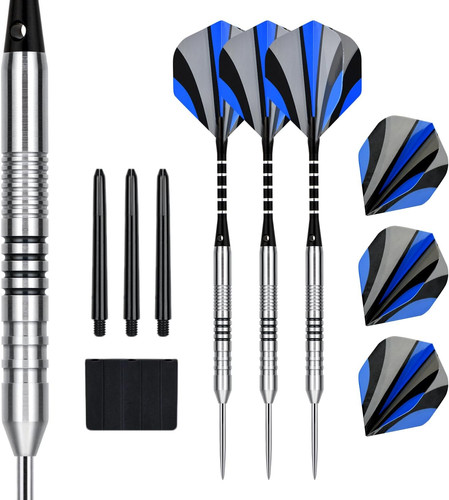 24g tungsten darts (steel tip)
The most common starting weight. Tungsten at 90%+ keeps barrel diameter narrow. Winmau, Mission, and Unicorn all offer reliable sets in the $40–$80 range.
24g tungsten darts (steel tip)
The most common starting weight. Tungsten at 90%+ keeps barrel diameter narrow. Winmau, Mission, and Unicorn all offer reliable sets in the $40–$80 range.
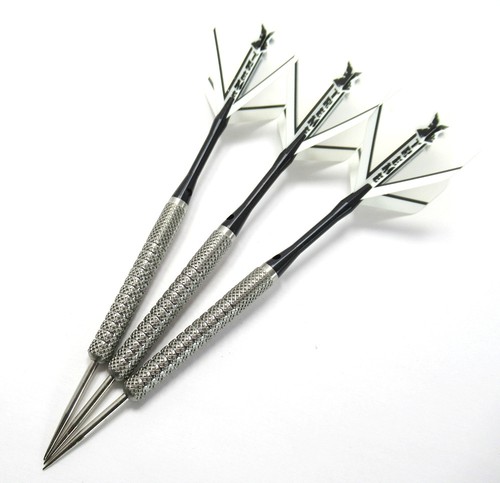 22g tungsten darts (steel tip)
For smooth-release wristy throwers. A narrower barrel than 26g at the same tungsten percentage — better for tight groupings at treble.
22g tungsten darts (steel tip)
For smooth-release wristy throwers. A narrower barrel than 26g at the same tungsten percentage — better for tight groupings at treble.
 26g tungsten darts (steel tip)
For arm-driven or deliberate throwers. Flatter arc, more forgiving of mild release inconsistencies. Heavier feel in hand translates to a more controlled delivery for some players.
26g tungsten darts (steel tip)
For arm-driven or deliberate throwers. Flatter arc, more forgiving of mild release inconsistencies. Heavier feel in hand translates to a more controlled delivery for some players.
 Dart tip sharpener
A dulled tip is the most common cause of bounce-outs on a sisal board. A rotating sharpener keeps tips in the right profile — not needle-sharp, but lightly pointed.
Dart tip sharpener
A dulled tip is the most common cause of bounce-outs on a sisal board. A rotating sharpener keeps tips in the right profile — not needle-sharp, but lightly pointed.
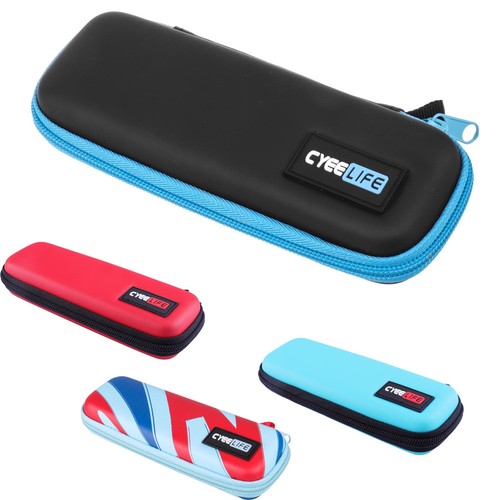 Dart case / wallet
Protects flights and tips in transit. A hard case is worth it for league play — soft pouches let flights crease, which changes flight behavior.
Dart case / wallet
Protects flights and tips in transit. A hard case is worth it for league play — soft pouches let flights crease, which changes flight behavior.