You swatched. You got gauge. Then you crocheted six inches and realized you're off by two stitches per four inches — enough to turn an adult sweater into a child's one. You blame yourself. You shouldn't. Blame the hook.
The problem isn't technique. It's that hook sizing is not a regulated standard in the way a metric bolt is a metric bolt. A hook labeled "5mm" from one manufacturer may physically measure anywhere from 4.75mm to 5.5mm in actual shaft diameter. Combine that with the geometry of how the hook grabs yarn — inline vs tapered throat — and you can get meaningfully different stitch sizes from two hooks nominally the same size.
This article walks through the real numbers, the types of hooks that cause the most confusion, and the gauge math you need to correct for it.
The four hook systems and why they measure differently
Standard aluminum/plastic hooks (Boye, Susan Bates, Clover)
These are the hooks most beginners buy. They follow the US letter system (B through Q and beyond) and the metric system simultaneously, but the two systems don't always agree on what "5mm" means in practice.
The dominant U.S. brands diverge on throat geometry:
- Boye (tapered throat): The shaft transitions gradually into the hook. Yarn sits lower in the groove, producing a looser stitch because the yarn rides the slope on the way out.
- Susan Bates (inline throat): The hook tip and shaft are in the same line. Yarn sits at the full shaft diameter, producing a tighter, more uniform stitch.
The practical upshot: a Boye H-8 (5mm nominal) and a Susan Bates H-8 (5mm nominal) will produce different gauge. Real-world measurements of the same nominal size often show 0.1–0.3mm shaft diameter variation between these brands, and the throat geometry difference amplifies that further.
Steel crochet hooks (thread and fine lace work)
Steel hooks use a completely different size numbering system that runs backwards. Size 00 is the largest (about 3.5mm) and size 14 is the smallest (about 0.75mm). If you pick up a steel hook labeled "7" expecting it to correspond to any letter in the standard system, you'll be confused — a steel size 7 is roughly 1.65mm, nowhere near a standard size 7 hook.
Steel hooks also have very short shanks, designed for tight, dense thread work with cotton crochet thread. If you try to use steel hook sizing intuitions for worsted yarn work, the entire reference frame breaks down.
Tunisian (Afghan) hooks
Tunisian hooks are longer — typically 25–35cm — and often have a stopper at the other end (or a cable extension for larger Tunisian work). The sizing uses the same metric system as standard hooks, but the recommended gauge for Tunisian is consistently looser than for standard crochet with the same yarn weight, because Tunisian simple stitch pulls more yarn through each loop.
If your pattern says "5mm hook, worsted weight, 14 stitches per 4 inches" — that's written for a standard hook. With a 5mm Tunisian hook and worsted yarn, expect approximately 12–13 stitches per 4 inches unless you compensate. Most Tunisian patterns account for this, but when converting standard patterns to Tunisian, you need to go down 0.5–1mm in hook size to match gauge.
Ergonomic hook sets (Clover Amour, Tulip Etimo)
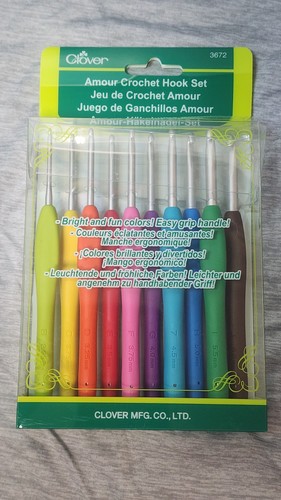
Ergonomic hooks have rubberized or resin handles with the metal hook portion inserted. The hook itself is typically inline-style. Clover Amour hooks in particular run very close to true metric — measurably more accurate than Boye or basic Susan Bates aluminum hooks in independent head-to-head measurements. If you're having chronic gauge trouble, switching to Clover Amour and re-swatching often closes the gap.
The size chart that shows the gaps
| US Letter | Nominal mm | Typical Boye actual | Typical S. Bates actual | Yarn weight match |
|---|---|---|---|---|
| B-1 | 2.25 | 2.2–2.35 | 2.25 | Lace / thread |
| E-4 | 3.5 | 3.4–3.6 | 3.5 | Fingering / sport |
| G-6 | 4.0 | 3.9–4.15 | 4.0 | DK / light worsted |
| H-8 | 5.0 | 4.85–5.1 | 4.9–5.0 | Worsted |
| I-9 | 5.5 | 5.4–5.6 | 5.5 | Worsted / aran |
| J-10 | 6.0 | 5.9–6.2 | 6.0 | Aran / bulky |
| K-10.5 | 6.5 | 6.4–6.75 | 6.5 | Bulky |
| L-11 | 8.0 | 7.9–8.2 | 8.0 | Bulky / super bulky |
Yarn weight categories and what they actually mean for gauge
The Craft Yarn Council has a standard weight system numbered 0 through 7. But a ball of yarn labeled "4 / Medium / Worsted" is a category, not a precise specification. Actual WPI (wraps per inch) for worsted yarn legitimately ranges from about 12 to 16 WPI depending on the fiber content, twist, and spinning method.
What this means in practice:
- A tight-spun wool worsted will produce a denser fabric at the same gauge than a loosely spun acrylic worsted
- Superwash wool (treated to be machine-washable) grows after washing — your pre-wash gauge is not your post-wash gauge
- Cotton and linen have almost no elasticity; your gauge will be tighter and the fabric heavier than wool at equivalent hook sizes
- Acrylic "breathes" differently — it stretches under tension during crocheting and relaxes back, so the act of measuring a swatch while it's still on your hook produces a tighter count than once it's laid flat
The gauge math: from swatch to adjustment
Step 1: Measure your swatch correctly
Work a swatch of at least 5 × 5 inches (not 4 × 4 — you need border stitches that distort gauge excluded from the measurement). Count stitches and rows across a 4-inch span in the center of the swatch. Do not measure along the edges.
Let the swatch rest off the hook for at least 15 minutes before measuring. For natural fibers, block the swatch the same way you'd block the finished piece — wet blocking produces different dimensions than steam blocking.
Step 2: Calculate the adjustment factor
Pattern says: 14 stitches = 4 inches.
Your swatch: 16 stitches = 4 inches.
Your stitches are too small (too many per inch). You need a larger hook.
The adjustment factor is: your gauge ÷ pattern gauge = 16 ÷ 14 = 1.14.
Your hook is effectively 14% too small. If you're on a 5mm (H-8), multiplying 5mm × 1.14 = 5.7mm — so moving to a 5.5mm (I-9) or 6mm (J-10) is the right direction. In practice, go up one hook size, re-swatch, and remeasure.
Step 3: The stitch count correction for existing patterns
If you cannot achieve the pattern gauge with any hook (some yarn/hook combinations simply won't match), you can correct the stitch count. This works for simple rectangular or tubular pieces but not for shaped garments where the math gets complex.
The formula: correct stitch count = pattern stitch count × (your gauge ÷ pattern gauge)
Example: Pattern says cast on 80 stitches. You're getting 16 st/4" and pattern wants 14 st/4".
80 × (14 ÷ 16) = 80 × 0.875 = 70 stitches.
You'd start with 70 stitches instead of 80 to achieve the same finished width.
When inline vs tapered throat makes the biggest difference
The inline vs tapered distinction matters most on these stitch types:
- Single crochet (sc): Tapered hooks produce slightly looser single crochet because the yarn slips off the slope. Inline hooks produce tighter, more uniform sc.
- Half double crochet (hdc): Less affected — the extra yarn over smooths out geometry differences.
- Double crochet (dc): Minimal effect on gauge; the multiple yarn-overs dominate.
- Tunisian simple stitch: Inline hooks are nearly universal here; the geometry of Tunisian pulls require the uniform shaft.
- Amigurumi / tight single crochet: This is where inline hooks (Clover Amour, Susan Bates) are noticeably tighter. If you're stuffing amigurumi and worried about stuffing showing through, an inline hook helps close the stitches.
Measuring hooks you already own
A digital caliper (measuring in 0.01mm increments) is the only reliable way to know what your hooks actually measure. Calipers under $15 are accurate enough for this purpose. Measure the shaft — the straight section between the thumb rest and the throat — not the throat itself.
If you don't have calipers, a thread gauge or knitting needle gauge card (the kind with labeled holes) can give you a rough reading by finding the smallest hole the hook shaft passes through cleanly.
The thread crochet case: steel hooks and size confusion
Steel hook sizes run 00 to 14 in the US system, with 00 being the largest. The international steel hook system uses metric sizing, which at least is intuitive (smaller number = smaller hook). Common thread work uses sizes 7–14 (US), corresponding to roughly 0.75mm to 1.65mm.
Thread gauge matters even more than yarn gauge because the work is smaller and errors compound. A finished lace doily worked at the wrong tension will be 20–30% smaller than intended and the pattern won't lay flat. Always swatch thread work, and always use the specific steel hook brand the pattern was written for if you can find it — vintage patterns especially were often written for specific discontinued brands.
Quick reference: what to do when you're off gauge
- Too many stitches per inch (fabric too tight): Go up one hook size. If you were on Boye, try switching to Clover Amour at the same nominal size first — the true-metric shaft may give you the 0.2mm you need without a full size jump.
- Too few stitches per inch (fabric too loose): Go down one hook size. Check your yarn label's recommended hook size — if you're already at or below it, your technique (tension) is the variable, not the hook.
- Gauge is right in width but wrong in height (row gauge off): Row gauge is harder to fix with hook size changes. Adjusting your stitch height — how far you pull up your loops before completing the stitch — is usually the answer, and it's a practice-and-feel change rather than an equipment change.
- Gauge swings on the same hook between projects: Fatigue, tension (emotional, not just yarn tension), and temperature all affect how tightly you hold yarn. This is normal. Always swatch fresh for each project.
Summary
Hook sizing is a guideline, not a specification. The label on a hook tells you approximately which ballpark you're in. The actual shaft diameter, throat geometry, and how that interacts with your specific yarn and hand tension determines your gauge. The fix is always: measure your swatch in the center, do the division, go up or down a size, and measure again. Caliper your hooks once if you work from patterns that require precise gauge — you'll immediately understand why some hook-yarn combinations have been frustrating you.
Gear actually worth buying
Smart eBay searches for the tools mentioned in this article. We earn a small commission on qualifying sales; your price is unchanged. Full disclosure.
 Digital caliper (0.01mm)
Measures actual hook shaft diameter in seconds. Under $15 for basic stainless steel — accurate enough for every hook-gauging task.
Digital caliper (0.01mm)
Measures actual hook shaft diameter in seconds. Under $15 for basic stainless steel — accurate enough for every hook-gauging task.
 Clover Amour hook set
Inline throat, true-metric shaft sizing, ergonomic rubber grip. The most accurate mass-market hook set available — fixes many mysterious gauge problems.
Clover Amour hook set
Inline throat, true-metric shaft sizing, ergonomic rubber grip. The most accurate mass-market hook set available — fixes many mysterious gauge problems.
 Tunisian hook set (with cable)
Interchangeable Tunisian hooks with cable extensions for wider pieces. Sizes 4mm–7mm cover most Tunisian worsted projects.
Tunisian hook set (with cable)
Interchangeable Tunisian hooks with cable extensions for wider pieces. Sizes 4mm–7mm cover most Tunisian worsted projects.
 Steel hook set (thread/lace)
Sizes 0–14 for cotton thread crochet. Sets from Susan Bates or Boye cover the full range — buy them as a set, the individual price is much worse.
Steel hook set (thread/lace)
Sizes 0–14 for cotton thread crochet. Sets from Susan Bates or Boye cover the full range — buy them as a set, the individual price is much worse.
 Gauge ruler / needle sizer
Labeled holes for checking hook and needle shaft size without a caliper. Works for both mm and US sizing. Under $5, every kit needs one.
Gauge ruler / needle sizer
Labeled holes for checking hook and needle shaft size without a caliper. Works for both mm and US sizing. Under $5, every kit needs one.