Suction Ratings: Air Watts, PA, and Why Wattage Alone Tells You Nothing
Vacuum suction is measured in several units, and manufacturers use them selectively. Understanding what each measures — and what it does not — prevents you from comparing numbers that are not actually comparable.
Air watts (AW) combine airflow and suction pressure into a single figure that represents the actual work the vacuum can do at the cleaning head. It is calculated as (airflow in CFM × suction pressure in inches of water lift) ÷ 8.5. Air watts is the most useful single-number spec for comparing vacuums because it accounts for both components. Consumer cordless vacuums range from around 20 AW (weak, adequate only for light debris on hard floors) to 80+ AW on boost mode (approaching corded performance).
Pa (pascals) measures suction pressure only, without accounting for airflow. Some manufacturers — particularly Chinese brands — advertise impressive Pa numbers (20,000 Pa, 25,000 Pa) that look impressive without revealing airflow. A high-Pa vacuum with low airflow can feel powerful on a hand test but underperform on carpet because carpet cleaning requires both pressure and volume. Pa is useful when comparing machines within the same brand's line; cross-brand Pa comparisons are unreliable.
Motor wattage describes electrical consumption, not cleaning power. It tells you how much electricity the motor uses, not how efficiently it converts that power into airflow and suction. A 500W corded motor and a 150W cordless motor can produce comparable air watts if the cordless design is efficient. Do not use wattage to compare across categories.
Battery Runtime: Reading "Up to X Minutes" Honestly
Runtime claims on cordless vacuums are almost universally measured on the lowest power setting, on hard floors, without a motorized brush head attached. The number you see on the box is not what you will experience cleaning carpet with the main floor head on standard mode.
A typical breakdown for a machine advertised at "up to 60 minutes":
- Minimum power, hard floor, no motorized head: ~55–60 minutes
- Standard mode, hard floor, motorized head: ~30–35 minutes
- Standard mode, carpet, motorized head: ~20–25 minutes
- Boost mode, carpet: ~8–12 minutes
This is not deceptive in the sense that manufacturers must test to consistent standards — but it does mean the advertised number is the ceiling, not the average. When evaluating runtime for your use case, estimate based on the third or fourth row above, not the first.
Charge time matters almost as much as runtime. A 4-hour charge time on a 25-minute battery means the vacuum is out of action most of the day. Better machines charge fully in 2–3 hours; some fast-charge designs reach 80% in under an hour.
Swappable vs Integrated Batteries
Swappable (removable) batteries let you buy a second battery pack and continue cleaning while the first charges. This effectively doubles usable runtime for whole-home sessions. Integrated batteries are permanently installed in the machine body.
Swappable batteries add cost (replacement packs typically run $50–120 depending on brand), but they also extend the machine's service life — when the battery degrades after 3–5 years, you replace the pack rather than the vacuum. Most premium brands (Dyson, Miele, Shark) offer replaceable batteries. Some budget brands with "removable" batteries technically allow removal but sell no replacement packs, making them effectively integrated in practice.
If you have a larger home (over 1,500 sq ft to vacuum per session), swappable batteries are worth the investment. For smaller spaces or apartments, integrated batteries are usually sufficient.
Shopping for cordless vacuums? Browse current eBay listings → (we earn a small commission; your price is unchanged).
Filtration: HEPA vs Standard
Vacuum filtration matters primarily for people with allergies, asthma, or households with pets. The filter traps particles that the vacuum picks up so they are not exhausted back into the room through the motor exhaust.
True HEPA (High Efficiency Particulate Air) filtration, as defined by the standard, captures 99.97% of particles 0.3 microns and larger. This covers most allergens, pet dander, dust mite debris, and fine particulates. To qualify, the filter must be tested to the standard — not all filters marketed as "HEPA-like" or "HEPA-style" meet this threshold.
Standard multi-layer filters in budget vacuums capture large particles effectively but allow finer particles to pass through. They are adequate for homes without allergy concerns and typical dust/debris loads.
Sealed vs non-sealed filtration systems also matter. A vacuum with a HEPA filter but an unsealed body design can allow unfiltered air to bypass the filter through gaps. Sealed designs (where the filter creates a sealed barrier between the dirty air path and the exhaust) are what allergy-sensitive households should look for. This detail is not always prominently advertised but is typically mentioned in the specification sheet.
Filter maintenance: HEPA filters must be cleaned and replaced on schedule to maintain performance. Most manufacturers recommend washing foam/felt pre-filters monthly and replacing the main HEPA filter every 12 months under normal use. Running a vacuum with a clogged filter dramatically reduces suction and can damage the motor.
Bin Size and Emptying Design
Cordless vacuum bins range from about 0.2 liters (small handhelds) to 0.8 liters (full-size sticks). A 0.5-liter bin typically covers one full cleaning session for a two-bedroom apartment before needing to be emptied.
Bin design affects how often you are exposed to the contents during emptying. Hygienic bin-emptying mechanisms (one-button drop, point-and-empty into the trash bin with no touching) reduce the allergen exposure during the worst moment of vacuuming. Some designs require you to reach into the bin to clear debris caught on internal filters — less desirable for allergy sufferers.
Transparent bins let you see fill level at a glance. This sounds minor but is genuinely useful — suction drops noticeably before the bin is completely full, so visual monitoring helps you empty at the right time.
Floor Head and Attachments
The floor head design determines cleaning effectiveness more than suction rating for many users. Two main types:
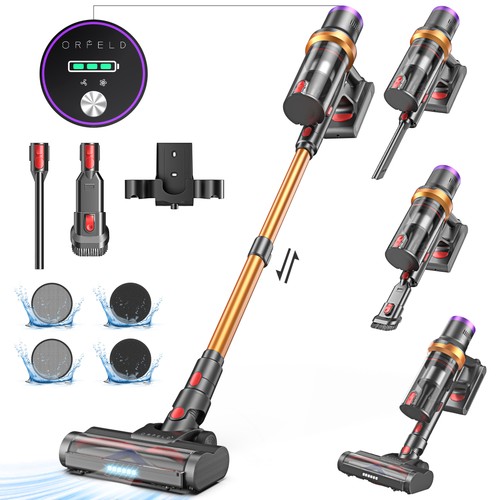
Motorized brush roll heads use a spinning brush to agitate carpet fibers and lift debris. These are necessary for any carpet cleaning. They struggle on large debris (small pebbles, pet kibble) because the brush can fling items rather than picking them up.
Soft roller heads (like Dyson's Fluffy attachment) use a soft drum to clean hard floors very effectively. They pick up fine grit and large debris simultaneously without scattering. They are not designed for carpet.
Many stick vacuums include both head types. If you have mixed flooring, this combination is worth paying for over a single-head machine.
Weight and Balance
Cordless stick vacuums typically weigh 5–8 lbs. The battery location — whether it sits at the top of the handle (common in Dyson designs) or near the floor head — affects balance more than total weight. Top-heavy designs fatigue your wrist faster during extended sessions. Balance is difficult to assess from specs alone; reading extended use reviews is useful here.
The Decision in Plain Terms
For a home with mixed hard floors and low-pile carpet, look for 40+ air watts in standard mode, a machine with both a motorized brush head and a soft-roller head, and a removable battery if your home is larger than 1,000 square feet. Add HEPA filtration if anyone in the household has allergies. The bin size is a secondary concern — 0.5 liters or more is adequate for most households. Do not buy on wattage alone, and translate any runtime claim down by about 40% to estimate real carpet cleaning time.
Search eBay for cordless vacuums
We earn a small commission on qualifying sales; your price is unchanged. Full disclosure.
 Cordless stick vacuum
Full-size sticks for whole-home hard floor and carpet cleaning
Cordless stick vacuum
Full-size sticks for whole-home hard floor and carpet cleaning
 Cordless vacuum pet
Tangle-free brush rolls and pet-hair optimized suction paths
Stick vacuum cleaner
Broad search including corded and cordless stick options
Cordless vacuum hardwood
Soft-roller head models that clean hard floors without scattering
Cordless vacuum pet
Tangle-free brush rolls and pet-hair optimized suction paths
Stick vacuum cleaner
Broad search including corded and cordless stick options
Cordless vacuum hardwood
Soft-roller head models that clean hard floors without scattering
 Handheld cordless vacuum
Compact units for cars, stairs, and upholstery spot-cleaning
Handheld cordless vacuum
Compact units for cars, stairs, and upholstery spot-cleaning