Upright vs Portable Spot Cleaner: Start Here
The single biggest mistake buyers make is choosing the wrong category of machine. Uprights and portables do different jobs, and buying the wrong one wastes money regardless of how good the specs are.
Upright carpet cleaners (sometimes called deep cleaners or carpet extractors) are designed to clean entire rooms of carpet. They typically have a motorized brush roll, a large clean-water tank (often 1 gallon or more), and a separate dirty-water tank of similar capacity. They spray cleaning solution into the carpet pile, agitate with brushes, then extract the dirty water back into the tank. Dry time typically ranges from 2 to 6 hours depending on the machine's extraction power and the ambient humidity.
Portable spot cleaners are handheld or compact corded machines for targeted stains: pet accidents, spilled wine, mud tracked in from outside. They have smaller tanks (typically 0.5 to 1.5 liters), less suction, and a hose-and-tool attachment rather than a wide floor head. They are faster to set up and easier to store, but they are not a replacement for whole-room cleaning.
If your primary goal is cleaning one or two rooms of carpet thoroughly, you want an upright. If your primary goal is reacting to accidents quickly, you want a portable. Many households benefit from having both.
Suction Power: What the Numbers Mean
Carpet cleaner suction is often measured in water lift (inches of water lift or mm H₂O), airflow (CFM, cubic feet per minute), or sometimes just motor wattage. These are not interchangeable, but they all relate to how aggressively the machine pulls dirty water back out of the carpet.
Water lift is the most useful spec for carpet cleaning. It measures how much vertical suction the machine can generate against resistance — more water lift generally means better wet extraction, especially in thicker pile. Budget uprights typically measure around 50–70 inches of water lift; better machines run 80–100+ inches.
Airflow (CFM) matters more for dry vacuum suction. For wet extraction, water lift is the number to check. A machine with high CFM but low water lift may move a lot of air but struggle to pull water from deep carpet fibers.
Be cautious about wattage claims as a proxy for suction. A 1200W motor does not automatically outperform an 800W motor — motor efficiency, impeller design, and sealing all affect actual suction at the nozzle.
Brush Rows and Agitation
Most upright carpet cleaners use one of three agitation systems: a single rotating brush roll, dual counter-rotating brush rows, or DirtLifter-style PowerBrushes (Bissell's terminology for a brush system that moves in multiple directions).
Single brush roll machines are the most common and affordable. They work the cleaning solution into carpet from one direction. Adequate for low-to-medium pile and light soiling.
Dual counter-rotating brushes clean from two directions simultaneously, which generally produces better results on medium and thick pile. The trade-off is more moving parts and slightly higher cost.
DirtLifter-style systems add vertical lifting motion to the horizontal scrubbing, which can help loosen embedded debris before the suction passes over. Useful if you are dealing with heavy pet traffic or tracked-in soil.
Brush roll access also matters for maintenance. Models with a front-access brush roll panel or a quick-release roll are much easier to clear of hair and fibers than designs that require disassembly.
Tank Design: Dual-Tank is Worth It
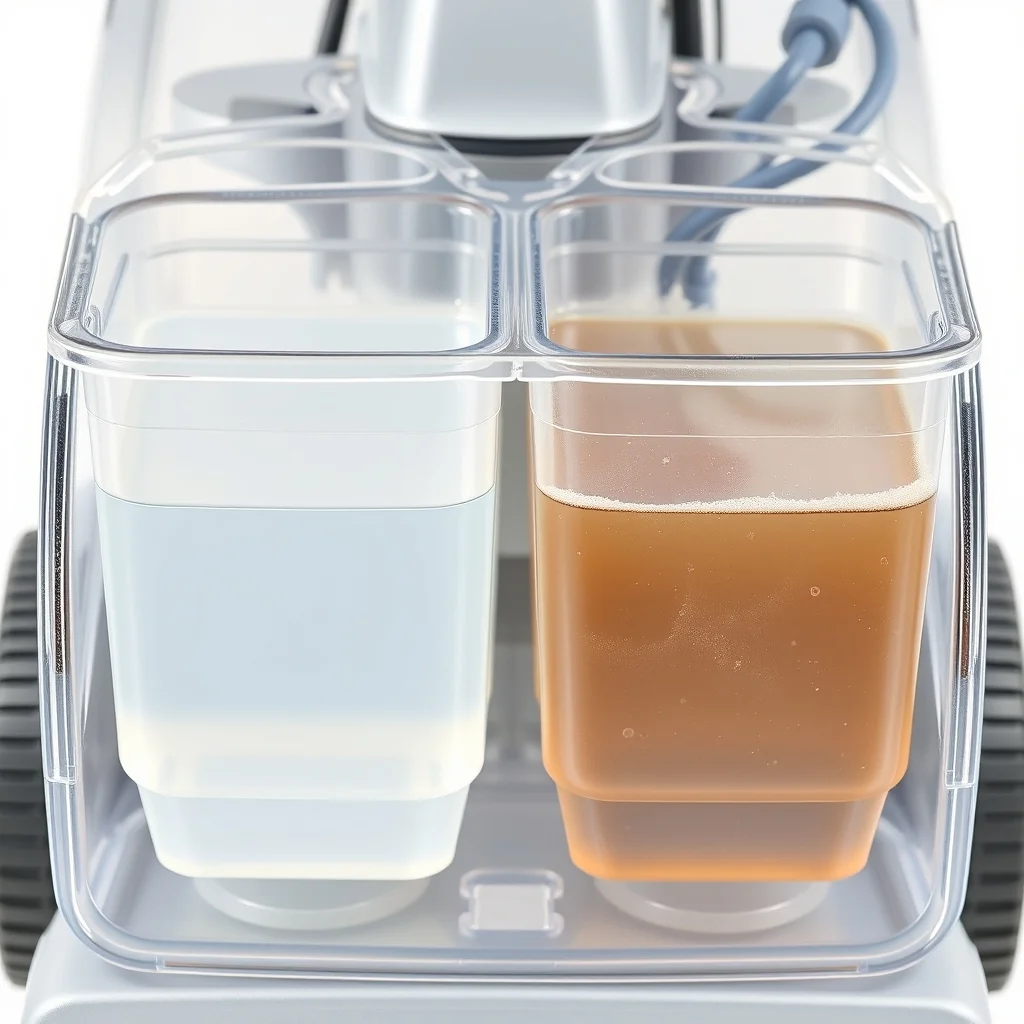
Some budget carpet cleaners use a single tank for both clean water/solution and dirty water extraction. This creates a real problem: you cannot easily tell how much clean solution remains, and dirty water can sometimes mix back in if the machine is tilted. Dual-tank designs — one for clean water, one for dirty — solve both problems.
On dual-tank machines, check whether both tanks are independently removable. Top-fill tanks are easier to fill at the sink; bottom-fill tanks tend to be more compact. Tank capacity for a room-sized job should be at least 0.75 gallons (roughly 3 liters) per tank. Smaller tanks mean more refill interruptions.
Transparent or semi-transparent tanks let you see fill levels at a glance. This sounds minor until you are mid-pass across a large room and the machine runs dry without warning.
Heated Cleaning: When It Is Worth the Premium
Heated carpet cleaners — machines with built-in water heaters — cost more to buy and use slightly more electricity, but they deliver measurably better results on grease-based stains and general grime. Hot water loosens carpet fibers, reduces the surface tension of oily soils, and can reduce the amount of cleaning solution needed.
Some machines heat water internally (true heating element, typically to 120–140°F). Others are designed to maintain heat if you pre-fill them with hot water from the tap. The distinction matters: internal heaters stay hot throughout the job; tap-hot designs cool down within minutes.
For households with pets or heavy cooking traffic (where grease and protein stains are common), internal heating is worth the price difference. For routine freshening of lighter-traffic carpets, it typically is not necessary.
Shopping for carpet cleaners? Browse current eBay listings → (we earn a small commission; your price is unchanged).
Cleaning Solution Compatibility
Most carpet cleaners are formulated for use with the brand's own cleaning solution. Running third-party solutions — especially high-foaming formulas — can void warranties and clog machines. That said, many machines will accept diluted, low-foam solutions from other manufacturers.
Enzyme-based formulas (designed to break down organic material like pet urine) are broadly compatible with most extractors but should be checked against the manufacturer's guidance. Some heating elements interact poorly with certain enzyme formulas at sustained high temperatures.
If you are cleaning a large area, factor cleaning solution cost into the total cost of ownership. Concentrated formulas that dilute to higher ratios are typically more economical than pre-diluted bottles.
Hose Length and Attachments
Upright carpet cleaners typically include at least one portable attachment — a hose with a narrow nozzle for stairs and upholstery. Hose length determines how high up stairs you can reach from the base unit sitting at the bottom. Anything under 5 feet of hose is short enough to be annoying; 7–8 feet gives reasonable range.
Check what attachments come in the box versus what must be purchased separately. Stair tool, upholstery tool, and crevice nozzle are the three most useful. Some brands bundle these; others sell them as add-ons.
Weight and Maneuverability
Full-size upright carpet cleaners with full tanks typically weigh 18–28 lbs. This matters for transport between rooms and especially for carrying on stairs. Some models have swivel steering, which significantly reduces effort around furniture.
Cord length affects how much floor space you can cover from a single outlet. Most full uprights have 20–25 foot cords. Shorter cords mean more outlet changes mid-job.
Noise Level
Carpet extractors are loud — typically in the 75–85 dB range during operation, which is comparable to a standard vacuum cleaner or a food blender. This is a function of motor power and extraction suction. Machines marketed as "quiet" usually mean quieter than competitors in the same power class, not quiet in an absolute sense.
If noise is a significant concern (working around sleeping children or in apartment buildings with thin walls), portable spot cleaners are generally quieter than uprights due to smaller motors. Some manufacturers publish decibel ratings; use those as a direct comparison tool rather than the marketing language around them.
What to Skip
A few features marketed prominently on carpet cleaners rarely justify the cost premium:
- Multiple cleaning modes labeled with marketing names: Most machines offer "express" and "deep clean" settings that differ mainly in how much solution is dispensed. The actual cleaning mechanism is identical.
- Built-in fragrance dispensers: These dispense scented solution into the carpet. The fragrance fades faster than the clean and adds cost per fill.
- Overly complex brush adjustment systems: A machine that requires tools to swap between carpet and hard floor mode adds friction to a task that should be simple.
The Decision in Plain Terms
Buy an upright with a dual-tank design and at least 70 inches of water lift if you are cleaning room-sized carpet. Add heated cleaning if pets or grease stains are regular problems. Buy a portable spot cleaner as a secondary machine for fast response to accidents — or as your primary if you only have area rugs and upholstery to maintain. Check brush roll access before buying anything, because cleaning the brush roll is a recurring task on any carpet machine.
Search eBay for carpet cleaners
We earn a small commission on qualifying sales; your price is unchanged. Full disclosure.
 Carpet cleaner machine
Full upright extractors for whole-room deep cleaning
Portable carpet cleaner
Compact spot cleaners for stairs, upholstery, and quick stains
Carpet cleaner machine
Full upright extractors for whole-room deep cleaning
Portable carpet cleaner
Compact spot cleaners for stairs, upholstery, and quick stains
 Carpet shampooer
Rotary brush machines for embedded grime and heavy soiling
Carpet shampooer
Rotary brush machines for embedded grime and heavy soiling
 Pet carpet cleaner
Enzyme-compatible machines with tangle-free brush rolls
Upholstery cleaner machine
Narrow-nozzle extractors for sofas, chairs, and car interiors
Pet carpet cleaner
Enzyme-compatible machines with tangle-free brush rolls
Upholstery cleaner machine
Narrow-nozzle extractors for sofas, chairs, and car interiors