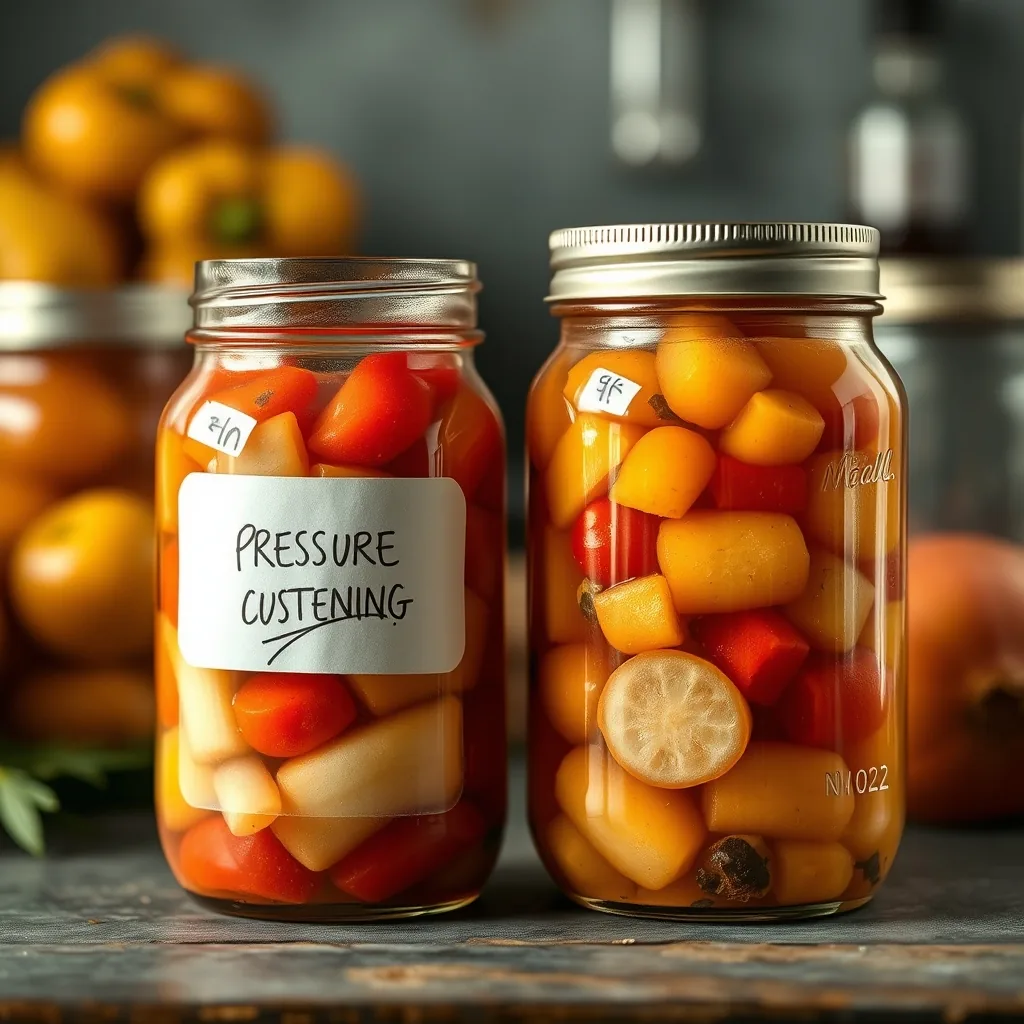
The reason home canning kills people every year — roughly one to three botulism outbreaks attributable to home canning annually in the United States, according to CDC records — is not that people are careless. It's that the danger is invisible, odorless, and the food looks and smells perfectly fine. Botulinum toxin is among the most acutely lethal substances known. The safety margin for getting the method wrong is zero.
This article explains the actual science behind the two canning methods, why the pH line exists where it does, and what's genuinely happening inside the jar when you process it.
What you're actually trying to kill
Clostridium botulinum is a spore-forming anaerobic bacterium found naturally in soil and water worldwide. Most foods carry spores on their surface. Under normal conditions (exposed to air, low moisture, high acid) those spores are harmless.
The problem with sealed jars is that you've created exactly the environment C. botulinum thrives in: anaerobic (no oxygen), warm, moist, low-acid. In those conditions, spores germinate into vegetative bacteria, which then produce botulinum neurotoxin.
There are two completely different targets in home canning:
- The toxin itself: Relatively easy to destroy. Botulinum toxin denatures at around 85°C (185°F) held for 5 minutes, or 80°C (176°F) held for 10 minutes. A rolling boil (100°C at sea level) destroys it quickly. If you boiled contaminated food before serving, you'd destroy the toxin. But you can't detect the toxin visually — which is why you shouldn't trust contaminated food by tasting it and you shouldn't open suspect jars.
- The spores: Far more heat-resistant. Spores require a temperature of 121°C (250°F) held for at least 3 minutes to reliably destroy them (the "12D" standard used in commercial canning refers to a 12-log reduction, actually requiring longer times for safety margins). You cannot reach 121°C in a water bath canner at sea level — boiling water tops out at 100°C. Only a pressure canner, which raises the internal temperature by raising pressure, can reach these temperatures.
Why pH 4.6 is the line
Clostridium botulinum cannot produce toxin in an environment with a pH at or below 4.6. This has been established through multiple research programs over decades and is the foundational principle behind high-acid vs low-acid canning rules.
At pH 4.6 and below:
- Spores may survive the canning process (they're very heat-resistant)
- But the spores cannot germinate and the bacteria cannot grow in that acid environment
- Therefore they cannot produce toxin
- Therefore water bath canning is safe for these foods
At pH above 4.6 (low-acid foods):
- Spores survive water bath processing
- Conditions inside a sealed jar are favorable for germination
- Germination → growth → toxin production
- The food can become lethally contaminated while looking, smelling, and tasting normal
The 4.6 threshold is not arbitrary. It's the lowest pH at which researchers have been able to demonstrate C. botulinum toxin production under any conditions. In practice, USDA guidelines build additional safety margin by using 4.5 or lower as the practical target for home canning.
Where common foods actually fall on the pH scale
| Food | Typical pH | Method required | Notes |
|---|---|---|---|
| Lemon juice | 2.0–2.6 | Water bath | Very high acid |
| Strawberry jam | 3.0–3.5 | Water bath | With added pectin/sugar |
| Dill pickles (brined) | 3.2–3.5 | Water bath | Acid from vinegar |
| Applesauce | 3.3–4.0 | Water bath | Varies by apple variety |
| Tomatoes, plain | 4.0–4.6 | Water bath + acid | Borderline — see below |
| Peaches | 3.4–4.0 | Water bath | Safe but borderline varieties exist |
| Figs | 4.6–5.0 | Pressure (or acidify) | Often misidentified as safe |
| Salsa (with low-acid vegetables) | 4.2–4.8 | Tested recipe required | Ratio-dependent |
| Green beans | 5.3–6.2 | Pressure only | Classic botulism risk food |
| Corn | 5.9–6.5 | Pressure only | High risk unaided |
| Meat, poultry | 5.5–6.5 | Pressure only | Always pressure |
| Potatoes | 5.6–6.0 | Pressure only | High starch, low acid |
| Pumpkin / squash (pureed) | 5.0–5.5 | Pressure only (cubed) | Purée not approved even for pressure |
| Garlic in oil | varies | Refrigerate only | Do not home-can |
The tomato problem
Tomatoes are the most common source of pH confusion in home canning. Modern tomato varieties have been bred for sweetness, which has pushed the pH of many cultivars up from the traditional 4.0–4.2 range to 4.3–4.6 — right at or above the safety line.
The USDA National Center for Home Food Preservation requires adding acid to tomatoes even for water bath processing:
- 2 tablespoons of bottled lemon juice per quart (or 1 tablespoon per pint), or
- ½ teaspoon of citric acid per quart (¼ teaspoon per pint)
Bottled lemon juice, not fresh. Fresh lemon juice has variable acidity; bottled is standardized. The same applies to vinegar — use 5% acidity vinegar (the standard supermarket product) not homemade or unknown-strength vinegar.
This is not optional traditionalism. Several documented botulism outbreaks have been traced specifically to tomato products canned without added acid, or with added fresh lemon juice of insufficient acidity.
Salsa: the ratio matters more than any single ingredient
Salsa is a mixture of high-acid ingredients (tomatoes, vinegar, citrus) and low-acid ingredients (peppers, onions, garlic). The final pH depends on the ratio. You cannot safely modify a tested salsa recipe by adding more peppers or reducing the vinegar — you might push the final pH above 4.6 without knowing it.
Use tested recipes from USDA, Ball, or university extension programs for salsa. These recipes have had their final pH tested in lab conditions. If you modify them, treat the result as a refrigerator product, not a shelf-stable one.
Figs: the commonly missed low-acid fruit
Figs are botanically a fruit but have a pH of 4.6–5.0 — well into low-acid territory. Many home canners treat them like other fruits and water bath process them, which is incorrect. Figs require pressure canning unless you acidify them with lemon juice (2 tablespoons bottled per pint). This is a specific tested exception; consult USDA guidelines before processing figs.
What happens inside the jar at water bath temperatures
At 100°C (212°F at sea level, lower at altitude), water bath processing accomplishes:
- Kills vegetative (non-spore) bacteria, yeasts, and molds that would cause visible spoilage
- Destroys any botulinum toxin already present (though you shouldn't eat contaminated food regardless)
- Creates a vacuum seal as the jar cools, preventing recontamination
- Inactivates most enzymes that cause browning and texture changes
What it does NOT accomplish:
- Does not kill C. botulinum spores or most other heat-resistant spores
- Does not sterilize the contents in the commercial sense
For high-acid foods, this is sufficient because the pH prevents spore germination. For low-acid foods, it creates a perfectly preserved anaerobic environment for toxin production.
What happens at pressure canning temperatures
A pressure canner operating at 10 psi above atmospheric pressure (at sea level) raises the internal temperature to approximately 115°C (240°F). At 15 psi, the temperature reaches approximately 121°C (250°F).
At these temperatures, held for the times specified in tested recipes:
- Destroys C. botulinum spores (the actual hazard in low-acid foods)
- Achieves the 12D or greater reduction for the relevant pathogens
- Results in a genuinely shelf-stable product
Common unsafe practices to avoid
Open-kettle canning
Filling hot jars with hot food and relying on the lid sealing as it cools — no water bath or pressure processing. The seal alone does not make food safe. Heat processing drives out air and achieves the thermal treatment the food requires. Open-kettle canning of low-acid foods has caused fatalities.
Oven canning
Dry heat in an oven does not penetrate jar contents the same way moist heat does. Internal temperatures are not reliably achieved. The USDA does not approve oven canning for any food product.
Dishwasher canning
A dishwasher does not reach or hold temperatures necessary for safe canning of any food. This has appeared as a viral social media tip and is not safe.
Using outdated processing times
USDA tested recipes from before roughly 1994 used processing times established with older equipment and produce varieties. Some older Ball Blue Book editions contain times that were revised upward after more rigorous testing. Use USDA NCHFP or current Ball Complete Book of Home Preserving (2020 edition or later) for all processing times.
Canning butter, dairy, or flour-thickened products
These have not been tested and approved for home canning. The density and composition prevent predictable heat penetration. Do not can them regardless of what recipes you may find online.
Equipment: what you actually need
Water bath canner
A large pot with a rack to keep jars off the bottom and enough depth to cover jars by 1–2 inches of water. Most 21-quart stock pots work. The rack prevents jars from rattling against the pot bottom and cracking. You do not need a specially labeled "canning pot" for water bath work.
Pressure canner
Not a pressure cooker. Pressure canners are larger (minimum 4-quart capacity per USDA, though 16–23 quart is more practical), have gauges, and are designed to maintain stable pressure over long processing times. A regular Instant Pot or electric pressure cooker is not approved for home canning — the capacity is insufficient and the pressure regulation has not been tested for this application.
Two types of pressure canners exist: those with dial gauges (need annual calibration with your county extension office) and those with weighted gauges (self-regulating, no calibration required). For most home canners, a weighted-gauge canner (All American, Presto) is the lower-maintenance option.
When to pressure can vs water bath: the decision
- Water bath: Fruits, jams, jellies, pickles (properly acidified), tomatoes (with added acid), fruit butters, chutneys with tested recipes
- Pressure canner: All vegetables not pickled (green beans, corn, peas, carrots, beets unless pickled), meats and poultry, soups and stews, beans, mixed low-acid products
- Neither — refrigerate or freeze instead: Garlic in oil, pumpkin purée, dairy, flour-thickened products, anything without a tested recipe from an approved source
If you are unsure which category a food falls into, look it up in the USDA National Center for Home Food Preservation (nchfp.uga.edu) before processing. The resource is free and has tested recipes for nearly every common home-canned food.
Gear actually worth buying
Equipment mentioned in this article. We earn a small commission on qualifying eBay sales; your price is unchanged. Full disclosure.
 All American pressure canner (921/923)
Weighted gauge, all-metal seal (no gasket to replace). The 21.5qt handles 7 quarts or 19 pints. Built to last decades. The standard recommendation from extension programs.
All American pressure canner (921/923)
Weighted gauge, all-metal seal (no gasket to replace). The 21.5qt handles 7 quarts or 19 pints. Built to last decades. The standard recommendation from extension programs.
 Presto 23-qt pressure canner
Dial gauge model, more affordable than All American, but get the gauge tested annually at your county extension office. Widely available and USDA-approved.
Presto 23-qt pressure canner
Dial gauge model, more affordable than All American, but get the gauge tested annually at your county extension office. Widely available and USDA-approved.
 Ball mason jars (wide mouth, quart)
Wide mouth quarts are the most versatile canning jar for vegetables and whole fruits. Buy by the case — individual pricing is poor. Inspect rings for rust before each use.
Ball mason jars (wide mouth, quart)
Wide mouth quarts are the most versatile canning jar for vegetables and whole fruits. Buy by the case — individual pricing is poor. Inspect rings for rust before each use.
 Canning tool kit (lifter, funnel, wand)
Jar lifter + wide-mouth funnel + lid lifter wand. Essential for safe handling of hot jars. Most kits under $15 are fine — the tools don't need to be premium.
Canning tool kit (lifter, funnel, wand)
Jar lifter + wide-mouth funnel + lid lifter wand. Essential for safe handling of hot jars. Most kits under $15 are fine — the tools don't need to be premium.
 Ball Complete Book of Home Preserving
400 tested recipes. The current edition (2020+) has updated processing times. This is the reference you want on the shelf — not older editions with superseded times.
Ball Complete Book of Home Preserving
400 tested recipes. The current edition (2020+) has updated processing times. This is the reference you want on the shelf — not older editions with superseded times.