Varroa destructor is the single largest driver of managed honeybee colony loss in most of the world, and the foundational skill for managing it is knowing when your mite load crosses the threshold that requires action. That means monitoring — but the three methods most commonly described (alcohol wash, sugar roll, and sticky board counts) have genuinely different accuracy levels, and using the wrong one can leave you thinking you have a low mite load when you don't.
This article covers what each method actually measures, the research on their relative accuracy, and practical guidance for when each one is and isn't appropriate.
What You're Trying to Measure
Mite load is typically expressed as mites per 100 bees — the number of phoretic (adult, bee-attached) Varroa per 100 adult bees in your sample. The standard economic threshold used by most extension services and the Honey Bee Health Coalition is:
- 2% (2 mites per 100 bees) during the brood-rearing season — treat at or above this
- 1% (1 mite per 100 bees) in late summer/early fall as the winter bee population is being raised — treat at or above this because winter bees live 4–6x longer and mite damage to them compounds over the winter
- 0% or as low as possible going into broodless periods, because phoretic mite rates spike when brood cycles are disrupted
The important thing to understand is that roughly 80% of Varroa in a colony with brood are in capped brood cells, not on adult bees. A mite check on adult bees is therefore measuring only the phoretic fraction of the total mite population. This doesn't make it useless — phoretic rate is a reliable proxy for total infestation level — but it's why small differences between sampling methods matter: you're working with a small visible fraction of a larger invisible population.
Alcohol Wash
The alcohol wash is the gold standard for accuracy among the practical methods available to individual beekeepers. It involves collecting a sample of approximately 300 bees (roughly a half-cup), submerging them in alcohol (isopropyl alcohol, windshield washer fluid, or soapy water), shaking for 30–60 seconds to dislodge mites, then straining and counting the mites separated from the bees.
Why it's the most accurate
Alcohol wash is the most accurate because it reliably kills and releases mites that are clinging to bees, removing human-to-human variation in whether a mite was dislodged during counting. Research comparing methods consistently shows alcohol wash results are within 5–10% of true phoretic mite load. It's also the method used as the reference standard in studies comparing other methods.
How to do it correctly
- Find the queen and set aside the frame she's on. You're sampling nurse bees, not the queen.
- Shake or brush bees from a brood frame into a large container. A half-cup (approximately 300 bees) is the standard sample size.
- Transfer the bees to a wide-mouth jar. Pour enough isopropyl alcohol (70% or higher) to fully cover the bees.
- Cap the jar and shake vigorously for 60 seconds. The alcohol kills the bees and loosens the mite attachment.
- Pour the contents through a 1/8" mesh screen over a white tray or white bucket. The bees stay on the screen; the mites and liquid pass through.
- Count the mites in the tray. Divide by the number of bees in your sample and multiply by 100 for the mites-per-100 figure.
The objection: it kills bees
The standard objection to alcohol wash is that it kills the sample (approximately 300 bees). For a healthy colony of 40,000–80,000 bees, this is statistically irrelevant — it's 0.5–0.75% of the population. The argument that "we shouldn't kill bees to check for mites" as a reason to use a less accurate method is misguided: if the less accurate method causes you to delay treatment and lose the colony, you've killed 40,000–80,000 bees. Use the accurate method.
The one legitimate exception: very small nucleus colonies (under 4,000 bees) where 300 bees is a meaningful portion of the population. In this case, sugar roll or soapy water wash (which allows release of the sample) is a reasonable compromise.
Sugar Roll
Sugar roll uses the same sample size as alcohol wash — approximately 300 bees in a jar — but coats them with powdered sugar instead of alcohol. The sugar causes mites to lose their grip on the bees when shaken, theoretically allowing them to fall off and be counted. The bees can then be returned to the hive.
The accuracy problem
Multiple studies comparing sugar roll to alcohol wash have found that sugar roll consistently undercounts mite load, often by 30–50% compared to alcohol wash results on the same colonies. The mechanism is that powdered sugar is not as effective at dislodging mites from bees as alcohol is, particularly mites under the abdominal plates where they're harder to reach. Mites also re-grip the bees between shaking cycles in a way they don't in alcohol.
A 2015 study published in the Journal of Economic Entomology (Jack et al.) found that sugar roll detected an average of 58% of the mites detected by alcohol wash on matched samples. Other studies have found similar results, with a general range of 40–65% sensitivity for sugar roll compared to alcohol wash.
In practical terms: if alcohol wash finds 3 mites per 100 bees (a treatable level), sugar roll might find 1.5–2 mites per 100 bees (below or at the threshold). A beekeeper relying on sugar roll alone may conclude no treatment is needed when treatment is overdue.
When sugar roll is appropriate
Sugar roll remains useful when you need a quick, non-lethal check that doesn't require specialized supplies, particularly for educational demonstrations, beginner beekeepers who are not yet ready to sacrifice a sample, or spot-checking during an inspection when alcohol isn't available. Just understand you're getting a floor estimate, not an accurate count.
Sticky Board (Natural Mite Drop)
A sticky board is a white board coated with petroleum jelly, shortening, or commercial adhesive, placed on the hive floor below a screen bottom board. It captures mites that naturally fall off bees as they move through the hive. After 24–72 hours, you count the mites on the board and calculate a daily mite drop rate.
What it actually measures
Sticky board counts mites that fell off bees naturally — which represents a tiny fraction of the total phoretic population. It measures mite fall rate, not mite load directly. The correlation between natural mite drop and actual infestation level is variable and dependent on many factors: colony size, brood area, time of year, and whether any treatments have been applied.
Research suggests a natural mite drop of 8–10 mites per day over 24 hours roughly corresponds to a 2% infestation level in a colony of average size during active brood-rearing season. But "roughly corresponds" is doing a lot of work in that sentence. The relationship varies enough that sticky board counts alone are considered poor tools for threshold-based treatment decisions by most extension and research beekeeping programs.
When sticky boards are useful
Sticky boards have two legitimate uses that don't involve precise mite load measurement:
- Confirming mite presence: If you've never used a sticky board and find zero mites after 72 hours, your colony likely has a very low mite load. This is weakly informative but establishes a baseline.
- Assessing treatment effectiveness: After applying a mite treatment, a dramatic increase in daily mite drop (the treatment is killing mites and they're falling off) followed by a return to low drop rates indicates the treatment worked. This is genuinely useful information.
- Monitoring trend direction: If your mite drop doubles over two weeks, that's a signal to do an alcohol wash to get an actual count.
Sticky boards should not be your primary monitoring method for determining whether to treat. They routinely undercount infestation levels compared to alcohol wash, and the variance in natural drop rates is too high for accurate threshold decisions.
Side-by-Side Comparison
| Method | Accuracy vs. true load | Kills sample? | Threshold reliable? | Best use |
|---|---|---|---|---|
| Alcohol wash | High (90–95%) | Yes (~300 bees) | Yes | Primary treatment-decision monitoring |
| Sugar roll | Low–medium (40–65%) | No (bees returned) | No — systematic undercounting | Rough trend monitoring; educational use; nuc colonies |
| Sticky board (natural drop) | Low — indirect measure | No | No — too variable | Treatment effectiveness check; mite presence/absence |
| CO2-based wash (Varroa Easy Check) | High — comparable to alcohol | No (CO2 stuns, bees recovered) | Yes | Alternative to alcohol wash where bee-kill is a concern |
How Often to Monitor
The Honey Bee Health Coalition and most university extension programs recommend monitoring at minimum:
- Monthly during the main brood-rearing season (spring through late summer)
- In late summer (August) as the winter bee cohort is being raised — this is the most critical check of the year
- After any treatment, to confirm efficacy
- When inspecting any colony that shows symptoms: bees with deformed wings, shotgun brood pattern, slow build-up, or unusual bee behavior
Deformed Wing Virus (DWV), vectored by Varroa, is often the first visible symptom of a high mite load — but by the time you see visibly deformed bees, your mite levels have been high long enough to have seriously compromised the colony. Monitoring prevents you from reaching that point.
The Bottom Line
Use alcohol wash for any decision about whether to treat. Sugar roll is better than nothing but systematically undercounts enough to cause real problems at threshold decision points. Sticky boards are useful tools but for different questions than "should I treat today."
The slight inconvenience of losing 300 bees every monthly check is a worthwhile trade for accurate information on a question that determines whether your colony survives the winter.
Mite monitoring supplies worth buying
The tools this article covers. Full disclosure.
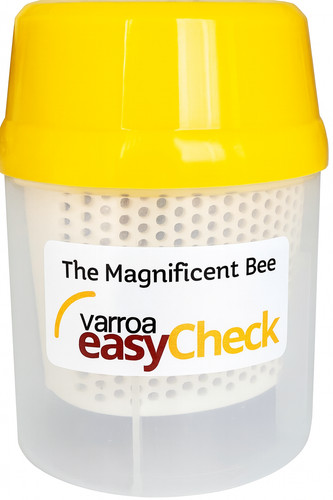 Varroa Easy Check device
CO2-based wash device — comparable accuracy to alcohol wash without killing the bees. Bees are stunned briefly, mites counted, bees returned. Higher upfront cost.
Sticky board / screen bottom board
Useful for trend monitoring and treatment efficacy checks. Not a substitute for alcohol wash at threshold decision points.
Varroa Easy Check device
CO2-based wash device — comparable accuracy to alcohol wash without killing the bees. Bees are stunned briefly, mites counted, bees returned. Higher upfront cost.
Sticky board / screen bottom board
Useful for trend monitoring and treatment efficacy checks. Not a substitute for alcohol wash at threshold decision points.
 Oxalic acid vaporizer
Once you confirm treatment is needed via alcohol wash, oxalic acid vaporization is one of the most effective and low-residue Varroa treatments available. Extended-release oxalic dribble strips (Apivar alternative) are also worth researching.
Oxalic acid vaporizer
Once you confirm treatment is needed via alcohol wash, oxalic acid vaporization is one of the most effective and low-residue Varroa treatments available. Extended-release oxalic dribble strips (Apivar alternative) are also worth researching.
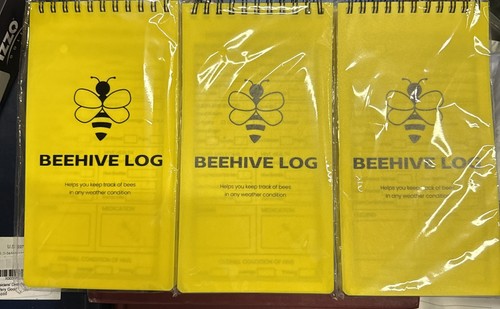 Hive inspection log
Monthly mite counts are only useful if you track them. A simple paper log or hive management app lets you see whether your load is rising, holding, or falling between inspections.
Hive inspection log
Monthly mite counts are only useful if you track them. A simple paper log or hive management app lets you see whether your load is rising, holding, or falling between inspections.