How axe throwing actually works: rotation basics
An axe thrown at a target rotates in the air. The number of rotations between release and impact determines whether the blade or the handle arrives at the board face. A "full rotation" throw from standard WATL competition distance (approximately 12 feet / 3.7 meters, measured from the release point) results in the axe completing roughly one full rotation and arriving blade-first.
If your axe consistently hits handle-first, you are either too close (needs more rotation), throwing too soft (needs more speed to maintain rotation rate), or the technique is generating spin too slowly. If the axe hits with the beard (bottom of the blade) rather than the bit (edge), you may be too far or releasing late.
The key insight for beginners: rotation is a function of axe weight, throw force, release point, and distance — and all four interact. Most beginners focus on technique adjustments, but selecting an axe with the right weight for your arm strength and preferred distance makes technique development significantly easier.
Axe weight and head geometry
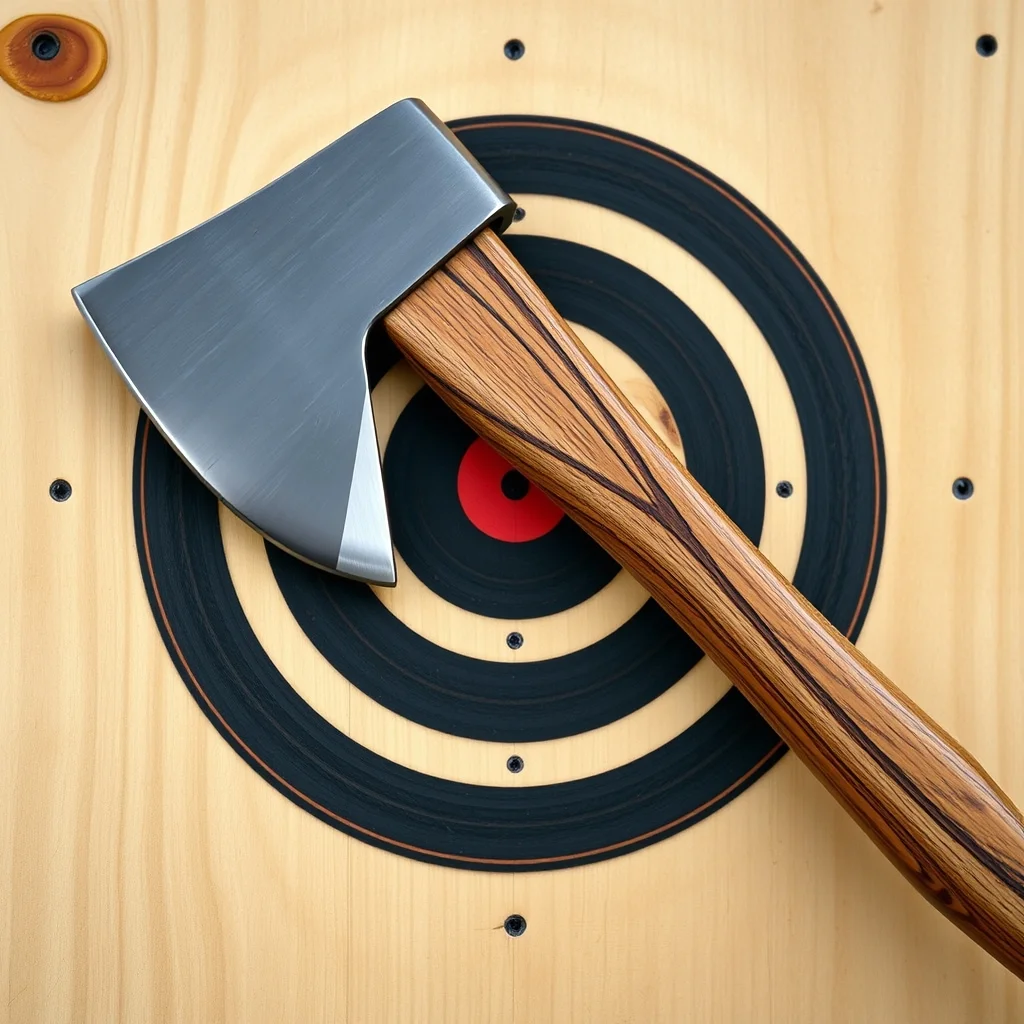
Competition throwing axes — the type used in WATL (World Axe Throwing League) and IATF (International Axe Throwing Federation) sanctioned events — typically have head weights in the range of 1.5 to 2.25 pounds (0.7–1 kg), with the head and handle combined weight usually 1.5–2.5 lb total depending on handle material and length.
Lighter axes (under 1.5 lb total)
Lighter throwing hatchets are generally easier to manage for beginners, require less arm strength, and can be thrown effectively at shorter distances (8–10 feet). The reduced mass means they have less kinetic energy at impact, which affects how reliably they bite into harder wood targets. They are more suitable for practice and backyard use than competition formats.
Competition-weight axes (1.5–2.25 lb head weight)
Competition-spec axes are heavier and require more consistent technique to control rotation, but the additional mass provides more consistent stick depth in the target board. Most purpose-built competition axes have a curved or bearded head profile that maximizes blade contact area at the board on impact.
Head profile: bearded vs straight
A bearded head has a downward extension below the blade edge (the "beard") that increases the overall cutting edge length and provides more surface area to grip the wood on impact. Straight-edge heads are simpler and work adequately for practice but have a smaller margin for slightly off-angle impacts. Competition axes typically use bearded profiles for this reason.
Handle: length, material, and fit
Handle length
WATL competition rules specify a maximum handle length of 16 inches for the standard big axe format. Most competition axes use handles in the 14–16 inch range. Shorter handles (under 12 inches) are used in hatchet formats and some no-spin throwing styles. Handle length affects the rotation arc — a longer handle means the axe covers more arc per throw and may require a slightly farther throwing distance to achieve the same rotation at impact.
| Handle length | Typical use | Standard throw distance |
|---|---|---|
| 10–12 inch | Hatchet / short-distance practice | 8–10 feet (varies significantly) |
| 14–16 inch | WATL/IATF big axe competition | ~12 feet (WATL standard) |
| 18–24 inch | Long-distance big axe / knife-and-hawk style | 15+ feet depending on technique |
Handle material
Hickory is the traditional and most common handle material for throwing axes. It is shock-absorbent, relatively light, and strong along the grain. Ash is similar in properties and also commonly used. Both are natural materials that can crack or split if the handle repeatedly impacts the board frame rather than the target face — a common consequence of bounced throws in practice. Steel or fiberglass handles eliminate breakage risk but alter the axe's balance and rotation characteristics, and some competition formats prohibit them.
Shopping for throwing axes? Browse current eBay listings → (we earn a small commission; your price is unchanged).
Single bit vs double bit
A single bit axe has one blade edge; a double bit has opposing blade edges on both sides of the head. For most throwing applications — and all major competition formats — single bit axes are used. The double bit creates a symmetrically balanced head with blades on both sides, which some knife-and-hawk throwing styles use for no-spin or multi-rotation throws, but it is not standard for the sport throwing that most beginners are practicing.
Single bit axes are more intuitive to handle safely, have a clear "blade forward" orientation that simplifies rotation diagnosis, and match the equipment used in commercial axe throwing venues. If you are learning to throw with the intention of competing or throwing at a venue, start with single bit.
Target board: wood species and construction
The target board is arguably as important as the axe in determining stick quality. An axe that reliably sticks in a good board may bounce off a board made from the wrong material or construction.
Wood species
Softwoods with straight, consistent grain are the standard for throwing targets. White pine, Eastern white pine, and similar soft conifers are the most common. The grain runs parallel to the board face, and the relatively low density allows the blade to penetrate cleanly without bouncing off the surface or requiring excessive force.
Avoid: hardwoods (oak, maple, walnut) — too dense for axe tips to penetrate reliably; plywood — the laminated grain structure causes bouncing; OSB and MDF — will not hold blade at all; green/wet wood — acceptable but dries unevenly and may split or check.
End-grain vs face-grain construction
Competition venues typically use face-grain plank boards — multiple 2×10 or 2×12 pine planks mounted vertically side by side on a frame, with the flat face of the board facing the thrower. This construction is easy to replace sections on as the center (bullseye area) degrades from repeated strikes.
End-grain targets (where the rings of the wood's cross-section face the thrower, like a log round sliced across) are excellent for sticking but harder to produce in consistent large sizes and are more common in some traditional game formats than in modern competition venues.
Board sizing and mounting
WATL standard target is approximately 36 inches wide and 36 inches tall at minimum, with a center bullseye circle and concentric scoring rings. The standard mount height positions the bullseye at approximately chest height (roughly 57 inches from floor to center, though competition setups vary). A solid backing frame that prevents the board planks from flexing or separating is essential — loose boards bounce axes.
Competition vs backyard use: what to actually buy
If you are setting up for backyard or garage use without competition goals, the priority is a practice-friendly setup rather than competition-legal equipment. A mid-weight hatchet (1.5–2 lb total) with a hickory handle in the 14–16 inch range, paired with a face-grain pine board mounted on a simple frame, covers everything you need to practice consistently and develop technique.
If you are purchasing with competition in mind, check the current WATL or IATF equipment specifications — the specific rules around head weight, handle length, and handle material vary by format and are updated periodically. Many competition throwers use purpose-made competition axes from manufacturers who design specifically to these specifications.
For either use case, buy two axes at minimum. Having a second axe means you can throw one, walk to the target, retrieve both, and throw again without a stopping pattern that breaks practice flow.
What to look for when buying used or budget axes
Used competition axes are commonly available and a reasonable value if checked carefully. Inspect: the handle for cracks or significant splits (small surface checks are normal; deep cracks along the grain are a safety concern); the head-to-handle fit (should be tight with no wobble); the blade edge for significant nicks or rolling that would require substantial regrinding; and the head for any cracks near the eye (where the handle passes through).
Budget axes labeled as "decorative" or "replica" axes are not designed for actual throwing. The head may be cast iron or low-quality steel rather than drop-forged carbon steel, and the handle fit may not be secure under repeated impact. These will fail quickly and unpredictably in throwing use. The test for a functional throwing axe is a simple one: it should be made from drop-forged or machined carbon or high-carbon steel, with a full-tang or securely wedged handle, from a manufacturer who describes it as functional for throwing.
 Throwing axe sets
 Competition throwing axes
 Axe throwing targets