Every new aquarium that fails in the first two months fails for the same reason: the nitrogen cycle was not established before fish were added. The tank looked clean. The water was clear. The fish died anyway, from ammonia or nitrite poisoning that the keeper could not see and had no idea was happening.
"Cycling" a tank means growing a colony of beneficial bacteria — specifically Nitrosomonas and Nitrospira — that convert fish waste into progressively less toxic compounds. Without them, ammonia from fish respiration and decaying food builds up in an enclosed system with nowhere to go. No filter removes ammonia. Only bacteria do.
This takes time. Four to eight weeks for a cold-start tank with no bacterial seed. Two to three weeks if you use a good bacterial additive and seeded media. The process cannot be rushed past those biological limits, no matter what any product promises. What you can control is how you manage the tank during that window.
What the Nitrogen Cycle Actually Is
Fish excrete ammonia (NH₃) through their gills and waste. In a cycled tank, Nitrosomonas bacteria oxidize ammonia into nitrite (NO₂⁻). Then Nitrospira oxidize nitrite into nitrate (NO₃⁻). Nitrate is relatively harmless at low concentrations and is removed by water changes.
The cycle is complete when your tank can process a known ammonia dose to zero ammonia and zero nitrite within 24 hours. That is the test. Not "I haven't seen ammonia in a few days." Not "the water looks good." Zero ammonia and zero nitrite within 24 hours of dosing to 2–4 ppm.
Bacteria colonize your filter media first — biological filtration happens there, not in the water column. This is why filter media is gold. A seeded sponge from an established tank can cycle a new tank in a week. A brand-new filter with new ceramic media takes the full 4–8 weeks.
The Two Methods: Fishless vs Fish-In
Fishless Cycling
You add ammonia to feed the bacteria without any fish present. The ammonia source is the main variable. Your options:
- Pure ammonia — the gold standard. Unscented, clear, no surfactants. Brands like Dr. Tim's Ammonium Chloride are sold specifically for this purpose. Dose to 2–4 ppm and maintain that level throughout.
- Fish food — add a small pinch daily. It decomposes and releases ammonia. Slower, less controllable, can cause bacterial blooms and cloudiness, but works.
- Raw shrimp — one small piece left in the tank decomposes over weeks, releasing ammonia. Very messy, very uncontrolled, but it works for people who do not want to source ammonia.
Pure ammonia is the right answer for anyone who wants a predictable timeline and clean water during the cycle. Dose the empty tank to 2–4 ppm ammonia, test every 2–3 days, redose when ammonia drops below 1 ppm. Keep nitrite from spiking above 5 ppm (do a partial water change if it does — high nitrite actually slows the bacteria that process nitrite).
The cycle is complete when 2 ppm of ammonia drops to zero and nitrite drops to zero within 24 hours, and nitrate has accumulated (proving the full chain is running).
Fish-In Cycling
This is the method most beginners end up using because they did not know fishless cycling was an option before they bought fish. It means cycling the tank with fish already in it, managing ammonia and nitrite levels with water changes to keep them from hitting lethal concentrations.
It can be done. Many healthy tanks were cycled this way. But it is harder on the fish, requires daily or every-other-day testing, and demands multiple partial water changes per week during the ammonia spike phase. It is genuinely stressful to the fish and causes measurable immune suppression even in species that survive it.
If you are going to do fish-in cycling, the species choice matters. Hardy, ammonia-tolerant fish:
- Zebra danios — the most common choice; genuinely tough
- White cloud mountain minnows — cold-tolerant, very hardy
- Rosy barbs — active, tolerant of the spike phases
- Platies — moderately tolerant livebearers
Do not use fish-in cycling with bettas, discus, fancy goldfish, corydoras, or any species marketed as "sensitive" or "intermediate." Do not use it with expensive fish you care about. Do not use it with fish-store impulse purchases.
Real Ammonia Readings: What They Mean
The API Freshwater Master Test Kit is the standard. Liquid test kits are more accurate than strips; strips are good for quick checks only, not for managing a cycle.
| Reading | Ammonia (NH₃/NH₄⁺) | Nitrite (NO₂⁻) | Nitrate (NO₃⁻) | Status |
|---|---|---|---|---|
| Empty new tank | 0 ppm | 0 ppm | 0 ppm | No cycle started |
| Week 1–2 (fishless) | 2–4 ppm (dosed) | 0 ppm rising | 0 ppm | Early phase — ammonia bacteria establishing |
| Week 2–4 | Falling | Spiking 1–5 ppm | 0–5 ppm rising | Mid-cycle — nitrite bacteria establishing |
| Week 4–6 | Falling to 0 | Falling to 0 | 10–40+ ppm | Near complete — do full ammonia dose test |
| Cycled tank | 0 ppm | 0 ppm | Accumulating | Complete — passes 24-hour ammonia dose test |
| Fish-in danger zone | > 1 ppm | > 0.25 ppm | — | Do immediate partial water change |
The nitrite spike in the middle of the cycle is often the part that confuses people. Ammonia starts dropping and it looks like the cycle is ending — but nitrite climbs to 2, 3, 5 ppm simultaneously. This is normal. It means the first bacterial colony is established and working; the second colony is just starting. The nitrite spike will eventually fall too, and that is when the cycle completes.
Speeding Up the Cycle Without Killing It
Bacteria colonies grow faster in warmer water. Keep the tank at 80–82°F during the cycle if your target fish tolerance allows it. This alone can cut 1–2 weeks off the timeline.
Bacterial additives vary enormously in quality. Products that contain live bacteria in refrigerated bottles — Dr. Tim's One and Only, Fritz Turbo Start 700 — work well when fresh. Seachem Stability is more shelf-stable and somewhat slower but reliable. Bottled "bacteria" in room-temperature bottles on a pet store shelf for months is essentially inert. Check the sell-by date and refrigeration history.
Seeded media is the fastest method by far. If you have a friend with an established tank, getting 2–3 sponges or a handful of ceramic rings from their filter is worth more than any commercial product. Two weeks becomes five days with enough seeded media and a bacterial booster.
Avoid starting with ammonia above 4 ppm. Higher doses do not establish bacteria faster — they can actually inhibit growth. The bacteria operate on a food-limited growth model; more food does not mean more bacteria up to the point of saturation, and high ammonia is toxic to nitrifying bacteria at sufficient concentrations.
What Goes Wrong: Common Cycle Failures
Chlorine and Chloramine
Tap water contains chlorine or chloramine to kill bacteria — including the bacteria you are trying to grow. Always dechlorinate with a quality dechlorinator (Seachem Prime is the standard; API Stress Coat works too) before adding water to the tank. Chloramine requires a dechlorinator specifically rated for it — standard sodium thiosulfate products do not fully neutralize chloramine.
Prime has the added property of temporarily detoxifying ammonia and nitrite for 24–48 hours without interfering with the test readings. This is why it is the go-to dechlorinator for fish-in cycling: you can dose Prime, do a water change, and buy the fish 24 hours of protection while the bacteria catch up.
Starting Over Without Knowing It
Washing filter media with tap water kills the bacteria. Replacing all the media at once kills the cycle. Running the tank without the filter for a day kills the cycle. These are genuinely common mistakes. Rinse filter media in old tank water only, never tap water. Replace media in stages — swap 25% of media at a time, weeks apart. The filter never stops running.
Antibiotics and Medications
Any antibiotic medication in a cycling or cycled tank will kill nitrifying bacteria. Even treatments sometimes marketed for use in established tanks. If you have to medicate fish, do it in a separate hospital tank with heavy aeration and daily 30–50% water changes to compensate for no biological filtration. Returning fish to the main tank too soon after dosing it with antibiotics will crash the cycle.
Overstocking Before the Cycle Is Proven
A tank that has been zero ammonia, zero nitrite for a week but has only been tested with a light bioload will be overwhelmed by adding the full planned stock all at once. Add fish in phases — 25–30% of planned stock, wait two weeks, test, add more. This gives the bacterial colony time to grow proportionally to the ammonia load.
Fish-In Cycling: Managing the Readings
If you already have fish in an uncycled tank, the protocol is daily or every-other-day testing and water changes sized to keep ammonia below 0.5 ppm and nitrite below 0.25 ppm. Use the table above as your guide.
Do not do 100% water changes. Partial water changes (25–30%) reduce toxins without removing all the bacteria building up on surfaces. A 100% water change restarts the clock.
Do not add "ammonia-neutralizing" additives unless you are using Prime, which does not interfere with the cycle. Some products work by removing ammonia rather than converting it, which starves the bacteria.
Do not feed heavily during the cycle. Half the recommended amount, once daily. Every bit of food that is not eaten contributes ammonia. Uneaten food should be removed within two hours.
When the Cycle Is Done: What Changes
A fully cycled tank reads zero ammonia and zero nitrite after the 24-hour dose test. Nitrate will be somewhere above zero — that is expected and fine. Nitrate accumulates until you do water changes; keeping it below 20–40 ppm is good practice, though most hardy freshwater fish tolerate up to 80 ppm without acute symptoms.
After the cycle is confirmed, do a large water change (40–50%) to bring nitrate down before adding fish. Test again 24 hours after adding fish to confirm the bacterial colony keeps up with the new bioload.
A properly cycled tank with appropriate stocking is genuinely stable. Ammonia should read zero consistently. Nitrite should read zero consistently. Nitrate will climb slowly between water changes. This is the baseline you are maintaining for the life of the tank. Any deviation from zero ammonia and zero nitrite is a signal to investigate — filter issue, overfeeding, dead animal, overstocking.
Gear worth having for cycling
We earn a small commission on qualifying eBay purchases. Price you pay is unchanged. Full disclosure.
 API Master Test Kit
Liquid test kit for ammonia, nitrite, nitrate, and pH. The standard for managing a cycle. Strips are not accurate enough.
API Master Test Kit
Liquid test kit for ammonia, nitrite, nitrate, and pH. The standard for managing a cycle. Strips are not accurate enough.
 Pure ammonia for fishless cycling
Dr. Tim's ammonium chloride or unscented clear ammonia. No surfactants. The cleanest way to fuel a fishless cycle.
Pure ammonia for fishless cycling
Dr. Tim's ammonium chloride or unscented clear ammonia. No surfactants. The cleanest way to fuel a fishless cycle.
 Bacterial starter (Fritz or Seachem)
Fritz Turbo Start 700 or Seachem Stability. Buy fresh from a store with cold storage. Room-temperature bottles on a dusty shelf are usually dead.
Bacterial starter (Fritz or Seachem)
Fritz Turbo Start 700 or Seachem Stability. Buy fresh from a store with cold storage. Room-temperature bottles on a dusty shelf are usually dead.
 Seachem Prime
The dechlorinator that also temporarily detoxifies ammonia and nitrite. Essential for fish-in cycling. Concentrated — the 500ml bottle lasts a long time.
Seachem Prime
The dechlorinator that also temporarily detoxifies ammonia and nitrite. Essential for fish-in cycling. Concentrated — the 500ml bottle lasts a long time.
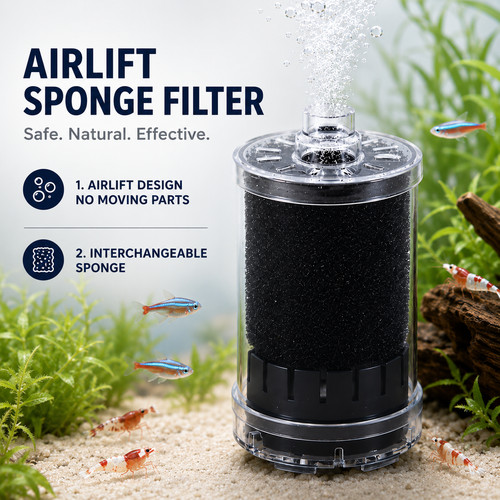 Sponge filters (biological media)
Bacteria live on surfaces, not in the water. Sponge filters provide enormous surface area and are easy to seed between tanks. The cheapest and most effective biological filter media.
Sponge filters (biological media)
Bacteria live on surfaces, not in the water. Sponge filters provide enormous surface area and are easy to seed between tanks. The cheapest and most effective biological filter media.